
In his opening remarks, Prof. Sukri Palutturi, S.KM., M.Kes., M.Sc.PH., Ph.D., Dean of the Graduate School of Hasanuddin University, said that artificial intelligence (AI) is one of the most rapidly evolving and relevant issues today, with applications expanding across a wide range of fields, including health sciences.
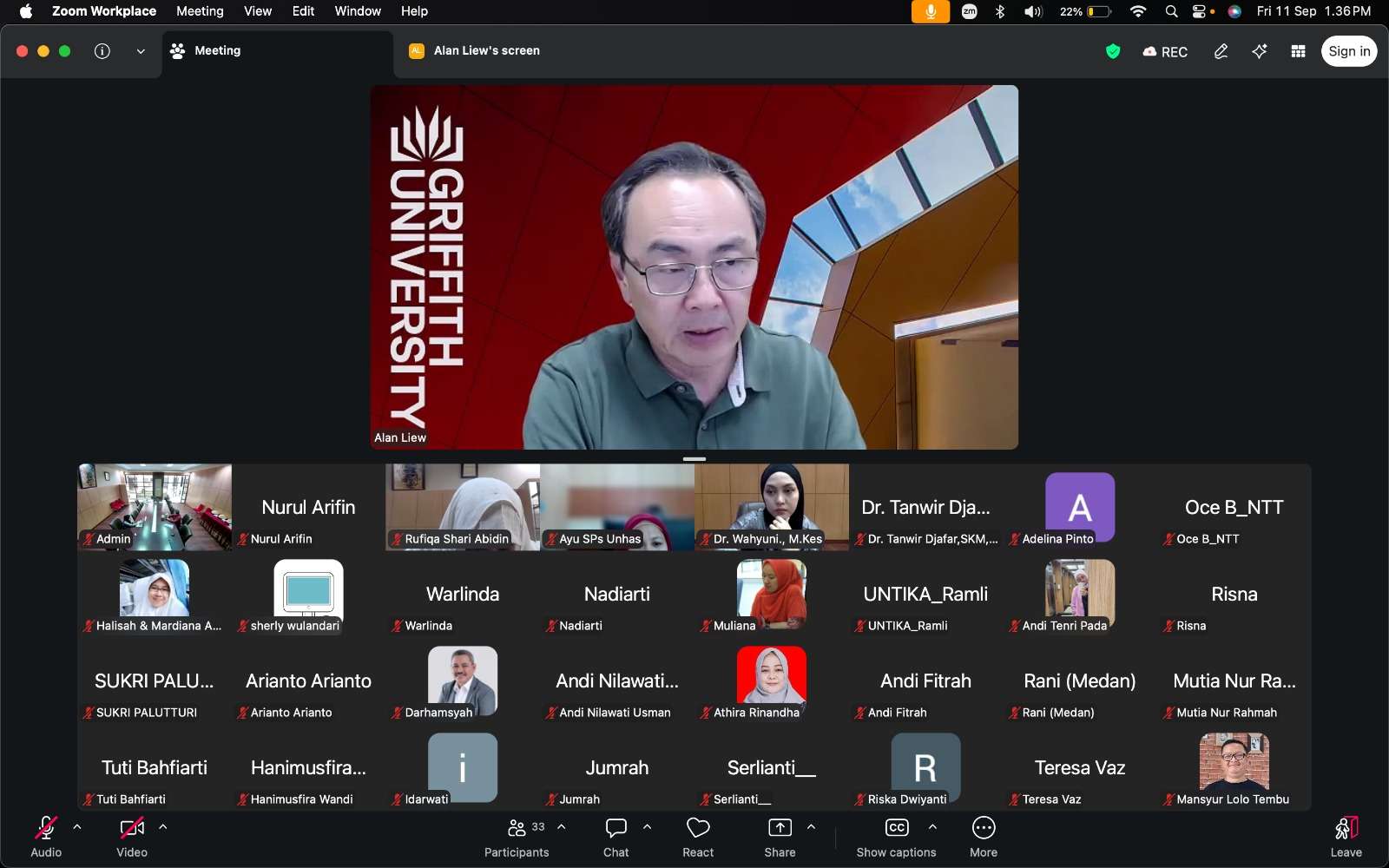
MARITIMEPOSTS.COM – Makassar, September 11, 2026 — The Graduate School of Hasanuddin University hosted an international guest lecture titled “Trustworthy AI for Critical Systems and Health Innovation” on Friday, September 11, 2026.
Held online via Zoom, the event featured Professor Alan Wee-Chung Liew, Head of the School of Information and Communication Technology at Griffith University, Australia. The lecture was attended by students, lecturers, researchers, healthcare professionals, and participants from various institutions.
In his opening remarks, Prof. Sukri Palutturi, S.KM., M.Kes., M.Sc.PH., Ph.D., Dean of the Graduate School of Hasanuddin University, said that artificial intelligence (AI) is one of the most rapidly evolving and relevant issues today, with applications expanding across a wide range of fields, including health sciences.
Therefore, he emphasized, academics need to understand not only the benefits of AI but also the challenges and risks associated with its use.
Prof. Sukri said the event was part of the Graduate School’s efforts to strengthen the internationalization of education and research. “Hasanuddin University continues to strengthen its internationalization programs in various areas, including through visiting professors, international conferences, joint research, and collaborative publications,” Prof. Sukri said. He also expressed hope that the meeting would open broader opportunities for cooperation between Hasanuddin University and Griffith University in the future.
In his presentation, Professor Alan explained that AI capabilities have advanced rapidly alongside developments in deep learning, large language models, generative AI, and agentic AI. However, he emphasized that high model accuracy alone does not guarantee that a technology is safe for use in real-world settings.
“High accuracy is certainly necessary, but it is not sufficient to guarantee the safe deployment of AI. The more important question is whether AI can be used responsibly under real-world conditions,” he explained.
According to Professor Alan, AI has increasingly become part of critical infrastructure and is now being used in healthcare, industry, government, banking, and various public systems. Failures in AI systems within these sectors can have operational, ethical, and financial consequences and may even threaten human safety.
For this reason, AI systems should possess several key characteristics, including reliability, explainability, robustness against disruptions, security against attacks, privacy protection, and clear accountability mechanisms.
In healthcare, AI offers significant opportunities to support early diagnosis, enable more personalized treatment decisions, analyze large volumes of medical images, and predict patient risks. However, its application also presents risks involving bias, misinterpretation, privacy violations, and recommendations that may not be appropriate for specific clinical conditions.
“AI in healthcare presents both opportunities and risks. If it is not developed carefully, bias and misinterpretation can cause or even amplify harm to patients,” Professor Alan stressed.
Professor Alan also presented research being developed through the TrustAGI Lab and AI for Health Lab at Griffith University. The research covers medical image analysis, pathology, dermatology, neuroscience, health informatics, electronic health records, and the use of AI to support clinical decision-making.
One of the projects focuses on using AI to help predict intervention outcomes for children with cerebral palsy based on health data and causal reasoning approaches.
The discussion session, moderated by Dr. Wahyuni, M.Kes., was highly interactive and explored practical steps for health researchers who have limited experience in developing AI systems.
Responding to a question on how researchers can begin working with AI, Professor Alan emphasized the importance of multidisciplinary collaboration.
“The best approach is to bring together healthcare professionals who understand clinical problems with AI scientists who possess the necessary technical expertise. These two fields need to work together to develop systems that are genuinely applicable and capable of delivering meaningful impact,” he explained.
Prof. Sukri welcomed the potential for collaboration between the Graduate School of Hasanuddin University and Griffith University in education, research, and scientific publication.
With 17 academic programs spanning environmental sciences, biomedicine, biomedical engineering, transportation management, midwifery, and development studies, the Graduate School of Hasanuddin University has significant potential to advance multidisciplinary AI research.
Such collaboration is expected to generate innovations that are relevant to the needs and challenges of Indonesian society.
Through the international guest lecture, the Graduate School of Hasanuddin University reaffirmed its commitment to preparing the academic community to navigate rapid advances in digital technology critically and responsibly.
Advances in AI, the university emphasized, must be accompanied by transparency, security, privacy protection, accountability, and strong governance so that technological innovation can genuinely improve the quality of healthcare services while delivering safe, equitable, and meaningful benefits to society.