

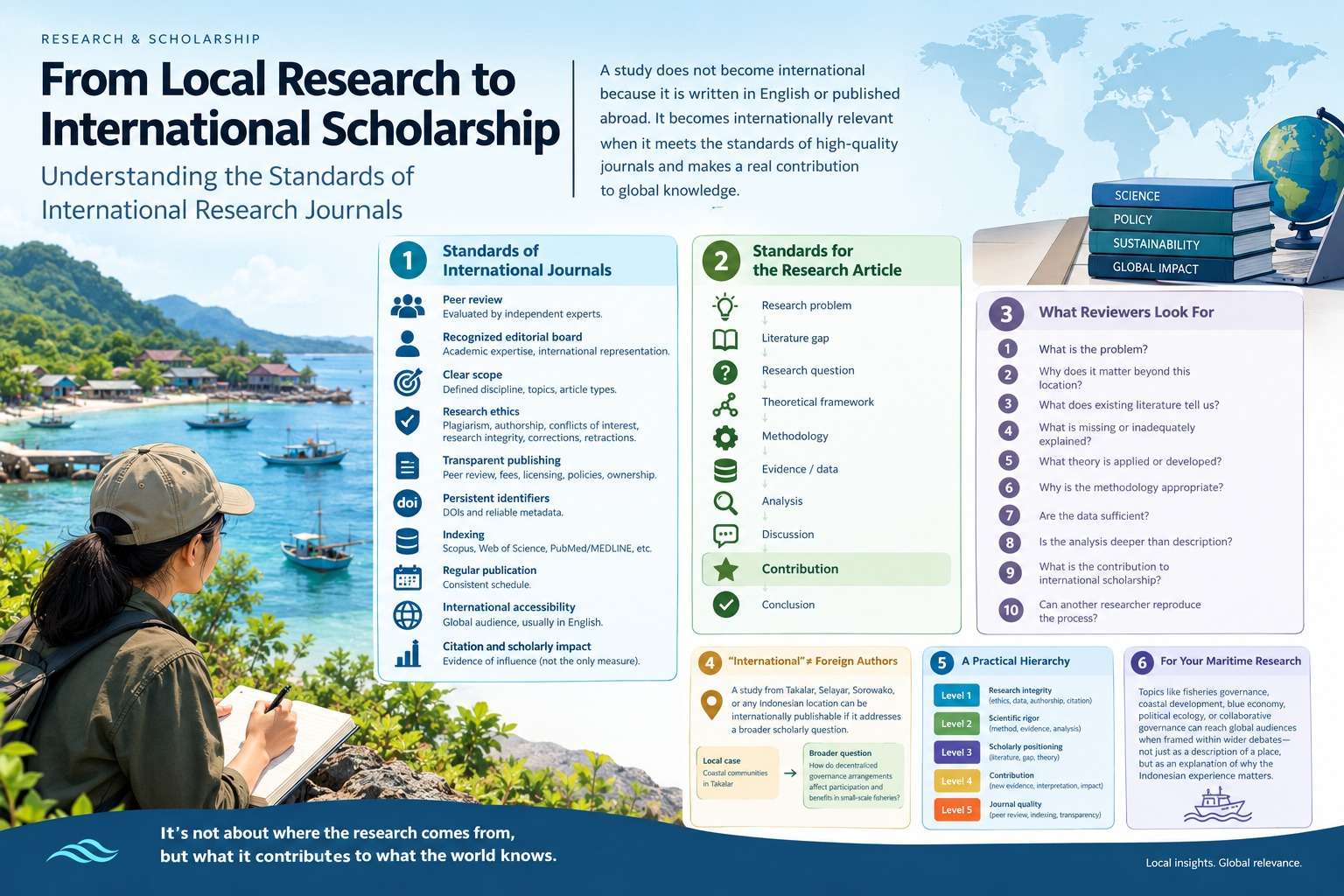
MARITIMEPOSTS.COM – Research does not become international simply because it is written in English, published outside Indonesia, or appears in a journal indexed by a global database. International scholarship is fundamentally concerned with the quality of the research process, the strength of the evidence, the clarity of the argument, and, most importantly, the contribution a study makes to a wider body of knowledge.
This distinction is increasingly important for researchers working on issues that are deeply rooted in particular places. Studies of coastal communities, fisheries, maritime governance, political ecology, blue economy, mining, social capital, or collaborative governance may emerge from a specific village, island, province, or country.
The geographical specificity of a study does not prevent it from becoming internationally relevant. What matters is how the researcher connects the empirical case to a broader scholarly question.
A reputable international research journal generally operates through a number of recognizable standards. One of the most fundamental is peer review, through which manuscripts are assessed by independent scholars with relevant expertise. The process is intended to examine the methodological soundness, originality, relevance, clarity, and contribution of the research before publication.
The journal itself should also have a credible editorial structure.
An established editorial board normally consists of scholars with identifiable expertise in the journal’s field, while international journals often have editorial and reviewer networks that extend across countries and institutions. A clear scope is equally important because researchers and readers need to understand what kind of scholarship the journal publishes and what intellectual community it serves.
Research ethics constitute another essential component. International scholarly publishing increasingly emphasizes responsible authorship, originality, plagiarism prevention, conflicts of interest, research integrity, data transparency where applicable, and appropriate procedures for corrections and retractions. These are not merely administrative requirements. They form part of the credibility of the academic knowledge-production process.
Transparency is also significant. A serious journal should make its editorial policies, peer-review procedures, publication charges where applicable, licensing arrangements, ownership, and publication practices sufficiently clear to authors and readers. Articles commonly carry persistent identifiers such as DOIs, allowing them to be reliably located and cited.
Indexing is another feature frequently associated with international journals. Databases such as Scopus, Web of Science, PubMed/MEDLINE for relevant fields, and various discipline-specific indexes provide mechanisms through which scholarly publications can be discovered and tracked. However, indexing should not be confused with a complete definition of research quality.
The same caution applies to journal metrics. Quartiles such as Q1, Q2, Q3, and Q4, Impact Factor, CiteScore, and SJR can provide useful information about a journal’s visibility and citation patterns, but they are indicators rather than substitutes for judging the intellectual quality of an individual article. A journal’s metric does not automatically determine the quality of every paper it publishes.
For researchers, therefore, an equally important question is: what makes an individual article suitable for international scholarship?
A strong research article normally begins with a clearly defined research problem. From that problem emerges a research question, followed by engagement with existing literature, identification of a gap, an appropriate theoretical or conceptual framework, a transparent methodology, credible evidence, systematic analysis, discussion, and a conclusion that demonstrates the study’s contribution.
The crucial word is contribution.
Consider the difference between two possible formulations. A study might state:
“This study describes the condition of coastal communities in South Sulawesi.”
Such a statement establishes a geographical and social context, but it does not necessarily reveal what the research contributes to existing scholarship.
A more analytically oriented formulation might state:
“This study explains how the interaction between social capital, institutional arrangements, and resource access shapes collaborative fisheries governance in small-scale fishing communities.”
Here, the Indonesian coastal community becomes an empirical setting through which a broader theoretical or governance question can be examined.
This is one of the most important transitions a researcher makes when moving from local research toward international publication: the movement from description toward explanation, interpretation, and contribution.
International reviewers are likely to ask several fundamental questions. What is the research problem? Why does it matter beyond the particular study site? What does existing scholarship already explain? What remains inadequately understood? What theoretical concept is being applied, challenged, refined, or developed? Why is the chosen methodology appropriate? Are the data sufficient to support the claims? Does the analysis go beyond description? And what does the study add to international scholarship?
These questions do not mean that every international article must develop a completely new theory. Contribution can take different forms. A study may provide new empirical evidence, offer a new interpretation of an established phenomenon, test an existing theoretical proposition in a different context, connect previously separated bodies of literature, develop a methodological approach, or reveal an empirical pattern that challenges assumptions in existing scholarship.
The idea of “international” also needs to be understood carefully. An international journal does not necessarily require research involving several countries. A study conducted entirely in Indonesia can be internationally relevant.
For example, research on coastal communities in Takalar can remain a local descriptive study if its primary objective is simply to document local conditions. But the same empirical setting can become relevant to an international scholarly debate when it addresses a broader question such as how decentralized governance arrangements influence participation, resource access, institutional legitimacy, or the distribution of benefits within small-scale fisheries.
The location remains Takalar. The empirical evidence remains Indonesian. What changes is the intellectual framing.
The Indonesian case becomes evidence through which a broader scholarly proposition can be explored.
This principle is particularly relevant to research on maritime affairs. Indonesia provides an extraordinary range of empirical settings for studying fisheries governance, coastal development, marine conservation, blue economy initiatives, resource conflicts, community institutions, and relationships between state and non-state actors.
The challenge is not simply to tell the international academic community what is happening in Indonesia. The greater challenge is to explain why the Indonesian experience matters to a broader conversation about society, institutions, power, environment, and sustainability.
Consider, for example, research concerning social capital and collaborative governance in a mining region. A study titled “Dinamika Modal Sosial dan Kontestasi Kekuasaan dalam Collaborative Governance di Wilayah Lingkar Tambang” could initially appear to be a geographically specific study.
However, the research can be positioned within much broader debates concerning bonding, bridging, and linking social capital; power asymmetries; collaborative governance; extractive industries; social license to operate; community participation; political ecology; and sustainability transitions.
In such a formulation, the particular location becomes a case through which a broader research question can be investigated.
The distinction is subtle but consequential.
Writing about Indonesia is not necessarily the same as using an Indonesian case to contribute to international scholarship.
A useful way to understand the progression is to think of research quality as operating across several interconnected levels.
The first is research integrity: ethical research, authentic evidence, responsible authorship, originality, and appropriate citation.
The second is scientific rigor: an appropriate research design, credible data, transparent procedures, systematic analysis, and an honest discussion of limitations.
The third is scholarly positioning: meaningful engagement with relevant literature, identification of a genuine research gap, connection with international debates, and appropriate use of theoretical or conceptual perspectives.
The fourth is scholarly contribution: demonstrating what becomes better understood because the research has been conducted.
Only after these foundations are established does the question of journal selection become fully meaningful.
A researcher should therefore avoid beginning with the question, “Which Scopus journal should I submit to?” A more fundamental question is, “What scholarly problem does my research solve, explain, illuminate, or challenge?”
Journal selection should follow from that answer.
A manuscript about fisheries governance, for instance, should be matched with journals whose readership is interested in fisheries, marine policy, environmental governance, development, sustainability, political ecology, or related fields. The journal should be selected not merely because it has a particular quartile but because its intellectual community is genuinely interested in the question being investigated.
This approach also changes the way a literature review is written. A literature review should not become a catalogue of authors and citations. Its purpose is to establish an intellectual conversation. The researcher needs to demonstrate what scholars agree upon, where debates remain open, what theoretical tensions exist, and where the proposed research enters that conversation.
The methodology then provides the bridge between the research question and the evidence. A reviewer needs to understand why particular respondents, locations, documents, observations, datasets, interviews, or analytical techniques were selected. The methodology should be sufficiently transparent that readers can assess the credibility of the research process.
The results provide the evidence, while the discussion explains its significance.
This distinction is important because results and discussion are not interchangeable. Results tell readers what the research found. Discussion asks what those findings mean in relation to existing scholarship.
It is often in the discussion section that the international contribution becomes most visible.
A study may find, for example, that certain forms of social capital facilitate collaboration while simultaneously reproducing exclusion. The descriptive finding is important, but the scholarly contribution emerges when the researcher explains how this finding relates to existing theories of social capital and collaborative governance and what it suggests about power within supposedly participatory institutions.
This is where a local empirical observation can become a contribution to international knowledge.
Ultimately, international research publishing is not primarily a competition to produce the most impressive title, the highest citation count, or the most prestigious journal name. It is a process of entering a scholarly conversation with evidence, methodological discipline, theoretical awareness, and a clear contribution.
For researchers working on Indonesia’s maritime and coastal realities, the opportunity is particularly significant. Villages, fishing communities, islands, marine protected areas, ports, mining regions, and coastal governance institutions are not merely places to be described. They can become important empirical laboratories for understanding wider questions about power, institutions, livelihoods, ecological change, justice, and sustainability.
The task, therefore, is not to make a local study artificially appear international.
The task is to discover the broader question already contained within the local reality.
When that question is clearly articulated, supported by credible evidence, situated within relevant scholarship, and developed through rigorous analysis, a study from a single Indonesian community can participate meaningfully in an international academic conversation.
That is perhaps the most important standard of all: not where the research comes from, but what the research contributes to what the world knows.