
What happens after the fishing boat returns to shore? For coastal fishing communities across the globe, the arrival at the dock marks not the end of labor, but the beginning of an intense economic race against time. While marine harvests define the daily catch, long-term economic survival on land hinges entirely on post-harvest handling, preservation, and commercial logistics.
MARITIMEPOSTS.COM – Without adequate infrastructure, fresh catches suffer rapid quality degradation. Severe limitations in cold chain storage, fish landing sites, and processing hubs force primary producers to offload their perishable inventory to intermediaries at distressed prices.
This systemic bottleneck leads to severe value erosion, leaving fishing families vulnerable to persistent poverty despite high capture yields.
To dismantle this structural barrier, Indonesia’s Ministry of Marine Affairs and Fisheries (KKP) launched the Kampung Nelayan Merah Putih (KNMP)—or the “Red and White Fishermen Village”—program.
Designed to transform underdeveloped fishing settlements into organized, highly productive, and self-reliant maritime centers, KNMP represents far more than a standard civil works campaign.
It marks a fundamental paradigm shift: moving away from viewing rural development as isolated physical construction and toward establishing an integrated, horizontally connected coastal economic ecosystem focused on post-harvest loss mitigation and downstream value addition.
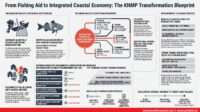
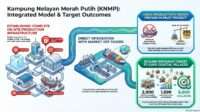
The core philosophy of the KNMP framework is built upon ecosystemic integration rather than piecemeal capital expenditure. Rather than handing over generic buildings, KNMP merges five core structural components into a unified operational matrix:
- Physical infrastructure
- Fishery operational activities
- Economic institutions
- Community capacity building
- Direct market access
A defining feature of this strategy is localized customization. Recognizing that maritime micro-regions differ fundamentally in target species, oceanographic conditions, and socio-economic dynamics, KNMP rejects fixed infrastructural packages. Physical investments are precisely tailored to the specific operational profile of each village.
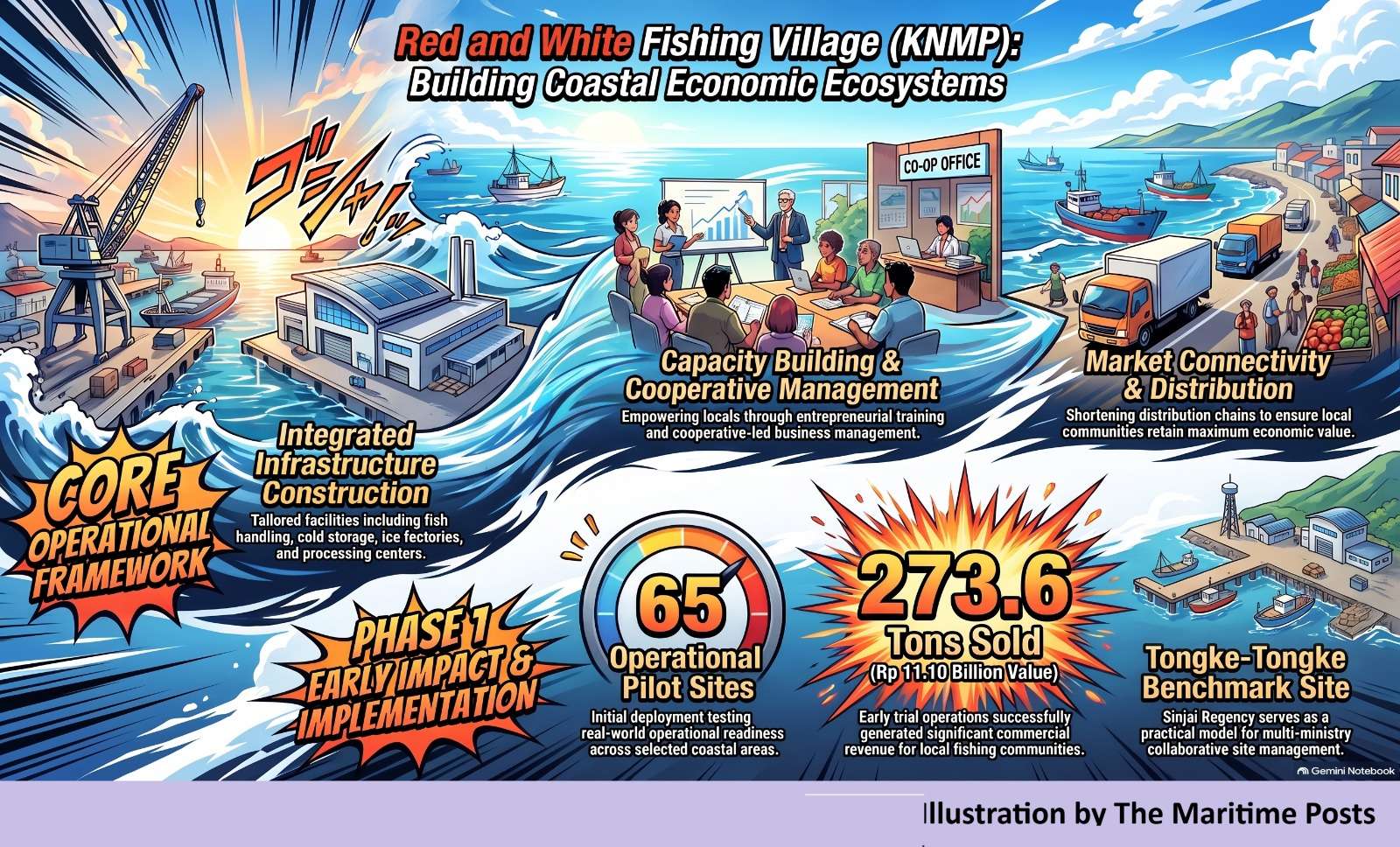
Depending on local baseline needs, assets may include landing and handling docks, cold storage facilities, ice manufacturing plants, processing and marketing centers, vessel repair workshops, supply kiosks, clean water distribution, and sanitation systems.
“The state’s policy mandate cannot conclude with the completion of physical assets. True development requires ensuring that facilities are actively managed, operationalized, and embedded within the continuous economic life of the coastal community.”
The Economic Ripple Effect—Empowering the Entire Shoreline Community
Conventional rural development interventions frequently rely on direct individual handouts or passive subsidies, which fail to build durable productive capacity.
KNMP shifts the intervention policy toward capital asset enablement and value-chain integration. By retaining post-harvest processing, logistics, and trade within the settlement, the program prevents local capital flight and creates systemic economic spillovers across the shoreline economy.
By establishing an organized processing and trading hub, the program creates vital economic entry points for non-sea-going demographics, women, drive downstream value addition by leading fish processing, turning raw catches into high-margin consumer products.
Youth, establish service-oriented micro-enterprises, vessel maintenance services, and creative economic ventures anchored to the new commercial hub.
Small businesses and traders, integrate directly into regional supply chains, managing equipment provisioning, retail kiosks, and localized distribution networks.
The 5-Stage Blueprint from Infrastructure to Market Integration
To systematically turn coastal settlements into self-sustaining economic hubs, the KNMP program operates through a structured, five-stage operational methodology.
- Infrastructure Development: Constructing customized physical assets engineered specifically for efficient post-harvest handling, cold storage, and landing logistics.
- Community Capacity Building: Executing technical training, managerial mentoring, and entrepreneurship programs to equip local residents with the skills required to run commercial facilities.
- Institutional Strengthening: Formalizing and scaling local cooperatives to serve as primary operational vehicles managing shared economic units and joint enterprises.
- Market Connection: Implementing supply chain disintermediation to shorten distribution channels, ensuring primary producers retain higher profit margins from their yield.
- Operational Sustainability: Establishing long-term management protocols and maintenance structures to guarantee decentralized asset stewardship and continuous commercial viability.
Early Proof of Concept—Multi-Billion Rupiah Validation
The operational viability of the KNMP blueprint is illustrated in places like Desa Tongke-Tongke, located in the Sinjai Regency of South Sulawesi. On September 25, 2026, KKP partnered with the Ministry of Cooperatives, the Ministry of Finance, and state-owned entity (BUMN) regulatory bodies in Tongke-Tongke to institute a collaborative management model.
This multi-ministerial partnership represents an explicit policy effort to dismantle departmental silos in rural development, establishing cross-agency synergy between infrastructure provision, cooperative funding, and state enterprise enterprise systems.
Moreover, KNMP relies on a decentralized, multi-tiered governance structure. Successful deployment incorporates provincial governments (pemerintah provinsi), regency/city governments (pemerintah kabupaten/kota), and village authorities (pemerintah desa), alongside local fishing groups and cooperatives.
These metrics demonstrate that targeted physical infrastructure, when supported by multi-tiered governance and direct market links, rapidly converts landed volume into verified financial transactions.
True Success Begins After the Ribbon Is Cut
The ribbon-cutting ceremony for a new cold storage facility or processing center does not mark project completion—it marks the operational starting line. The long-term impact of the KNMP strategy relies on post-construction factors: localized asset stewardship, institutional transparency, and continuous community-level accountability.
To turn infrastructure into long-term wealth, coastal communities must maintain operational clarity regarding facility management responsibilities, transparent business mechanisms, and collective maintenance of public assets. Local cooperatives serve as the decisive mechanism here.
They must operate not as passive administrative entities, but as competitive, transparent business units capable of managing assets, interfacing with commercial buyers, and distributing dividend yields back to community members.
“True development success is defined by what happens long after project infrastructure is handed over: whether public facilities remain fully functional, institutional management stays transparent, and economic value continues to cycle within the local community.”
The Road to Self-Reliance
Deploying physical infrastructure without building human capacity, cooperative governance, and market access leaves rural economic development incomplete. Indonesia’s Kampung Nelayan Merah Putih program provides a compelling framework for sustainable coastal development, demonstrating that overcoming rural poverty requires moving beyond standalone public works toward fully integrated economic ecosystems.
By pairing customized physical infrastructure with technical capacity building, multi-tiered public governance, local cooperative management, and market integration, coastal communities can protect catch value and foster sustainable local economies.
As public sector leaders and development institutions search for scalable models of regional economic resilience, one vital benchmark remains paramount: when construction ends, will the local community possess the institutional strength, asset stewardship, and market access necessary to steer their own economic self-reliance?
The Editorial Team