


MARITIMEPOSTS.COM – Why do some development programs flourish while others struggle, even when they follow the same regulations, funding mechanisms, and planning procedures?
For decades, governments, international donors, and development practitioners believed the answer lay in designing stronger institutions, improving governance, and creating better policies.
Yet reality has repeatedly challenged that assumption. Communities with similar laws often produce remarkably different outcomes, suggesting that something beyond the formal rulebook is shaping development.
This puzzle inspired one of the most influential contributions to comparative politics and institutional studies: Gretchen Helmke and Steven Levitsky’s landmark 2004 article, Informal Institutions and Comparative Politics: A Research Agenda.
Rather than dismissing governance failures as poor implementation, the authors proposed a more fundamental question: What if the rules that actually guide people’s behavior are not the ones written in official documents?
Helmke and Levitsky argue that societies operate through two sets of institutions simultaneously.
The first consists of formal institutions—constitutions, laws, regulations, organizational structures, and official procedures.
These are visible, codified, and legally recognized. The second consists of informal institutions—unwritten but widely understood rules that emerge from social relationships, political practices, cultural expectations, and everyday interactions. These informal rules often determine how formal institutions actually function.
Importantly, informal institutions should not be confused with random habits or cultural traditions.
According to Helmke and Levitsky, they are socially shared rules that people consistently recognize, communicate, and enforce outside officially sanctioned channels. Although unwritten, violating these rules may carry significant social or political consequences. In many societies, these invisible rules become just as influential as formal regulations.
Development projects illustrate this interaction remarkably well. Officially, community planning meetings may be open, participatory, and transparent.
Yet in practice, priorities are often negotiated before the meeting begins through personal relationships, local elites, trusted intermediaries, or political brokers. The formal meeting then serves primarily to legitimize decisions already reached informally. Looking only at official procedures therefore tells only part of the story.
One of the paper’s most enduring contributions is its explanation that formal and informal institutions rarely operate independently. Instead, they interact in different ways.
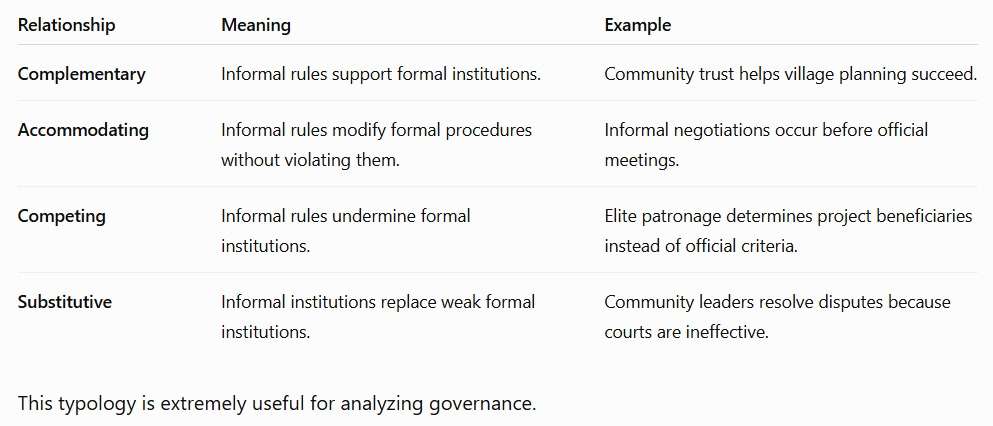
Informal rules may complement formal regulations by strengthening cooperation, accommodate them by quietly modifying procedures, compete with them by undermining official decisions, or even substitute for weak formal institutions altogether.
Understanding governance requires examining these interactions rather than studying formal structures in isolation.
This perspective fundamentally changes how we evaluate development. Instead of asking whether participation occurred or whether regulations were followed, informality theory encourages us to investigate who actually influences decisions, whose voices are heard, and what unwritten rules shape collective action.
Governance becomes less about institutional design alone and more about the relationships, negotiations, and power dynamics that unfold behind official processes.
The theory also broadens our understanding of power. Informal institutions reveal that authority does not always flow from legal office or organizational hierarchy. It may emerge through kinship networks, long-standing patronage relationships, community reputation, traditional leadership, or strategic alliances.
Consequently, two villages following identical development guidelines may experience very different outcomes because their informal institutions differ substantially.
This insight is particularly valuable for community empowerment and collaborative governance. Many development initiatives assume that building trust, encouraging participation, and strengthening social capital automatically produce better governance.
While these elements remain important, Helmke and Levitsky remind us that cooperation itself operates within broader institutional environments. Trust may coexist with elite domination, reciprocity may reinforce unequal patron-client relationships, and participation may conceal silent exclusion.
For practitioners, this means successful development requires more than designing better policies. It demands understanding the invisible architecture of social life—the unwritten agreements, informal norms, local brokers, and everyday negotiations that shape collective decisions. Ignoring these dimensions risks producing governance reforms that appear effective on paper but fail to transform realities on the ground.
More than two decades after its publication, Informal Institutions and Comparative Politics remains remarkably relevant. Around the world, governments continue promoting transparency, participation, and collaborative governance, yet implementation gaps persist.
Helmke and Levitsky’s central lesson endures: societies are governed not only by the rules we write, but also by the rules we live. For scholars, policymakers, and development practitioners alike, understanding informality is no longer optional—it is essential for understanding how development truly works.