
- Why understanding the ocean requires science, specialisation, and the ability to connect its many invisible worlds.
- Millions of people depend directly on coastal and marine resources for food, income, transportation and cultural relationships extending across generations.
By Kamaruddin Azis, founder MaritimePosts.com
MARITIMEPOSTS.COM – To someone standing on the shores of Indonesia, the ocean can appear deceptively simple, presenting an immense blue surface moving rhythmically toward the land.
Waves arrive, break and retreat, while the distant horizon draws an apparently clean boundary between water and the endless tropical sky.
Yet the sea is anything but simple, because beneath its blue surface lies an extraordinary mosaic of physical, chemical, biological and human processes.
Currents move nutrients and pollutants, microorganisms sustain food webs, sediments record environmental change, while human decisions continuously reshape the future of coastal ecosystems.
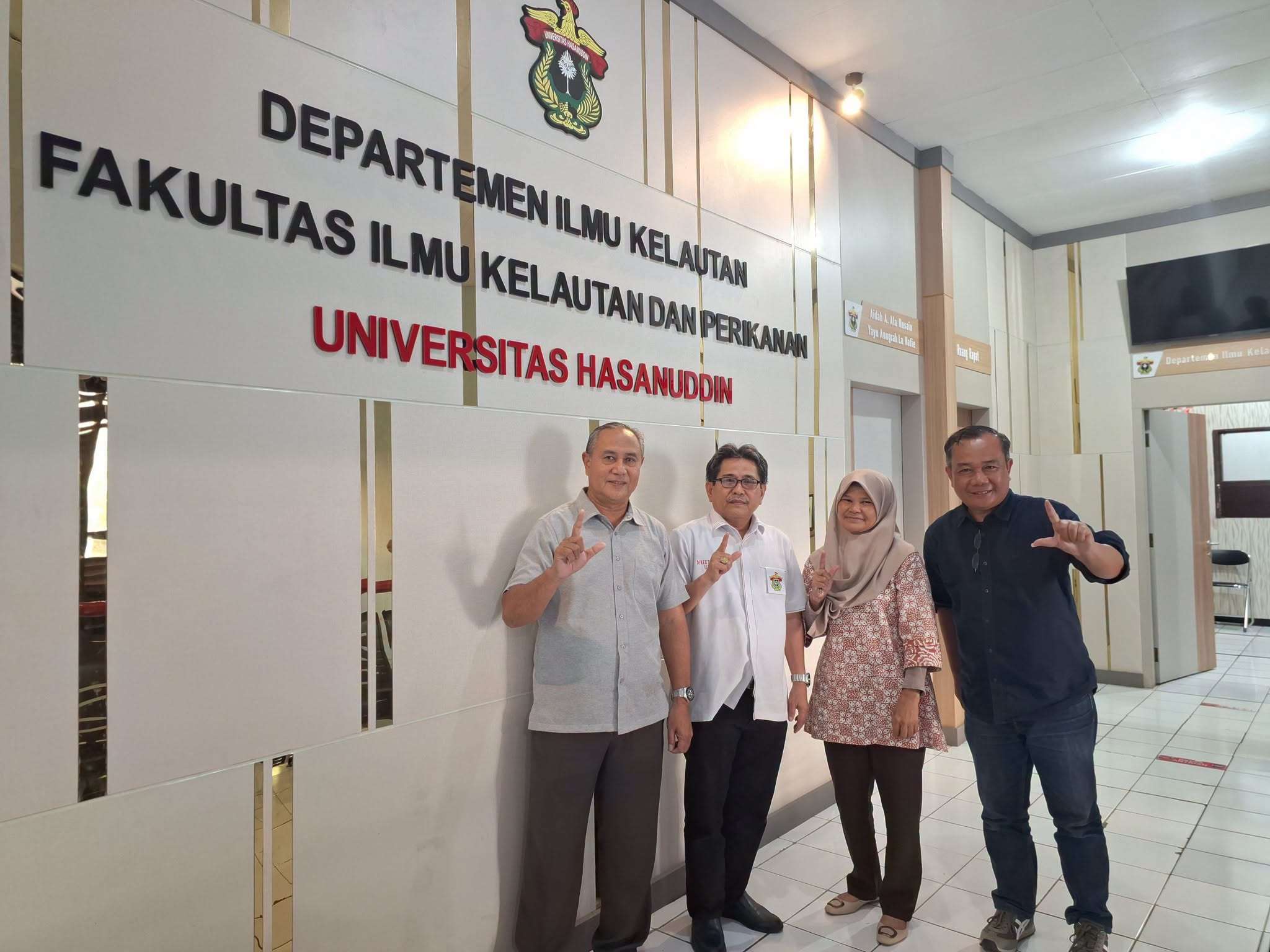
I was reminded of this complexity recently when I returned to my academic home at the Faculty of Marine Science and Fisheries of Hasanuddin University in Makassar.
The visit began not with scientific data or academic discussions, but with the warmth of a homecoming over bowls of konro, Makassar’s traditional beef rib soup.
There was laughter, recollection and the familiar pleasure of meeting senior professors and academic friends whose presence immediately revived memories of my student years.
Later, I walked toward the third floor of the Department of Marine Science, where the atmosphere shifted into the quieter rhythm of an academic corridor.
It was there that a simple but powerful thought returned to me after many years of working with coastal communities and marine development issues.
The sea is not one thing. It is a mosaic.
How we understand the ocean depends greatly on the scientific lens through which we choose to observe its complicated and interconnected systems.
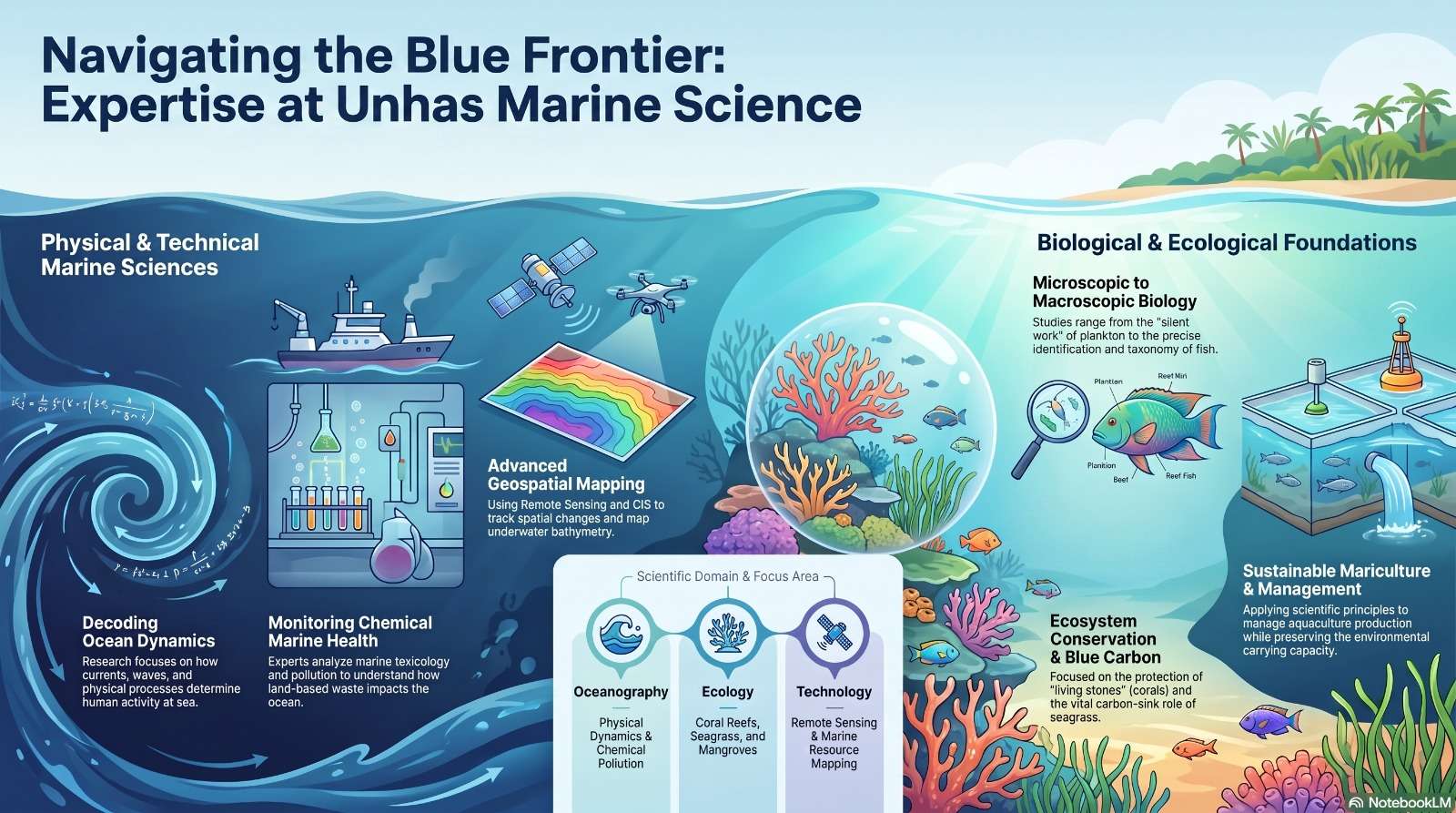
Reading the Invisible Architecture of the Sea
Before the ocean becomes a habitat for fish, corals or plankton, it operates as an enormous and constantly moving physical machine.
Oceanographers such as Prof. Abd. Rasyid J., affectionately known to us as Bang Cido, and Wasir Samad taught students to look beyond waves as scenery.
The sea moves through complex systems of currents, waves and water masses that transport energy, nutrients, organisms and pollutants across enormous geographical distances.
Physical processes occurring far offshore can eventually determine fishing conditions, coastal erosion and ecological changes experienced by communities hundreds of kilometres away.
However, the physical ocean cannot be separated from the chemical composition of the water constantly moving through this enormous natural system.
Scholars such as Dr. Muhammad Farid Samawi and Muhammad Hatta examine seawater not simply for its colour, temperature or apparent clarity.
Chemical composition can reveal environmental stress, while pollutants often tell uncomfortable stories about industrial activities and human behaviour occurring far from the coastline.
This is where the supposedly clear boundary between land and sea begins to disappear under the careful observation of marine science.
Waste released into rivers, cities, farms, industries or mining landscapes can eventually travel downstream and enter coastal and marine ecosystems.
The sea remembers what happens on land, even when people living inland rarely recognise their connection with the ocean.
A Coral Reef Is Not a Rock
One of the most persistent public misconceptions about marine ecosystems concerns the extraordinary living structures that we commonly call coral reefs.
From above the water, a reef may appear as a shallow patch, a navigational obstacle or simply another beautiful destination for recreational divers.
However, coral is alive, and the enormous structures created by coral organisms represent some of the most complex biological architecture on Earth.
At Unhas, scholars including Prof. Chair Rani and Prof. Jamaluddin Jompa helped strengthen an important academic tradition in coral reef ecology.
Other academics, including Syafyuddin Yusuf and Aidah Ambo Ala Husain, contributed perspectives on coral conservation and the ecological dynamics of reef systems.
Through this scientific lens, a coral reef becomes much more than an attractive underwater landscape displayed in tourism advertisements and social media photographs.
A reef grows, responds to environmental pressure and provides habitat for an extraordinary diversity of organisms living within complicated ecological relationships.
It serves as a nursery, feeding ground and refuge, while its physical structures can reduce wave energy reaching vulnerable coastal communities.
When coral reefs are degraded, therefore, society does not merely lose colourful underwater scenery or an attractive destination for international tourists.
Fish lose habitat, coastal communities lose ecological protection, and fishing households may lose part of the natural foundation supporting their livelihoods.
The death of a reef is never an isolated ecological event because its consequences can travel directly into coastal economies and household kitchens.
The Ocean’s Invisible Workforce
Our emotional relationship with marine conservation is often dominated by large and charismatic animals such as whales, turtles and dugongs.
Their images are powerful, and their vulnerability has understandably become an important symbol of international campaigns to protect marine biodiversity.
However, some of the most important workers sustaining ocean life are organisms that most people will never see with their naked eyes.
Prof. Rahmadi Tambaru, alongside specialists such as Benny Audy Jaya Gosari and Sulaiman Gosalam, represents a scientific world focused on these invisible organisms.
Plankton may be extraordinarily small, but physical size is an extremely poor measurement of ecological importance within complex marine food systems.
These organisms occupy the foundation of marine food webs, influence biological productivity and participate in processes connected with the global carbon cycle.
The fish arriving at our dining tables ultimately depend on ecological relationships beginning with organisms invisible to most seafood consumers.
This is perhaps one of marine science’s most humbling lessons about the complicated architecture sustaining life beneath the ocean surface.
The survival of enormous marine animals may ultimately depend on organisms too small for the human eye to notice.
The Forgotten Meadow Beneath the Water
For many decades, marine conservation possessed its own ecological celebrities, particularly spectacular coral reefs and visually distinctive mangrove forests.
Seagrass, locally known as lamun in Indonesia, often remained the forgotten ecosystem occupying the quieter spaces between reefs and mangroves.
Yet scholars such as Prof. Rohani A. R. helped bring greater scientific attention to the extraordinary ecological importance of seagrass ecosystems.
A seagrass meadow may lack the immediate visual drama of a colourful coral reef filled with tropical fish and recreational divers.
To an untrained observer, it can appear as little more than ordinary grass growing quietly beneath shallow coastal waters.
Science, however, tells a radically different story about the ecological functions performed by these seemingly modest underwater meadows.
Seagrass provides habitat, feeding areas and nursery grounds for numerous marine organisms that support wider coastal food webs and fisheries.
More recently, seagrass ecosystems have moved toward the centre of international discussions about climate change and blue carbon.
Their capacity to capture and store carbon has transformed scientific and policy interest in ecosystems that were previously overlooked or underestimated.
There is an important irony in the long history of humanity’s relationship with these quiet and highly productive coastal ecosystems.
For decades, one of the ocean’s most valuable habitats received limited attention partly because it did not appear spectacular enough.
Nature does not organise ecological importance according to humanity’s preference for beauty, drama or attractive photographs.
When the Sea Becomes a Human Space
Marine science becomes incomplete when scientific observation stops with water, organisms and ecological processes occurring beneath the ocean surface.
The sea is also a deeply contested human space shaped by livelihoods, economic ambitions, political decisions and competing claims over resources.
The work of academics such as Ahmad Bahar, Prof. Amran Saru and Marzuki Ukkas reminds us of this complicated reality.
Millions of people depend directly on coastal and marine resources for food, income, transportation and cultural relationships extending across generations.
There are fishers, aquaculture farmers, tourism operators, industries, governments, conservation organisations and communities with customary relationships to marine resources.
Increasingly, these different actors are making competing claims over the same coastal and marine spaces across Indonesia’s enormous archipelagic territory.
Who can fish, where tourism can expand and which marine areas should receive protection are ultimately questions involving power and governance.
Science can identify ecosystem decline, measure water quality, map environmental damage and explain the ecological consequences of human activities.
However, science alone cannot determine how competing human interests should be negotiated within democratic, economic and political systems.
The social sea is sometimes considerably more difficult to manage than the biological ocean studied inside laboratories.
Giving the Ocean Coordinates
Another generation of marine scientists taught students that understanding the sea also requires the ability to see environmental problems spatially.
Muhammad Anshar Amran and Nurjannah worked with remote sensing, while Ahmad Faisal explored the expanding possibilities of Geographic Information Systems.
Muhammad Banda Selamat contributed to marine resource and bathymetric mapping, demonstrating how spatial technologies could reveal hidden underwater landscapes.
Today, digital maps are everywhere, and smartphones can identify our geographical position within seconds using increasingly sophisticated satellite systems.
During my student years, however, marine mapping felt like entering an entirely different technical universe filled with unfamiliar tools and concepts.
Satellite imagery, spatial data and geographic information systems eventually revealed one fundamental principle about environmental change and marine management.
Every environmental problem happens somewhere.
A damaged coral reef has coordinates, while a seagrass meadow occupies a measurable space vulnerable to competing development pressures.
Coastal erosion follows geographical patterns, and pollution travels through pathways shaped by currents, rivers, topography and human infrastructure.
Mapping transforms general environmental concern into evidence that can guide scientific analysis, public policy and coastal management decisions.
The ocean may appear borderless from the beach, but effective management requires geographical precision and an understanding of spatial relationships.
Knowledge That Takes Years to Surface
There is something peculiar about education because its deepest value is not always immediately visible to the students receiving it.
As students, we could spend hours learning fish taxonomy under academics such as Prof. Andi Iqbal Burhanuddin and other marine biology lecturers.
We studied morphology, compared physical characteristics and struggled to remember scientific names that sometimes appeared disconnected from everyday coastal realities.
Sedimentology required us to examine materials lying quietly on the seabed and understand the environmental histories hidden inside individual sediment grains.
At the time, many of these exercises could easily feel like academic obligations necessary for completing courses and surviving examinations.
Students naturally worried about assignments, laboratory reports, practical activities and the grades determining their progress through university.
However, knowledge possesses a strange ability to remain dormant until real life creates the conditions necessary for understanding its importance.
Years later, you may stand in a coastal village where residents complain that their beach is disappearing faster every rainy season.
Suddenly, sediment matters.
You may join a discussion about declining fish catches and discover that local people are describing significant changes in species composition.
Suddenly, taxonomy matters.
You may examine a development plan and realise that a proposed investment overlaps directly with an ecologically sensitive coastal habitat.
Suddenly, spatial analysis matters.
Education sometimes works as a slow burn because lessons arrive in classrooms while understanding emerges decades later.
Loving the Ocean Is Only the Beginning
Walking again through the halls of Marine Science at Unhas, I thought about the many lecturers who shaped our understanding.
Some studied the sea through microscopes, while others interpreted enormous marine landscapes through satellite imagery and sophisticated spatial technologies.
Some dived among coral reefs, while others examined plankton, chemical compounds, sediments or invisible changes occurring within the water column.
Some focused on aquaculture and marine production, while others confronted difficult questions about managing resources among competing human interests.
Each academic possessed only part of the enormous puzzle required to understand the complexity of Indonesia’s marine environment.
Together, however, their different scientific specialisations formed a mosaic capable of revealing the ocean as an interconnected life-support system.
Perhaps this is why our public conversation about the sea must now move beyond romantic expressions of admiration and environmental slogans.
We celebrate beautiful beaches, photograph sunsets, organise coastal clean-ups and repeatedly declare our love for Indonesia’s extraordinary maritime heritage.
All these actions possess value, but love by itself can never become a complete strategy for managing complex marine ecosystems.
Laut tidak cukup hanya dicintai. Laut harus dipelajari, dipahami, dan diperjuangkan dengan ilmu pengetahuan.
The sea is not enough to be loved because it must also be studied, understood and defended through rigorous scientific knowledge.
Indonesia’s maritime future will not be secured by one discipline, one professor, one university or one government institution working alone.
Oceanography must speak with chemistry, ecology must engage with mapping, and biology must connect with climate science and human development.
All these disciplines must also confront economics, governance and the everyday realities experienced by millions of people living along Indonesia’s coastlines.
The next time we stand before the blue horizon, perhaps we should resist the temptation to see only an endless surface of water.
Behind the waves are currents we cannot see, microorganisms invisible to our eyes and chemical changes impossible to recognise without scientific instruments.
There is carbon stored beneath seagrass meadows, environmental history buried within sediments and human decisions made hundreds of kilometres inland.
The sea is much closer to our daily lives than we imagine, and before protecting it, we must first learn how to see it.