

By Irawan Asaad, Ph.D.
Director of Climate Change Resource Mobilization, Ministry of Environment, Republic of Indonesia
His presentation was delivered during the Climate Dialogue event themed “Youth Action for Climate Protection: Towards a Green and Sustainable Indonesia.” The event was part of the Climate Change Thematic Community Service Program (KKN) and was organized through a collaboration between the Ministry of Environment/Environmental Control Agency (KLH/BPLH) and Hasanuddin University. It served as a preparatory session for students participating in the Climate Change Thematic KKN program.
MARITIMEPOSTS.COM – Climate change is no longer a future scenario. It is a present reality reshaping economies, societies, ecosystems, and national security across the globe. What was once regarded as a scientific warning has become one of the defining geopolitical and development challenges of the twenty-first century.
For Indonesia, the climate crisis is not an abstract environmental issue. It is a matter of sovereignty, economic resilience, and human security.
As the world’s largest archipelagic nation, Indonesia stands on the front lines of climate impacts while simultaneously playing a critical role in global climate solutions.
The following five strategic realities illustrate why climate action must now be viewed as a core component of national development rather than a separate environmental agenda.
1. Climate Change Is the Defining Threat of Our Century
Over the past four decades, climate change has evolved from a growing scientific concern into a global emergency. The world has moved beyond the stage of warning and entered an era of measurable impacts.
Indonesia’s legal framework recognizes climate change through Law No. 32 of 2009, which defines it as changes in atmospheric composition caused directly or indirectly by human activities.
These changes are primarily driven by increasing concentrations of greenhouse gases, including carbon dioxide (CO₂), methane (CH₄), nitrous oxide (N₂O), and fluorinated gases that trap heat within the Earth’s atmosphere.
The scientific consensus has become increasingly unequivocal. The Sixth Assessment Report of the Intergovernmental Panel on Climate Change (IPCC) concluded that:
“Human influence has warmed the climate at a rate that is unprecedented in at least the last 2,000 years.”
The significance of this finding lies not only in the warming itself, but in the extraordinary speed at which it is occurring.
Throughout Earth’s history, ecosystems and societies have adapted to environmental changes over centuries and millennia. Today, however, climate shifts are unfolding within a single human lifetime.
This acceleration creates a dangerous mismatch between the pace of environmental change and the capacity of natural and human systems to adapt. The result is growing vulnerability, increasing disruption, and heightened systemic risk.
2. Indonesia Has More Than 17,000 Climate Front Lines
Indonesia’s geographic identity as an archipelagic nation makes climate change an existential challenge.
With more than 17,000 islands stretching across the equator, Indonesia’s territorial integrity is closely linked to the stability of its coastal and marine ecosystems.
Rising sea levels, currently estimated at approximately 0.8 to 1.2 centimeters per year in various Indonesian waters, present a long-term threat to low-lying coastal areas and small islands.
For many countries, sea-level rise represents an environmental concern. For Indonesia, it raises questions of sovereignty.
The loss of land due to coastal erosion and inundation is not merely a reduction in environmental assets; it has implications for territorial boundaries, maritime zones, and national security.
Equally concerning is the human dimension. Approximately 65 percent of Indonesia’s population lives in coastal regions, making millions of people directly vulnerable to flooding, erosion, saltwater intrusion, and displacement.
Protecting coastlines, therefore, is not simply a conservation effort. It is an investment in safeguarding communities, maintaining territorial integrity, and preserving the physical foundations of the nation itself.
3. The Nature of Disasters Has Fundamentally Changed
Indonesia is increasingly experiencing the consequences of a warming climate through the growing frequency and intensity of hydrometeorological disasters.
Today, approximately 80 percent of disasters occurring in Indonesia are associated with climate and weather-related factors. These include floods, droughts, landslides, extreme rainfall events, tropical storms, and forest and land fires.
According to data from Indonesia’s Meteorology, Climatology, and Geophysics Agency (BMKG), average temperatures increased by approximately 0.03°C per year between 1981 and 2018. While this trend may appear modest, its cumulative effects are profound.
Higher temperatures alter rainfall patterns, increase evaporation rates, intensify drought conditions, and create favorable conditions for larger and more destructive forest fires. They also contribute to the spread of vector-borne diseases and place additional stress on food and water systems.
As scientific evidence becomes increasingly robust, the distinction between “natural” disasters and climate-induced disasters becomes less meaningful. Many of the extreme events now affecting Indonesia are occurring within a climate system that has already been significantly altered by human activity.
4. Climate Action Is an Economic Imperative
Climate policy is often portrayed as an environmental obligation. In reality, it is also an economic necessity.
Studies suggest that Indonesia could face economic losses ranging from 0.66 percent to 3.45 percent of Gross Domestic Product by 2030 if climate risks are not effectively managed. Such losses would affect multiple sectors simultaneously and undermine long-term development objectives.
Agriculture faces increasing uncertainty as changing temperature and rainfall patterns alter growing conditions and productivity. Fisheries and marine resources are threatened by warming oceans and ecosystem degradation. Infrastructure becomes more vulnerable to extreme weather events. Public health systems face rising costs associated with climate-sensitive diseases.
Beyond these direct impacts lies a broader challenge: the degradation of natural capital. Indonesia’s forests, wetlands, coral reefs, and coastal ecosystems provide critical services that support economic growth, food security, and community livelihoods. Their decline represents not only an environmental loss but also a reduction in the productive assets upon which development depends.
Viewed through this lens, climate action functions as a form of long-term economic insurance. Investments in mitigation and adaptation help reduce future costs, strengthen resilience, and protect national prosperity.
5. Indonesia’s Net-Zero Journey Is a Development Strategy
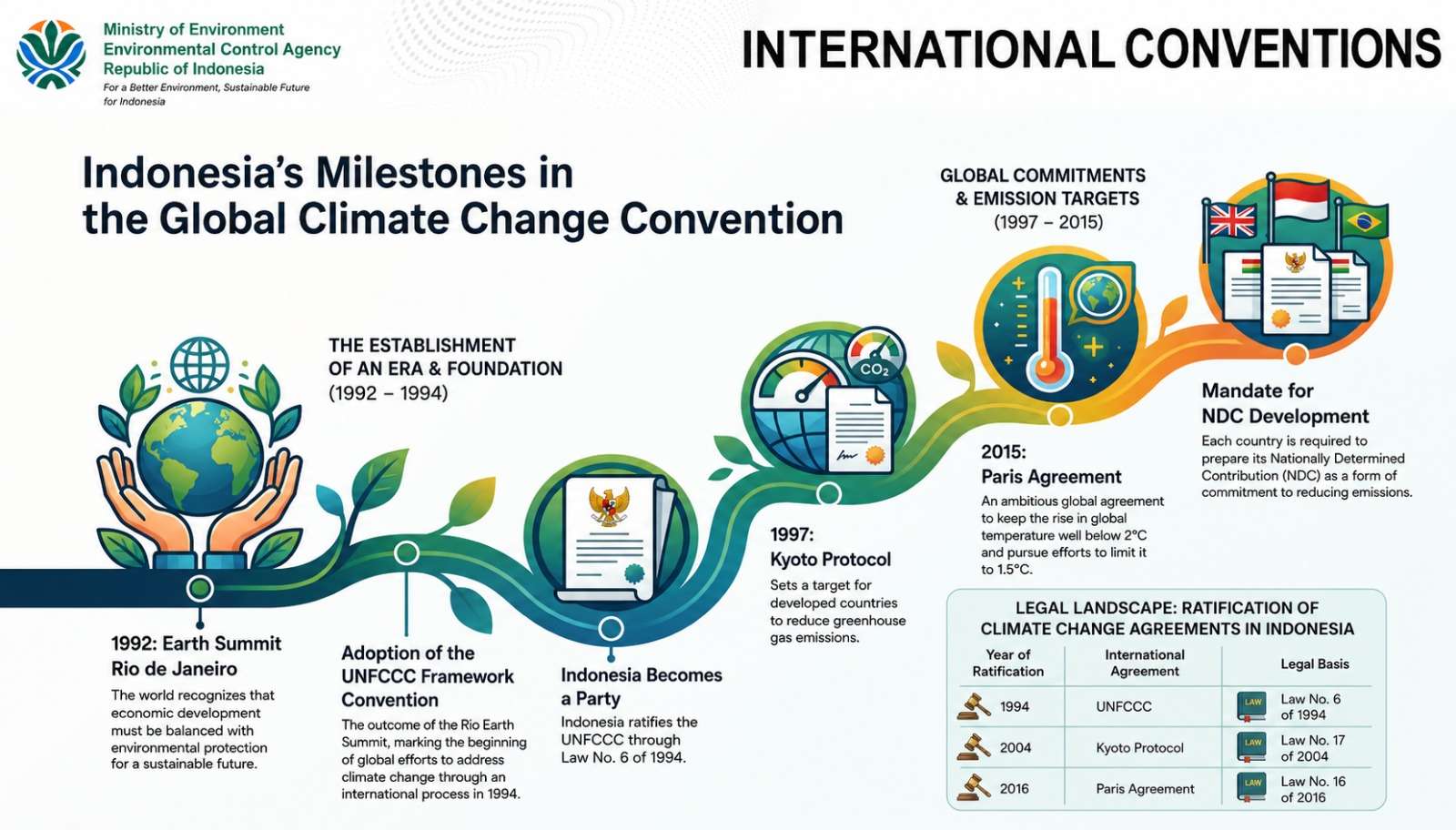
Indonesia has responded to the climate challenge with increasingly ambitious commitments under the Paris Agreement.
Through its Enhanced Nationally Determined Contribution (Enhanced NDC), Indonesia has pledged to reduce greenhouse gas emissions by 31.89 percent through domestic efforts and by up to 43.20 percent with international support. The country has also established a target of achieving Net Zero Emissions by 2060 or earlier.
These commitments are not isolated environmental targets. They are becoming integral components of Indonesia’s broader development agenda.
Climate considerations are now embedded within national planning frameworks, including the National Medium-Term Development Plan (RPJMN). Efforts to strengthen adaptation, accelerate energy transition, improve land-use management, and build climate resilience are increasingly linked to economic development priorities.
The forthcoming Second Nationally Determined Contribution (Second NDC) represents an important milestone. It aims to further align Indonesia’s mitigation and adaptation strategies with national development goals while strengthening resilience across key sectors.
At the same time, Indonesia continues to advance climate diplomacy through multilateral platforms such as the United Nations Framework Convention on Climate Change (UNFCCC), the G20, and BRICS, advocating for equitable climate action and stronger support for developing countries.
From Climate Diplomacy to Climate Governance
The climate agenda has moved from the margins of international negotiations to the center of national governance.
Today, decisions regarding energy, infrastructure, agriculture, industry, urban development, and natural resource management are all climate decisions. Every pathway toward sustainable economic growth increasingly depends on our ability to build resilience and reduce emissions simultaneously.
The fundamental question facing Indonesia is no longer whether climate change is real. The evidence is overwhelming, and its impacts are already visible across the archipelago.
The more urgent question is whether we can transform our development model quickly enough to meet the challenge.
If nearly eighty percent of disasters affecting Indonesia are now influenced by climate-related factors, then climate policy can no longer be treated as a secondary concern. It must become a central pillar of national development, economic planning, and public policy.
The future of Indonesia’s prosperity, security, and resilience will depend on how effectively we respond to that reality today.
This version is written in the style of an international policy op-ed suitable for publication in climate policy platforms, development journals, conference proceedings, government publications, or outlets such as The Jakarta Post, East Asia Forum, The Diplomat, or UNDP/UN Climate Change knowledge platforms.