
PELAKITA.ID – At the southern tip of South America, the continent does not simply end—it unravels.
The land fractures into a labyrinth of fjords, islands, and channels. Mountains rise abruptly from the sea, exposing their granite cores to an unforgiving sky. Here, at the edge of the world, nature exists on a scale so vast and elemental that human presence feels temporary, almost incidental.
This is Patagonia.
Stretching across southern Chile and Argentina, Patagonia is one of Earth’s last great wildernesses—a landscape forged by tectonic upheaval, volcanic fire, relentless winds, and immense rivers of ice. It is not a place designed for comfort. Rather, it is a place where life has endured through adaptation, resilience, and a profound understanding of nature’s limits.
In Patagonia, survival is not about conquering the landscape. It is about learning how to live within it.
A Land Shaped by Wind
Few places on Earth are as defined by wind as Patagonia.
The powerful westerlies sweep across more than 5,000 kilometers of uninterrupted Pacific Ocean before colliding with the Andes, carrying immense energy accumulated over thousands of miles. The result is a landscape where wind is not merely weather—it is an architect.
Nowhere is this more evident than in Chile’s Torres del Paine National Park. Towering granite spires rise dramatically above the plains, their jagged forms sculpted by millions of years of glacial erosion and constant atmospheric assault.
The wind influences everything.
Condors soar effortlessly by reading invisible currents that spiral around cliffs and valleys. Lenga forests cling to mountainsides, their twisted trunks bent permanently in the direction of prevailing gusts. These trees do not resist the wind. They survive because they yield to it.
Patagonia teaches a lesson often forgotten in modern society: resilience is not always found in strength. Sometimes it is found in flexibility.
The Kingdom of Ice
Further south, another force dominates the landscape—ice.
The Southern Patagonian Ice Field is one of the largest freshwater reserves on the planet and one of the last great remnants of the Ice Age. Vast expanses of snow accumulate year after year, compressing into dense blue glacial ice that slowly moves across the landscape like frozen rivers.
These glaciers are not static monuments.
They advance, retreat, grind mountains into sediment, and carve deep valleys that define Patagonia’s geography. Their movement is so slow that it escapes human perception, yet their influence spans entire geological epochs.
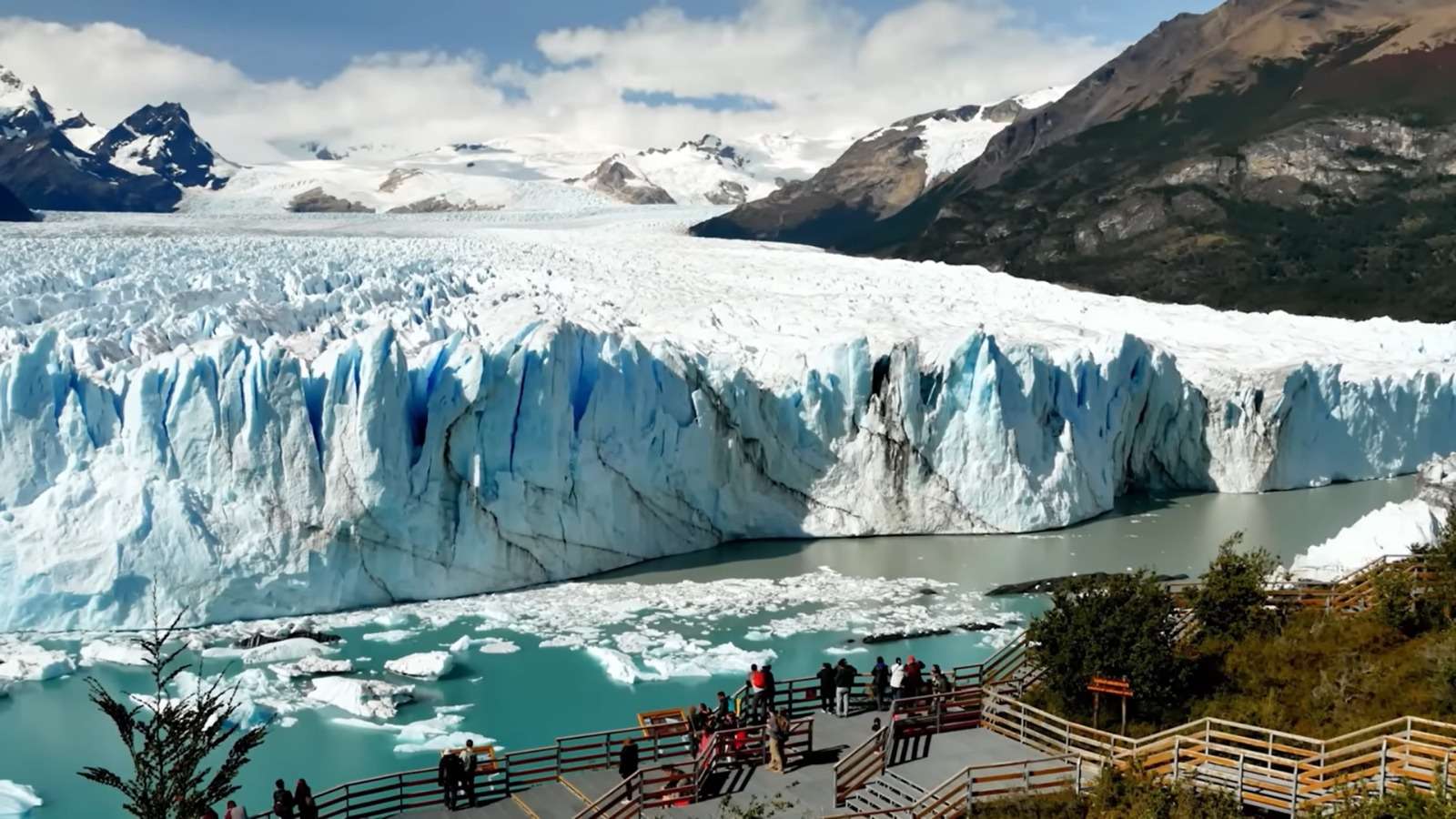
One of the most remarkable examples is Argentina’s Perito Moreno Glacier. Visitors gather to witness colossal blocks of ice breaking away from its towering face and crashing into the waters below. The thunderous sound echoes across the lake like a reminder that even the most seemingly permanent features of the Earth are constantly changing.
The glacier’s deep blue color reveals another story—a story of time itself. Centuries of compression have removed nearly all air from the ice, allowing it to absorb every wavelength of light except blue.
It is the color of age, density, and geological patience.
Fitz Roy and the Limits of Human Ambition
For mountaineers, few peaks carry the mystique of Mount Fitz Roy.
Its dramatic granite walls rise sharply into the Patagonian sky, creating one of the most iconic landscapes on Earth. Yet climbing Fitz Roy is not merely a physical challenge. It is a confrontation with a place that remains utterly indifferent to human aspirations.
The mountain does not reward ambition. It demands respect.
Here, climbers enter a world governed by wind, ice, and rock—a world where conditions can shift within minutes and where nature always has the final word.
In Patagonia, people quickly learn that they are not masters of the landscape. They are guests within it.
Life on the Steppe
East of the Andes, the environment changes dramatically.
The mountains intercept moisture from the Pacific, creating a vast rain shadow that stretches across much of Argentine Patagonia. The result is the Patagonian Steppe, an immense semi-arid grassland where scarcity shapes every aspect of life.
The horizon seems endless.
The sky dominates the landscape, dwarfing the earth below. Water is precious, distances are immense, and survival depends on efficiency rather than abundance.
For generations, gauchos—the legendary horsemen of Patagonia—have adapted to these conditions. Their knowledge of weather, water sources, animal behavior, and seasonal rhythms has been passed down through experience rather than textbooks.
Their relationship with the land is not one of ownership but of practical intimacy. They understand that in an environment this harsh, survival depends on cooperation with nature rather than control over it.
Tierra del Fuego: The End of the Continent
Farther south lies Tierra del Fuego, the “Land of Fire.”
Named by European explorers who observed the coastal fires of Indigenous Yaghan communities, the archipelago represents one of humanity’s most remarkable stories of adaptation.
For thousands of years, Indigenous peoples survived in this cold, wet, and isolated environment using knowledge deeply rooted in the rhythms of the sea and land.
Beyond Tierra del Fuego lies the Beagle Channel, one of the world’s most famous waterways and the final maritime corridor before the turbulent Drake Passage and Antarctica.
On its shores stands Ushuaia, often called the southernmost city on Earth.
Yet even here, human settlement feels provisional.
The surrounding mountains, oceans, and relentless winds remain the dominant forces. Civilization exists not as a conquest of wilderness, but as a temporary arrangement within it.
A Lesson for a Changing Planet
Patagonia is more than a destination of extraordinary beauty.
It is a living reminder of how life can persist in the face of uncertainty, instability, and environmental extremes. In an era defined by climate change, melting glaciers, and increasingly unpredictable weather, the lessons embedded in Patagonia’s landscapes feel more relevant than ever.
For centuries, the people and ecosystems of this region have survived not by demanding stability from nature, but by adapting to its constant change.
That may be Patagonia’s greatest gift to the modern world.
As humanity confronts environmental challenges on a global scale, this remote wilderness offers a powerful alternative to the narrative of domination that has shaped much of human history. It suggests that resilience comes not from imposing our will on nature, but from understanding its forces, respecting its limits, and learning how to live within them.
At the edge of the world, Patagonia reminds us that the Earth does not belong to us.
We belong to it.
And perhaps the wisest path forward is not to conquer the planet, but to listen to it.
Source: