
MARITIMEPOSTS.COM – For centuries, modern economic imagination has been dominated by land.
Industrial zones, plantations, highways, mining corridors, and urban skylines are often treated as the primary symbols of national prosperity. Yet across many parts of the world, especially in island and coastal nations, the true engine of survival lies elsewhere: the sea.
From the icy Atlantic waters of Iceland to the turquoise tuna corridors of the Maldives, fisheries remain one of humanity’s oldest economic systems—feeding millions, shaping cultures, generating exports, and sustaining entire nations. In some countries, the ocean is not merely a natural resource. It is the backbone of the national economy itself.
Recent global data from institutions such as FAO, UNCTAD, OECD, and the World Bank show that several countries remain heavily dependent on fisheries and aquaculture for GDP, employment, and foreign exchange.
Many of them are small island states or maritime societies where geography leaves little room for large-scale agriculture or heavy industry.
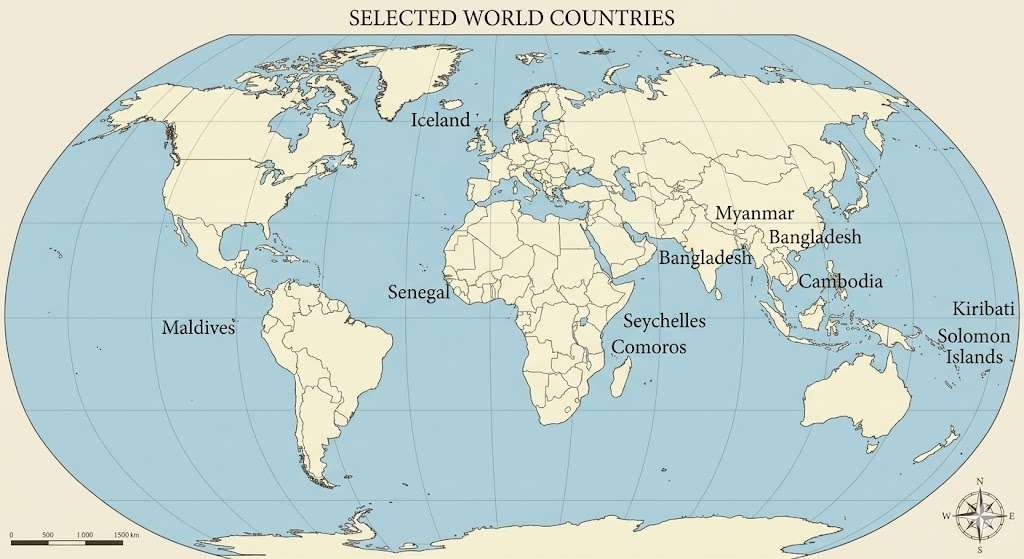
Among the countries most economically tied to fisheries are the Maldives, Iceland, Seychelles, Kiribati, Solomon Islands, Comoros, Myanmar, Bangladesh, Cambodia, and Senegal.
These nations differ in religion, culture, climate, and political systems. Yet they share one common reality: the sea determines the rhythm of national life.
Maldives: Tuna and Tourism
The Maldives is often globally marketed as a paradise of luxury resorts and crystal lagoons. But beneath the tourism imagery lies a deep fishing civilization.
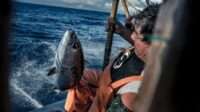
For generations, tuna fishing has been central to Maldivian identity and economic survival. Fisheries remain among the country’s largest export sectors, supporting livelihoods across dispersed island communities.
In many ways, the Maldives demonstrates how marine economies can coexist with global tourism without entirely erasing traditional fishing cultures.
Iceland: How Fish Built a Modern Nation
Few countries illustrate the power of fisheries more dramatically than Iceland.
Long before Iceland became known for geothermal energy, fintech innovation, or Arctic tourism, cod fisheries built the nation’s economic foundations. Fish exports financed infrastructure, modernization, and national development.
Even today, despite economic diversification, seafood remains one of Iceland’s strategic sectors. The country also became a global example of fisheries management, using science-based quotas to protect fish stocks while maintaining profitability.
Iceland’s story reveals a powerful truth often ignored in developing countries: fisheries are not a “backward sector.” Managed properly, they can become the foundation of advanced national development.
Small Islands, Big Dependence
In countries such as Kiribati, Seychelles, Solomon Islands, and Comoros, fisheries are not just important—they are existential.
Kiribati, scattered across the Pacific Ocean, depends heavily on tuna fishing licenses sold to foreign fleets. Seychelles has built much of its export economy around tuna processing and marine industries. In Solomon Islands and Comoros, fisheries sustain food security, employment, and government revenue simultaneously.
For many small island developing states, the ocean functions as farmland, marketplace, transportation route, and national treasury all at once.
Without healthy marine ecosystems, economic collapse becomes a real possibility.
Asia’s Fisheries Giants
In Southeast and South Asia, fisheries support millions of livelihoods even when their direct contribution to GDP appears statistically modest.
Myanmar, Bangladesh, and Cambodia rely heavily on fisheries for employment and food security. Cambodia’s Tonlé Sap inland fisheries system, for example, has long been considered one of the most productive freshwater fisheries on Earth.
Bangladesh has emerged as one of the world’s major aquaculture producers, particularly in shrimp and freshwater fish cultivation. Fisheries there are deeply linked to rural survival, nutrition, and export earnings.
These examples highlight a crucial point: fisheries are often underestimated because conventional GDP calculations fail to capture their social and cultural significance.
Indonesia: A Maritime Giant That Often Looks Inland
Indonesia should be central in any global discussion about marine economies.
As the world’s largest archipelagic nation, Indonesia possesses enormous fisheries potential: tuna corridors, coral reef ecosystems, mangrove forests, seaweed industries, and millions of small-scale fishers spread across thousands of islands.
Yet fisheries contribute only around 2–3 percent of Indonesia’s national GDP.
At first glance, this may appear relatively small compared to countries like the Maldives or Iceland. But the numbers can be misleading. Indonesia’s overall economy is so large and diversified that even a “small” percentage represents a massive marine sector employing millions of people.
In regions such as Maluku, North Maluku, Sulawesi, and eastern Indonesia, fisheries are far more than statistics. They shape daily life, local economies, and cultural identity.
Communities like the Bajo, Bugis, Makassarese, and many island societies continue to depend on the sea not merely as an occupation, but as civilization itself.
The Paradox of the Blue Economy
Today, governments and international institutions increasingly promote the idea of the “blue economy”—economic growth driven by sustainable use of marine resources.
The concept sounds promising. But reality is far more complicated.
Many fisheries-dependent nations now face mounting threats:
Overfishing occurs when fish are caught faster than marine ecosystems can naturally replenish them.
In many parts of the world, industrial-scale fishing fleets harvest enormous quantities of tuna, sardines, mackerel, and other commercially valuable species, often leaving little time for populations to recover. This not only threatens biodiversity, but also destroys the economic foundation of small-scale fishing communities that depend on healthy fish stocks for survival.
Illegal fishing has become one of the largest hidden crimes in the global maritime economy.
Illegal, unreported, and unregulated (IUU) fishing allows foreign or domestic vessels to operate without permits, violate quotas, use destructive gear, or evade taxes and monitoring systems. In developing maritime nations, illegal fishing drains billions of dollars in revenue while weakening state sovereignty and pushing traditional fishers into deeper poverty.
Ocean warming, driven by climate change, is rapidly altering marine ecosystems across the planet.
Rising sea temperatures disrupt fish migration routes, reduce oxygen levels in seawater, and trigger coral bleaching events that destroy fragile habitats. Species that once thrived in certain waters are now moving toward cooler regions, creating uncertainty for fishing communities whose livelihoods depend on predictable marine seasons.
Coral reef destruction represents one of the most alarming ecological crises in tropical seas.
Coral reefs function as underwater nurseries where countless marine species breed, feed, and grow. However, destructive fishing practices, coastal development, sedimentation, and rising sea temperatures have caused massive reef degradation worldwide. Once coral ecosystems collapse, fish populations decline dramatically, affecting both biodiversity and coastal economies.
Marine pollution continues to poison oceans at an unprecedented scale.
Plastic waste, oil spills, industrial chemicals, untreated sewage, and agricultural runoff increasingly contaminate marine ecosystems. Microplastics have now been found in fish, sea salt, and even human bodies, illustrating how ocean pollution ultimately returns to human life through the food chain. For coastal communities, polluted waters also threaten tourism, fisheries, and public health simultaneously.
Industrial exploitation of coastal zones often transforms fragile shorelines into spaces dominated by ports, reclamation projects, factories, mining operations, tourism infrastructure, and large-scale aquaculture.
While these projects are frequently justified in the name of economic growth, they can displace indigenous and fishing communities, destroy mangroves and seagrass ecosystems, and accelerate coastal erosion.
In many countries, traditional maritime societies find themselves squeezed between ecological decline and development policies that prioritize profit over long-term sustainability.
Ironically, communities that have protected marine ecosystems for generations are often the most vulnerable when ecological collapse begins.
Climate change has intensified this crisis.
Rising sea levels threaten coastal settlements. Changing ocean temperatures alter fish migration routes. Extreme weather events make traditional fishing more dangerous and unpredictable.
For small island states and coastal societies, this is not an abstract environmental debate. It is a direct economic and cultural emergency.
Beyond GDP: The Ocean as Civilization
The world’s fisheries-dependent countries remind us that the ocean cannot be measured solely through export figures or GDP ratios.
The sea is also memory, identity, spirituality, and social order.
For maritime communities, fisheries are not simply industries. They are systems of knowledge passed through generations: reading currents, understanding seasons, navigating stars, respecting ecological balance, and maintaining communal solidarity.
Modern development policies often focus overwhelmingly on land-based growth while treating coastal communities as peripheral. Yet history shows that some of humanity’s most resilient societies emerged from the sea.
Perhaps the future of sustainable development will depend on rediscovering an old lesson long understood by maritime peoples:
A nation does not only grow from the land beneath its feet, but also from the waters that surround it.