

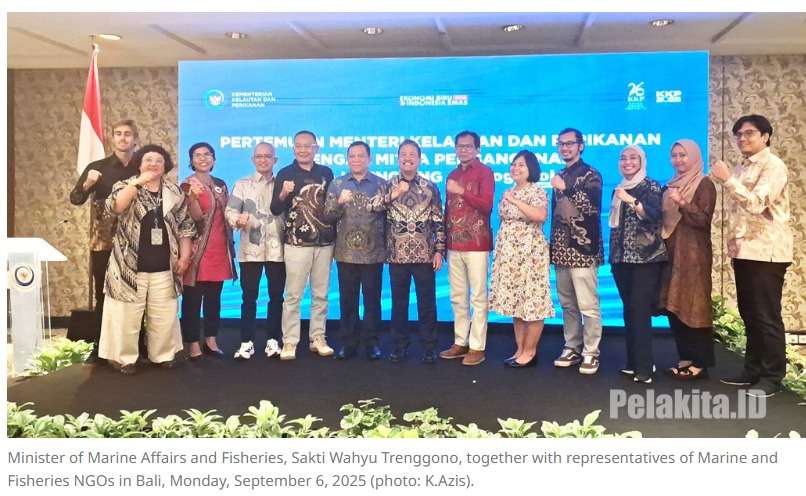
A quota-based system requires robust scientific data, transparent quota allocation, effective monitoring and enforcement, and strong safeguards to ensure that small-scale fishers are not marginalized by larger commercial interests.
MARITIMEPOSTS.COM – As the world’s largest archipelagic nation, Indonesia is endowed with one of the richest marine and fisheries resources on the planet. This immense wealth is not merely an economic asset but a national trust that must be managed responsibly to deliver lasting benefits for both present and future generations.
Yet despite its extraordinary potential, Indonesia’s marine resources have not fully translated into greater prosperity for fishers, fishing crews, seafood workers, and the millions of people living in coastal and small-island communities.
For Indonesia’s Minister of Marine Affairs and Fisheries, Sakti Wahyu Trenggono, addressing this challenge requires more than increasing fish production.
It demands a fundamental transformation in fisheries governance—from a model centered on extraction to one built upon sustainability, economic certainty, and value creation.
In his view, the success of the fisheries sector should no longer be measured solely by the volume of fish landed, but by its ability to sustain fish stocks while generating equitable economic opportunities for coastal communities.
This vision aligns closely with Indonesia’s broader national development agenda, which prioritizes downstream industrialization, domestic value addition, food security, employment creation, and the sustainable management of natural resources.
Within the fisheries sector, these objectives are translated into a governance framework that ensures marine resources are harvested scientifically, responsibly, and in ways that maximize long-term economic value for the nation.
Against this backdrop, the Measured Fishing Policy (Penangkapan Ikan Terukur, or PIT) has emerged as one of the government’s flagship reforms.
According to Minister Trenggono, PIT is far more than an administrative regulation; it represents a strategic shift toward modern fisheries management.
Through science-based catch quotas allocated across Indonesia’s Fisheries Management Areas, the policy seeks to balance economic growth with ecological sustainability while ensuring that fish resources remain available for future generations.
The policy rests on a solid legal foundation through Government Regulation No. 11 of 2023 concerning Measured Fishing.
This regulatory framework provides greater legal certainty for government agencies, fishing operators, investors, and coastal communities by establishing clear rules for the utilization of marine resources.
Rather than allowing fisheries to operate without effective controls, catch limits are determined according to the biological capacity of fish stocks and ecosystem resilience.
Minister Trenggono argues that quota-based fisheries management is no longer a policy option but a national necessity. Scientific assessments indicate that fish stocks in several Indonesian Fisheries Management Areas are experiencing increasing pressure from intensive exploitation.
Without effective intervention to regulate fishing effort, Indonesia risks gradual stock depletion that could ultimately undermine the country’s fisheries, threaten food security, and weaken the livelihoods of millions who depend on the sea.
From this perspective, the Measured Fishing Policy is not intended to restrict fishers, but to secure the long-term future of Indonesia’s fisheries.
By creating greater certainty for businesses, improving operational efficiency, strengthening industrial competitiveness, and encouraging investment in seafood processing and downstream industries, PIT aims to generate greater economic value beyond the point of capture.
In doing so, fisheries become not merely a source of raw materials, but a driver of sustainable national economic development.
Nevertheless, the long-term success of PIT will depend largely on the quality of its implementation.
A quota-based system requires robust scientific data, transparent quota allocation, effective monitoring and enforcement, and strong safeguards to ensure that small-scale fishers are not marginalized by larger commercial interests.
Without these essential pillars, the policy’s promise of sustainability and fairness may prove difficult to realize.
Ultimately, the Measured Fishing Policy reflects Indonesia’s ambition to build a world-class fisheries governance system—one that integrates ecological stewardship, economic competitiveness, and social justice into a single management framework.
As Minister Sakti Wahyu Trenggono has consistently emphasized, the future of Indonesian fisheries will not be determined by how much fish can be caught today, but by how wisely the nation safeguards its marine resources so they continue to sustain livelihoods, strengthen industries, and support national prosperity for generations to come.
___
Editor Kamaruddin Azis
Sources: https://pelakita.id/2025/10/06/jaringan-lsm-nasional-teken-komitmen-sinergi-kkp-dukung-kebijakan-ekonomi-biru-dari-pit-hingga-knmp/