

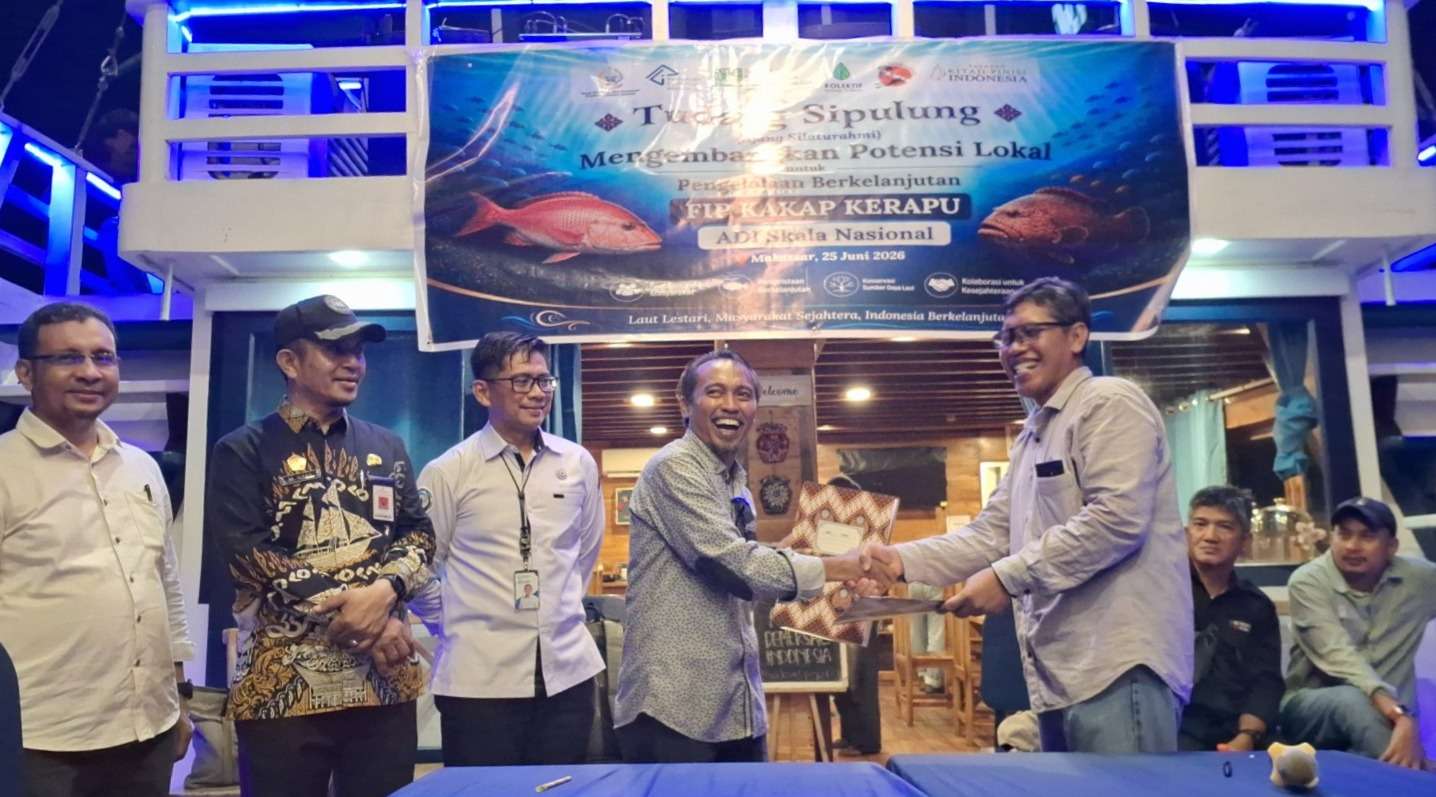
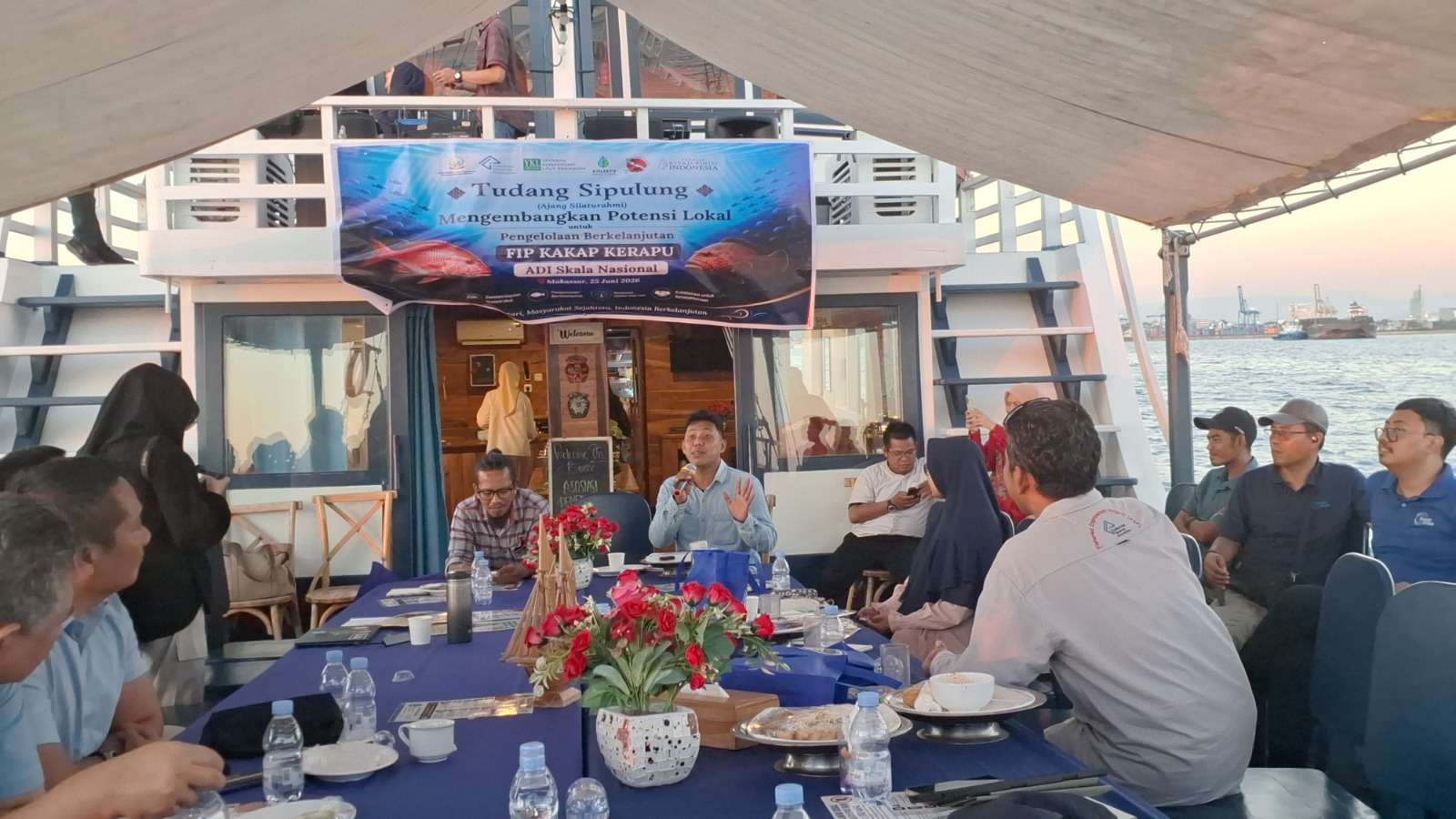
MARITIMEPOSTS.COM – MAKASSAR, Indonesia — Aboard a traditional Pinisi schooner sailing across the Makassar Strait, government officials, fisheries experts, industry leaders, conservation organizations, academics, and fishers gathered with a common purpose: ensuring the long-term future of Indonesia’s snapper and grouper fisheries.
The gathering, known as Tudang Sipulung—a Bugis-Makassar tradition of collective deliberation—served as more than a meeting. It symbolized a growing national movement toward sustainable fisheries management built on collaboration, science, and shared responsibility.
At the center of that effort is the Indonesian Demersal Association (ADI), which has spent the past five years leading a Fisheries Improvement Project (FIP) focused on snapper and grouper, two of Indonesia’s most valuable export commodities.
Beyond Business: A Shared Responsibility
For ADI Chairman Agus Saputra, the future of Indonesia’s demersal fisheries depends on abandoning the idea that any single stakeholder can solve sustainability challenges alone.
Indonesia possesses one of the world’s richest marine ecosystems, and snapper and grouper fisheries play a crucial role in supporting coastal livelihoods and export revenues.
Yet increasing pressure from international markets, evolving regulations, and concerns over declining fish stocks have made sustainable management an urgent priority.
“The challenges we face cannot be solved in isolation,” Agus emphasized during the forum. “Sustainability requires collaboration among government agencies, industry, NGOs, researchers, and fishing communities.”
This philosophy, commonly known as co-management, has become the foundation of ADI’s Fisheries Improvement Project. Rather than relying solely on regulations, the approach encourages shared decision-making and collective responsibility among all actors in the fisheries sector.
South Sulawesi: A Model for the Nation
One of the strongest examples of this collaborative approach can be found in South Sulawesi.
Over the past several years, partnerships involving ADI, local government agencies, conservation groups, and fishing communities have produced tangible results.
Training programs have strengthened fishers’ capacity, licensing service centers have improved legal compliance, and stakeholder forums have created new channels for dialogue and decision-making.
A major milestone has been the establishment of the South Sulawesi Snapper-Grouper Management Committee, a multi-stakeholder platform that brings together government representatives, industry participants, and fishers to jointly address fisheries management challenges.
The success of the initiative has drawn national attention and has already influenced broader fisheries governance discussions. Participants at the Makassar Strait meeting expressed hope that similar management committees can be established across Indonesia’s major snapper and grouper fishing grounds.
“The South Sulawesi experience shows that sustainability becomes possible when all stakeholders work together,” said several speakers throughout the forum. “This model should be replicated nationwide.”
Sustainability Begins with Data
While collaboration forms the foundation, scientific evidence is the engine driving the process.
Dr. Mukhlis Kamal, who has helped guide ADI’s Fisheries Improvement Project since its inception in 2019, described the association’s journey toward building a data-driven fishery.
Collecting reliable fisheries data has not always been easy. In the early years, obtaining information from companies and fishers was often challenging. However, growing international market demands for traceability and sustainability have gradually changed attitudes.
Today, ADI and its partners are collecting data on fish stocks, catch volumes, fish sizes, fishing effort, and ecosystem impacts as part of a long-term effort to achieve full assessment under the Marine Stewardship Council (MSC), one of the world’s most recognized sustainability certification systems.
According to Mukhlis, data generated by fishers, companies, students, researchers, and government agencies all contribute to understanding the health of Indonesia’s fisheries.
“Every piece of information helps us understand whether our fisheries are moving toward sustainability,” he explained. “Without data, we are simply guessing.”
The Warning Signs Beneath the Surface
The discussions also highlighted growing concerns about fish stock depletion.
Studies conducted in Fisheries Management Area 713, which covers the Makassar Strait and surrounding waters, indicate that several snapper stocks are under increasing pressure. Researchers have documented signs of overfishing, with some species showing reduced reproductive capacity.
One of the most pressing concerns is the capture of juvenile fish before they have had an opportunity to reproduce.
Many snapper and grouper species do not reach sexual maturity until they are three or four years old. Yet consumer preferences often favor smaller fish, creating incentives to harvest individuals before they contribute to future generations.
“If we continue harvesting fish before they can breed, stock collapse becomes only a matter of time,” Mukhlis warned.
The issue highlights the need for science-based harvest strategies, including size limits, monitoring systems, and stock assessments.
Protecting Fish Means Protecting Reefs
Sustainable fisheries management extends beyond fish populations alone.
Participants repeatedly emphasized that healthy snapper and grouper stocks depend on healthy coral reef ecosystems. Reefs provide critical habitat, feeding grounds, and nursery areas for many demersal species.
As a result, conservation efforts must address both fisheries management and ecosystem protection simultaneously.
The Fisheries Improvement Project also requires monitoring potential impacts on protected species such as dolphins, whales, and sea turtles. International sustainability standards increasingly demand evidence that fishing activities do not harm vulnerable marine wildlife.
This broader ecosystem perspective reflects a growing understanding that fisheries sustainability and marine conservation are inseparable.
Looking Beyond Today’s Catch
South Sulawesi Marine Affairs and Fisheries Agency Head M. Ilyas delivered one of the strongest messages of the forum: sustainability is not an environmental luxury but an economic necessity.
Drawing from recent conversations with fishers, he described how rising operating costs and declining catches are already affecting livelihoods. Some fishers spend more money on fishing trips than they earn from selling their catch.
For Ilyas, such stories illustrate the risks of prioritizing short-term production over long-term resource management.
“If fish stocks continue to decline, eventually both fishers and businesses will suffer,” he said.
He called on seafood exporters and buyers to think beyond immediate market demand and consider whether fish resources will still be available five or ten years from now.
A Shared Future
Ultimately, the message emerging from the gathering aboard the Pinisi was clear: sustainability is not simply about protecting fish populations.
It is about securing livelihoods for coastal communities, maintaining business viability for seafood exporters, preserving marine ecosystems, and ensuring that future generations inherit healthy oceans.
Five years into its Fisheries Improvement Project, ADI believes it has learned an important lesson: meaningful change occurs when government, industry, scientists, NGOs, and fishing communities work together.
The sea may belong to everyone, but so does the responsibility to protect it.
As the sun set over the Makassar Strait, participants left with a renewed commitment to chart a sustainable course for Indonesia’s snapper and grouper fisheries—one built on collaboration, science, and a shared vision for the future.