

PELAKITA.ID – There are places in the world that seem almost too extraordinary to be real. Ecuador is one of them.
At first glance, it appears to be a relatively small nation tucked into the northwestern corner of South America. Yet within an area smaller than Italy, Ecuador contains an astonishing concentration of landscapes, ecosystems, cultures, and natural wonders that few countries on Earth can rival.
In a matter of hours, travelers can journey from the snow-covered peaks of the Andes to the dense Amazon rainforest, from Pacific beaches to the legendary Galápagos Islands.
It is a country where active volcanoes tower above cloud forests, where ancient indigenous traditions coexist with colonial cities, and where one can literally stand with a foot in each hemisphere.
Ecuador does not merely challenge expectations—it redefines them.
A Nation Named After the Equator
Ecuador derives its name from the equator itself, the invisible line that divides the Earth into northern and southern hemispheres. Few countries are so intimately connected to a geographic feature that defines their identity.
Near the capital city of Quito stands the famous Mitad del Mundo, or “Middle of the World,” monument. Here, visitors can experience the novelty of standing in both hemispheres simultaneously. Local traditions have transformed this geographical curiosity into a cultural attraction, with demonstrations such as balancing an egg upright on a nail along the equatorial line.
Yet Ecuador’s relationship with geography goes even deeper.
The country is home to Mount Chimborazo, whose summit is the point on Earth closest to the sun. Although Mount Everest remains the tallest mountain above sea level, Chimborazo’s location near the equator means the Earth bulges outward beneath it. As a result, its peak sits farther from the planet’s center than any other point on Earth.
It is a fact that perfectly symbolizes Ecuador itself: a place where reality often feels stranger than fiction.
A Global Treasure of Biodiversity
For a country of modest size, Ecuador possesses one of the highest levels of biodiversity on the planet.
Its landscapes encompass four distinct regions: the Andes Mountains, the Amazon rainforest, the Pacific coast, and the Galápagos Islands. Together, these environments support more than 1,600 bird species, approximately 16 percent of the world’s amphibians, and 8 percent of all mammal species.
Within these ecosystems, visitors may encounter spectacled bears in the Andes, pink river dolphins in the Amazon, tiny glass frogs hidden among cloud forest vegetation, and marine iguanas on remote volcanic islands.
Ecuador has also become a global pioneer in environmental protection. It was the first country in the world to recognize the rights of nature within its constitution, granting ecosystems legal standing and establishing a groundbreaking framework for conservation.
The Ancient Homeland of Chocolate
Long before chocolate became a global obsession, cacao was already flourishing in Ecuador.
Archaeological evidence suggests that cacao cultivation in the region dates back more than 5,000 years to the Mayo-Chinchipe culture. Today, Ecuador remains one of the world’s premier producers of fine-flavor cacao, particularly the prized Nacional variety, renowned for its floral aroma and complex taste.
Travelers exploring Ecuador’s chocolate routes can visit plantations, learn traditional production methods, and discover how centuries of agricultural knowledge continue to shape one of the country’s most celebrated exports.
Quito: Where History Meets the Andes
Perched nearly 2,850 meters above sea level, Quito is one of the highest capital cities in the world and among South America’s most beautiful urban centers.
Recognized as the first UNESCO World Heritage City in history, Quito boasts an exceptionally preserved colonial core filled with cobblestone streets, grand churches, and historic plazas.
Among its architectural treasures is La Compañía de Jesús, often regarded as one of the finest examples of Baroque architecture in Latin America. Its gold-covered interior dazzles visitors with intricate craftsmanship and artistic detail.
Above the city rises El Panecillo, crowned by a massive aluminum statue of the Virgin Mary. From this vantage point, sweeping views reveal the dramatic Andes stretching toward the horizon.
Quito is not simply a historical destination—it is a gateway to Ecuador’s extraordinary natural landscapes.
The Avenue of Volcanoes
Running through the heart of Ecuador is a spectacular corridor known as the Avenue of Volcanoes.
First described by explorer Alexander von Humboldt, this region contains more than a dozen towering volcanic peaks rising above fertile valleys and traditional farming communities.
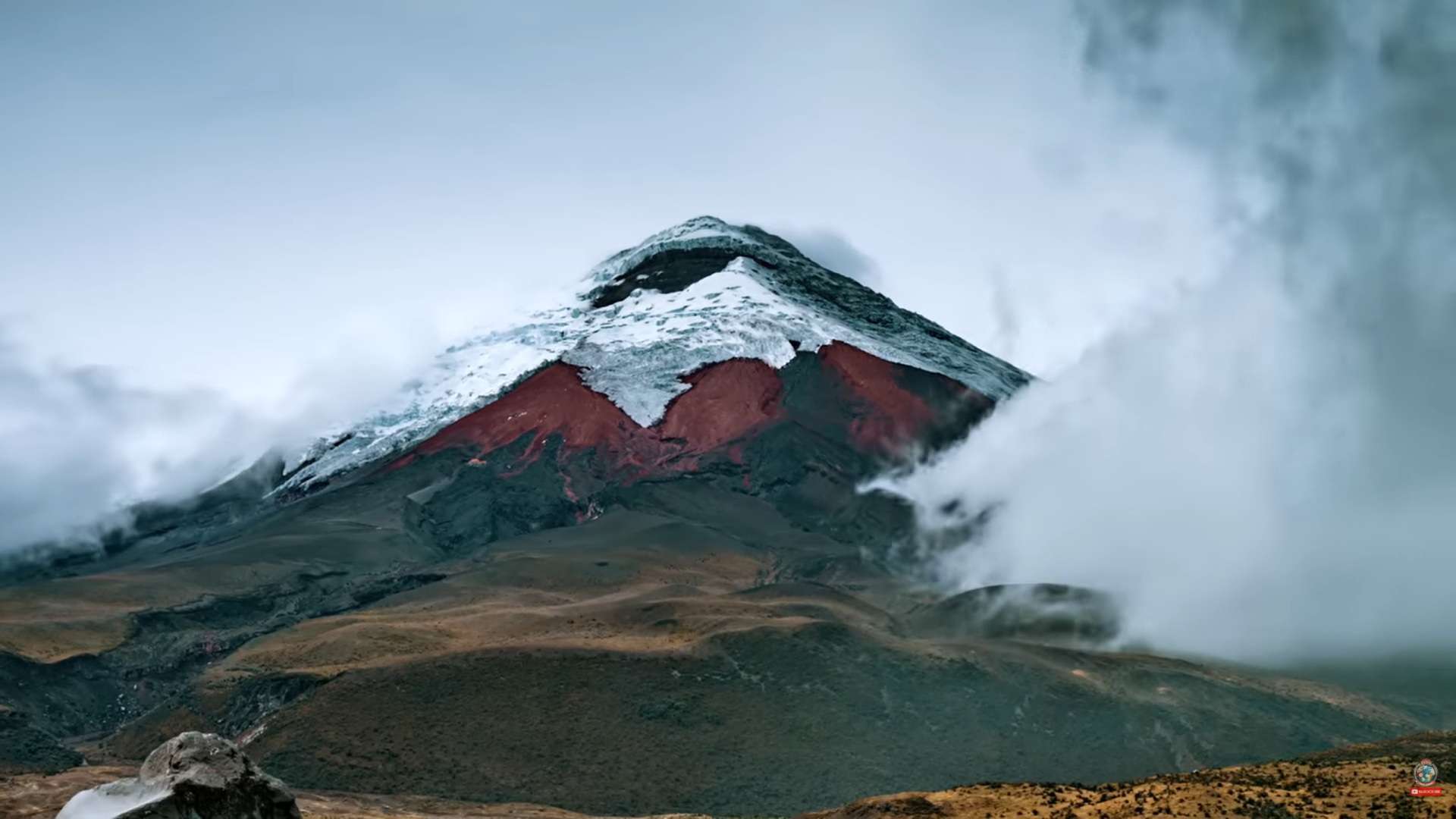
Among them, Cotopaxi stands as one of the world’s highest active volcanoes. Reaching 5,897 meters, its near-perfect cone is capped with permanent snow despite its location near the equator. Revered for centuries by indigenous communities, Cotopaxi remains one of Ecuador’s most iconic natural landmarks.
Nearby, Chimborazo dominates the landscape at 6,263 meters. Though dormant for over a millennium, its immense size and glaciers continue to shape local ecosystems and water supplies.
Together, these volcanic giants create one of the most dramatic mountain landscapes on Earth.
Crater Lakes and Andean Wonders
Ecuador’s volcanic history has produced remarkable geological formations.
One of the most breathtaking is Quilotoa, a massive volcanic caldera filled with turquoise water. Sitting nearly 4,000 meters above sea level, the crater lake combines stunning natural beauty with deep spiritual significance for indigenous communities.
Further north, the province of Imbabura offers a landscape of sacred volcanoes, tranquil lakes, and indigenous culture. The famous Otavalo Market showcases some of South America’s finest textiles, crafts, and traditional artistry.
Nearby, Lake San Pablo and Lake Yahuarcocha provide serene settings framed by towering Andean peaks, reminders of the volcanic forces that shaped the region.
Baños: Ecuador’s Adventure Capital
Nestled between the Andes and the Amazon basin lies Baños de Agua Santa, a town synonymous with adventure.
Named after its thermal springs, which are heated by volcanic activity, Baños attracts travelers seeking both relaxation and adrenaline.
The surrounding landscape is filled with waterfalls, including the spectacular Pailón del Diablo, where roaring water plunges through a narrow canyon.
The town’s most famous attraction may be the “Swing at the End of the World,” suspended high above a valley with views toward the active Tungurahua Volcano. Few experiences capture Ecuador’s spirit of adventure quite so vividly.
Cuenca and the Cultural Soul of Ecuador
South of Quito lies Cuenca, often considered Ecuador’s cultural capital.
A UNESCO World Heritage Site, Cuenca charms visitors with colonial architecture, flower-filled plazas, blue-domed cathedrals, and riverside promenades.
Its history stretches back long before Spanish colonization. The area was once home to the Cañari civilization and later became an important Inca center.
Today, museums, archaeological sites, and vibrant cultural traditions preserve this rich heritage while maintaining a distinctly modern character.
Into the Amazon
Covering more than 120,000 square kilometers, Ecuador’s Amazon rainforest is one of the most biologically diverse regions on Earth.
At its heart lies Yasuní National Park, often described as one of the most species-rich places ever studied by scientists.
Here, jaguars roam dense forests, pink dolphins navigate winding rivers, and thousands of plant species flourish within a remarkably compact area.
What distinguishes Ecuador’s Amazon is its accessibility. Within a few hours of leaving Quito, travelers can find themselves immersed in rainforest ecosystems while learning directly from indigenous communities such as the Kichwa, Shuar, and Waorani peoples, whose knowledge of the forest spans countless generations.
Cloud Forests and Coastal Beauty
Not all of Ecuador’s ecological treasures lie deep in the jungle.
The cloud forest of Mindo offers a completely different experience. Wrapped in mist and alive with birds, butterflies, orchids, and waterfalls, it has become a global destination for ecotourism and birdwatching.
Meanwhile, Ecuador’s Pacific coastline stretches for more than 2,000 kilometers. Fishing villages, surfing towns, mangrove forests, and whale-watching opportunities create a vibrant coastal culture deeply connected to the sea.
Each year, humpback whales migrate through Ecuadorian waters, adding another layer to the country’s extraordinary wildlife spectacle.
The Galápagos: A Living Laboratory of Evolution
No journey through Ecuador is complete without reaching the Galápagos Islands.
Located nearly 1,000 kilometers from the mainland, this volcanic archipelago inspired Charles Darwin’s theory of evolution and remains one of the world’s most important natural laboratories.
The islands are home to giant tortoises, marine iguanas, blue-footed boobies, flightless cormorants, and countless species found nowhere else on Earth.
Strict conservation measures protect the fragile ecosystem, ensuring that future generations can continue to witness this remarkable convergence of wildlife and evolutionary history.
In the Galápagos, nature unfolds with an intimacy and authenticity that few places can match.
A Country of Impossible Contrasts
Ecuador feels almost impossible.
It is a country where glaciers overlook tropical forests, where ancient traditions endure beneath active volcanoes, and where evolutionary history remains visible in living creatures.
Within its borders lie some of the world’s richest ecosystems, most dramatic landscapes, and most enduring cultural traditions.
Perhaps that is what makes Ecuador so unforgettable. It does not rely on a single attraction or iconic landmark. Instead, it offers an astonishing collection of experiences that somehow coexist within one small nation.
Few places demonstrate more clearly that size is no measure of greatness.
Ecuador may be small on the map, but in terms of natural wonder, cultural richness, and sheer diversity, it stands among the most extraordinary countries on Earth.