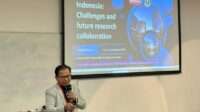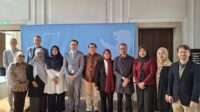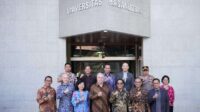


As an alumnus of Political Science at the Faculty of Social and Political Sciences (FISIP) of Universitas Hasanuddin (Unhas), Rusdi Mardan brings social sensitivity and the ability to read institutional dynamics. Meanwhile, more than three decades of experience in various major corporations—ranging from British American Tobacco, Danone Aqua, Astra International, Hutchison 3 Indonesia, to Indosat—have shaped him into an executive with strong corporate discipline.
PELAKITA.ID – The world of higher education is often seen as an “ivory tower”—an academic space rich in ideas, yet frequently distant from the dynamics of a competitive and rapidly evolving economy.
In the context of State University with Legal Entity status (PTN-BH) such as Universitas Hasanuddin (Unhas), that challenge has now shifted.
Universities are no longer only expected to produce graduates and research outputs, but also to build economic independence based on assets, innovation, and professional governance.
It is within this landscape that the appointment of Rusdi Mardan as President Director of PT Hadin Metavisi Akademika (Hadin) in June 2026 marks a strategic step signaling a new direction in Unhas’s business management.
With a long background in national and international corporate environments, Rusdi brings a more aggressive, measurable, and performance-based managerial approach to strengthening the university’s economic foundation.
An Sospol Alumnus with Corporate DNA: A Blend of Social Insight and Business Discipline
Rusdi Mardan’s selection is not merely about individual capacity, but about the unique combination of his background.
As an alumnus of Political Science at FISIP Unhas, he brings social sensitivity and the ability to understand institutional dynamics.
At the same time, more than 30 years of experience in major companies—from British American Tobacco, Astra International, Danone Aqua, Hutchison 3 Indonesia, to Indosat—have shaped him into an executive with strong corporate discipline.
This combination is crucial in the context of a university with a complex structure, diverse stakeholders, and a distinctive organizational culture. The ability to bridge social considerations and business logic is a key asset in driving the transformation of Hadin as a university business entity.
The President Commissioner of PT Hadin Metavisi Akademika, Dr. Eka Sastra, stated that Rusdi’s extensive business experience is expected to accelerate Hadin’s transformation into a professional holding company capable of supporting Unhas’s economic independence.
The 100-Day Blueprint: Execution Discipline as the Foundation of Change
In the corporate world, transformation is not achieved by vision alone—it requires momentum and fast execution. Rusdi Mardan has designed his first 100 days as a critical phase of Hadin’s transformation.
During the first 30 days, the focus is on stabilization: comprehensive audits of business units, cost efficiency measures, and identification of inefficiencies.
From day 31 to 60, transformation begins to accelerate through digitalization, strengthening strategic partnerships, and integrating business units to become more adaptive and coordinated.
From day 60 to 100, the focus shifts to performance delivery: revenue growth, portfolio optimization, and the implementation of real-time data-based monitoring systems.
This approach reflects an important shift from administrative culture toward a measurable and accountable performance-driven culture.
Turning 60,000 Academic Members into a Digital Economic Ecosystem
Unhas holds significant economic potential through its more than 60,000 academic community members, which so far has not been managed as an integrated economic ecosystem.
Rusdi promotes the concept of a campus super app as an entry point for the digitalization of university services and transactions.
More than just an application, this initiative is aimed at building a data-driven university ecosystem, where every economic and service interaction can be monitored, analyzed, and optimized.
Through this integration, Hadin is positioned not only as a manager of business units, but also as a driver of efficiency and transparency in campus economics, while minimizing potential revenue leakage.
Bridging the Valley of Death Between Research and Industry
One of the classic challenges of higher education in Indonesia is the broken link between research and industry. Many academic innovations stop at journals and research reports without ever reaching the market.
At this point, Hadin is positioned as a bridge for innovation downstreaming.
“Hadin must become the bridging between research and the market,” emphasized Rusdi Mardan.
In this approach, research outputs no longer remain purely academic products but are translated into products, services, or business models with economic value. Thus, universities are not only producers of knowledge but also economic actors based on innovation.
Vision 2030: Building a Sustainable Campus Business Ecosystem
Rusdi Mardan also places a long-term vision toward 2030 as the direction for Hadin’s transformation consolidation. There are five main pillars:
- Healthy profitability across all university business units
- An integrated digital ecosystem as the operational backbone
- Business diversification based on strategic partnerships
- Governance based on Good Corporate Governance (GCG) and strict KPIs
- Development of professional talent equivalent to industry standards
These five pillars are designed to build a model of university economic independence that does not rely solely on education funding, but also on a professionally managed business ecosystem.
A New Paradigm of Campus Economics
The presence of a corporate-background figure like Rusdi Mardan marks an important shift in how universities manage their assets and economic potential. Unhas is no longer functioning solely as an academic institution, but also as an economic entity expected to be adaptive, competitive, and results-oriented.
The challenge of the first 100 days will be an early test: whether this transformation can move from concept to real implementation, and whether Unhas can become a national model for university economic independence.
Ultimately, the bigger question is not merely whether universities can do business, but how university-based business can strengthen academic missions and the institution’s contribution to national development.