


When people talk about the energy transition, they often imagine solar panels replacing coal plants, electric vehicles replacing fossil-fuel engines, and renewable energy steadily taking over national power grids. Yet Indonesia’s experience suggests that the transition to a low-carbon future is not primarily a technological challenge. It is a political one.
MARITIMEPOSTS.COM – Despite committing to ambitious climate goals under the Paris Agreement and setting a target of achieving at least 23 percent renewable energy in its national energy mix, Indonesia’s path toward decarbonization remains uncertain. The obstacles are not merely financial or technical.
They are embedded in competing political interests, institutional arrangements, economic dependencies, and struggles over who gets to shape the country’s energy future.
Research by Abidah B. Setyowati and Jaco Quist, published in Energy Policy in 2022, offers a compelling window into these dynamics. By examining regional energy planning processes in Bali and South Kalimantan, the authors reveal how energy transitions are negotiated, contested, and often constrained by local political realities.
The contrast between the two provinces could hardly be sharper.
In Bali, the energy transition has become part of a broader vision for the island’s future. As one of the world’s premier tourism destinations, Bali’s economic prosperity depends heavily on environmental quality and global perceptions of sustainability. Supported by strong political leadership and an active civil society, the province initially embraced an ambitious goal of achieving 100 percent renewable energy by 2050.
However, turning that vision into reality quickly exposed the limits of regional authority. Indonesia’s electricity sector remains highly centralized, with the state-owned utility PLN exercising enormous influence over energy planning and investment decisions. Bali’s push for renewable energy encountered resistance from a national system that continued to prioritize coal-based electricity imported from Java on grounds of economic efficiency and existing infrastructure commitments.
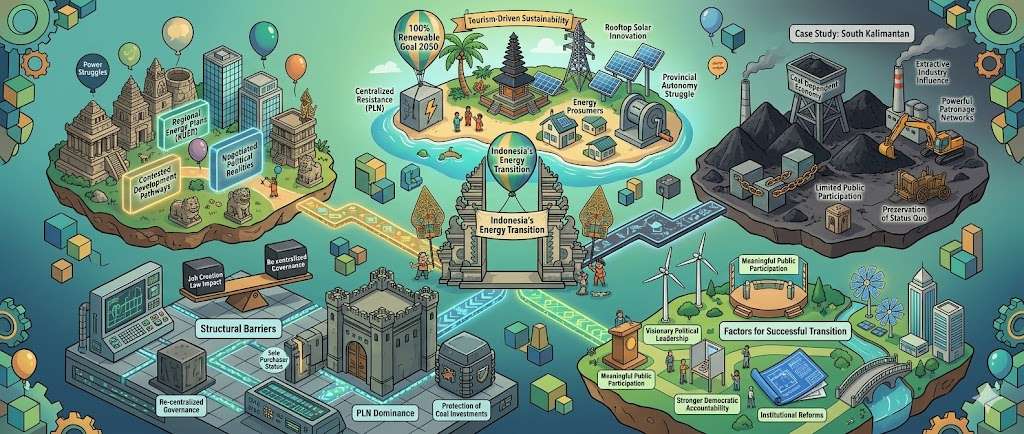
Rather than abandoning its ambitions, Bali adapted. Provincial leaders negotiated compromises, promoting natural gas as a transitional fuel while aggressively encouraging rooftop solar installations in households, hotels, and commercial buildings. Citizens increasingly became energy “prosumers,” generating their own electricity in an effort to overcome regulatory and institutional barriers. In Bali, the energy transition evolved into a form of local innovation and political negotiation—a struggle to expand provincial autonomy within a highly centralized system.
Thousands of kilometers away, a very different story is unfolding in South Kalimantan.
As one of Indonesia’s largest coal-producing regions, South Kalimantan’s economy remains deeply dependent on extractive industries. Coal mining contributes substantially to provincial income, employment, and political influence. Unsurprisingly, discussions about renewable energy often collide with powerful economic interests that have been built around fossil fuels for decades.
Unlike Bali, where civil society actively participates in shaping energy policy, regional planning in South Kalimantan has largely been dominated by government officials, consultants, and business interests. Public participation remains limited, while political leadership has shown little enthusiasm for a rapid transition away from coal.
The reason is not difficult to understand. Coal is widely perceived as the province’s economic lifeblood. Powerful patronage networks connect political elites, business actors, and extractive industries, creating strong incentives to preserve the status quo. As a result, regional energy plans continue to project significant coal consumption while renewable energy receives only modest attention. Environmental activists and community groups seeking to challenge the dominance of the coal sector often operate within a difficult and sometimes hostile political environment.
These contrasting experiences reveal a deeper issue at the heart of Indonesia’s energy transition: the tension between decentralization and centralization.
Following the democratic reforms of the late 1990s, Indonesia embarked on one of the most ambitious decentralization programs in the world, granting substantial authority to provincial and local governments. Yet recent policy developments, including the Job Creation Law, have re-centralized important aspects of energy governance. Provincial governments are therefore caught between growing expectations to pursue sustainable development and limited authority to shape energy systems independently.
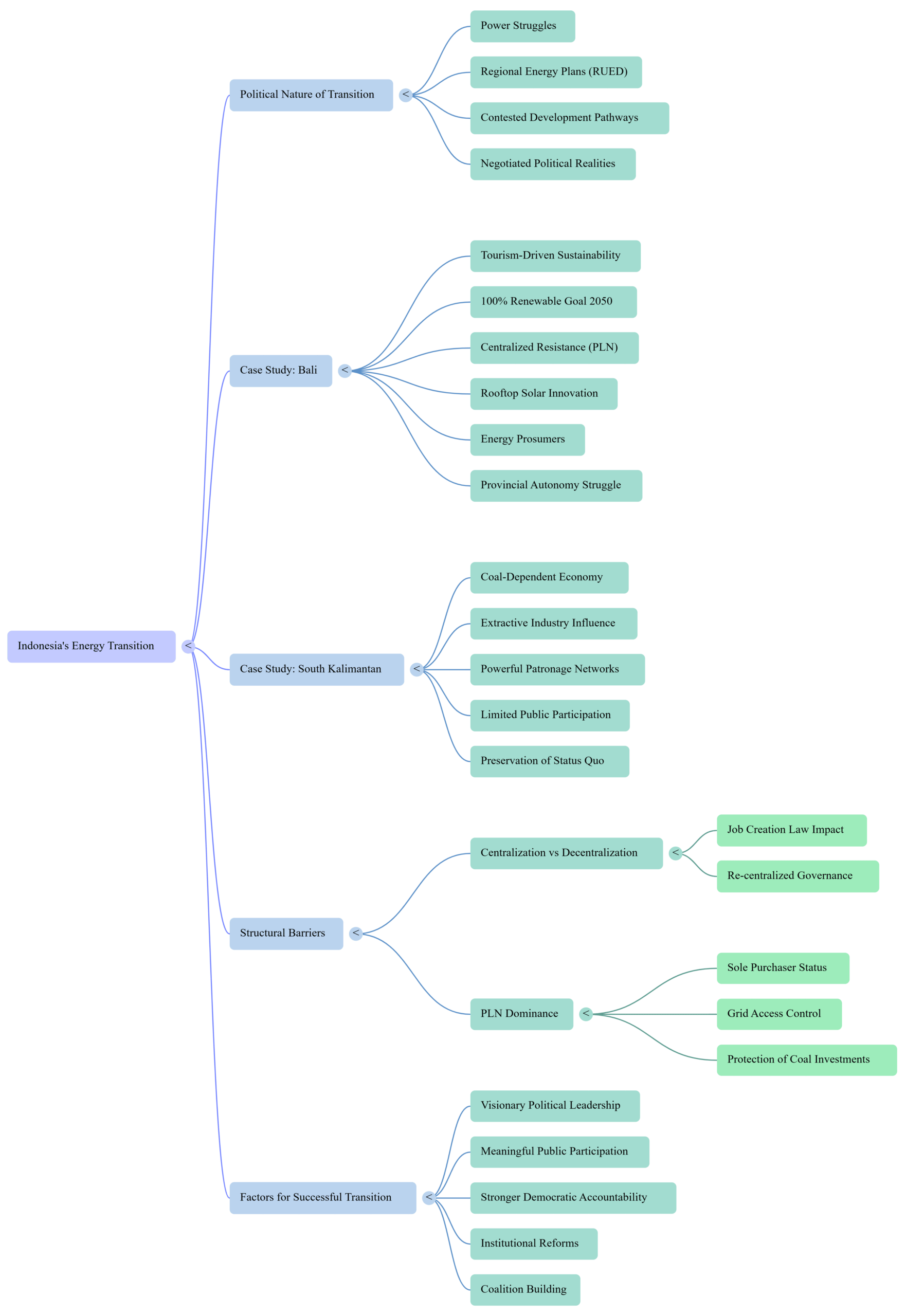
At the same time, PLN’s dominant position in the electricity sector creates additional barriers. As the sole purchaser and primary distributor of electricity, the utility maintains significant control over energy investments and grid access. Critics argue that this structure often discourages decentralized renewable energy projects and protects existing investments in coal-fired generation.
The result is that Indonesia’s energy transition is not unfolding as a straightforward technological transformation. Instead, it has become a political arena where competing interests clash over resources, authority, and development pathways. Decisions about energy are simultaneously decisions about jobs, revenues, power relations, and regional identities.
The lessons extend far beyond Indonesia. Across much of the Global South, governments face the challenge of balancing economic growth, energy security, and climate commitments. The Indonesian experience demonstrates that renewable energy targets alone are insufficient. Successful transitions require visionary political leadership, meaningful public participation, stronger democratic accountability, and reforms that enable communities and private actors to participate more actively in energy production.
Ultimately, the future of Indonesia’s energy transition will not be determined solely by the efficiency of solar panels or the falling cost of renewable technologies. It will depend on whether political institutions can navigate competing interests and build coalitions capable of supporting change. Energy planning, as the experiences of Bali and South Kalimantan make clear, is far more than a technical exercise. It is a contest over the future itself—one province, one policy, and one political struggle at a time.
___
In their 2022 article, “Contested Transition? Exploring the Politics and Process of Regional Energy Planning in Indonesia,” published in Energy Policy, Abidah B. Setyowati and Jaco Quist examine how Indonesia’s transition toward low-carbon energy is shaped not only by technical planning but also by political negotiations among actors operating at different levels of government. Drawing on interviews, policy analysis, and case studies, the authors argue that regional energy planning is a contested process in which national and provincial actors compete, negotiate, and collaborate to influence future energy pathways. The study finds that while decentralization has created opportunities for local governments to promote renewable energy initiatives, the effectiveness of these efforts is strongly influenced by political leadership, civil society participation, institutional arrangements, power relations, and local political-economic structures. Ultimately, the authors conclude that successful energy transitions require more than supportive regulations; they depend on the ability of subnational actors to navigate complex governance dynamics and mobilize local political support for change.
___
Written by Kamaruddin Azis