
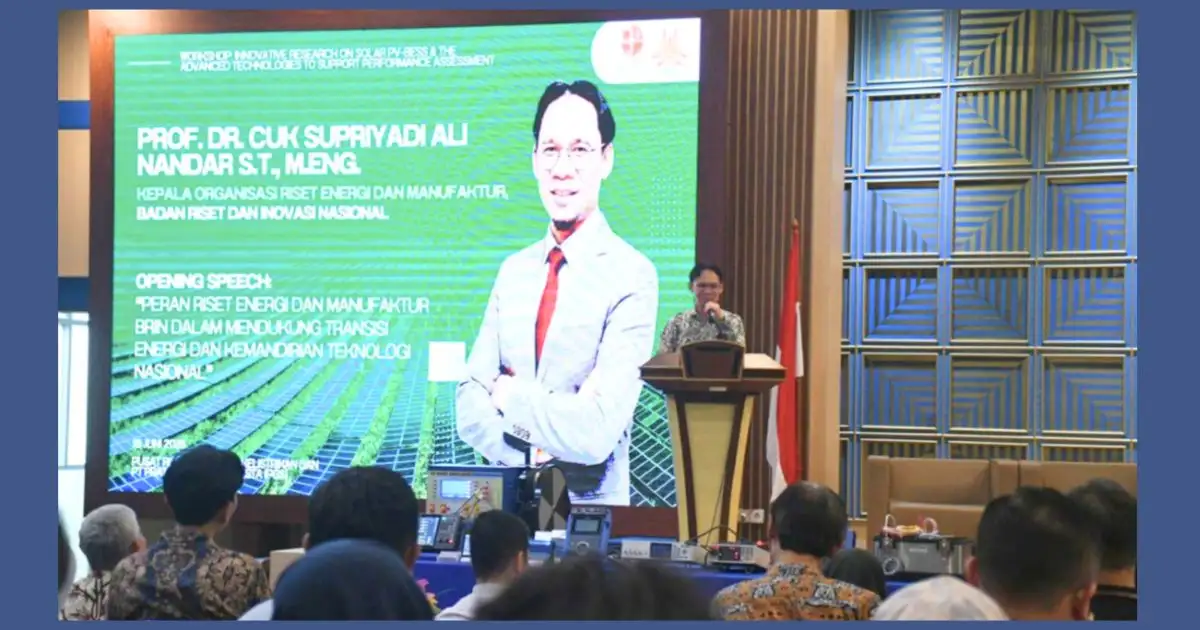
MARITIMEPOSTS.COM – BRIN Public Relations. The National Research and Innovation Agency (BRIN) continues to strengthen its support for renewable energy development through the Workshop on Innovative Research on Solar PV-BESS and Advanced Technologies to Support Performance Assessment, held at the Auditorium of Building Management 720, B.J. Habibie Science and Technology Area, South Tangerang, on Thursday (June 18).
Organized by BRIN’s Research Center for Electrical Power Technology (PRTK), the workshop brought together various stakeholders, including government agencies, research institutions, academics, industry representatives, and electricity utilities.
The event focused on developments in Photovoltaic-Battery Energy Storage System (PV-BESS) technology, testing facilities, and strategies for implementing renewable energy in Indonesia.
Head of BRIN’s Energy and Manufacturing Research Organization, Prof. Cuk Supriyadi Ali Nandar, emphasized that collaboration is a key factor in accelerating the development of national electricity technologies.
“We hope this event will not only serve as a forum for sharing information but also become the first step toward strengthening collaboration in research, testing, and the development of solar PV-BESS technology in Indonesia,” he said.
According to Cuk, renewable energy technology development requires more than innovation alone. Adequate testing facilities, technology standardization, and synergy among government agencies, research institutions, industry players, and technology users are essential to ensure that technologies can be implemented widely and sustainably.
He added that BRIN remains committed to strengthening research and innovation capabilities to produce technological solutions that meet the needs of Indonesia’s energy sector.
Meanwhile, Eka Rakhman Priandana, Head of BRIN’s Research Center for Electrical Power Technology, explained that the workshop also served as a platform to introduce the center’s research competencies and facilities to stakeholders in the electricity sector.
According to Eka, PRTK BRIN continues to enhance its research, testing, and measurement capabilities to ensure the performance, reliability, and safety of PV-BESS technologies before their deployment in the field.
“Cross-sector collaboration is expected to accelerate innovation development, strengthen testing facilities, support technology standardization, and promote the downstream commercialization of research outcomes to help achieve Indonesia’s energy transition and net-zero emission targets,” Eka explained.
During the workshop, participants also gained perspectives from industry representatives and regulators regarding the challenges and opportunities in renewable energy implementation.
Representing industry, Agus Setiawan from PLN’s Research and Development Center presented the concept of a Virtual Power Plant (VPP) as one of the supporting technologies for the energy transition and PLN’s smart grid development.
Agus explained that the increasing use of intermittent renewable energy sources, such as solar and wind power, requires a more flexible and responsive electricity system.
VPP technology enables distributed energy resources—including solar power plants, battery energy storage systems (BESS), electric vehicles, and energy management systems—to operate in a coordinated manner as a single virtual power plant.
“This approach can improve the reliability of the electricity system, reduce curtailment of renewable energy generation, and accelerate the penetration of clean energy without compromising grid stability,” Agus stated.
He added that the development of technologies such as BESS and VPP requires strong research support, adaptive regulations, and sustained collaboration among government agencies, industry players, and research institutions.
From the regulatory perspective, Hery Ferdiansyah, Coordinator for Renewable Energy Engineering and Environmental Affairs at the Directorate General of New, Renewable Energy and Energy Conservation (EBTKE) of the Ministry of Energy and Mineral Resources (ESDM), outlined the government’s policy direction for accelerating renewable energy development in Indonesia.
According to Hery, the government continues to strengthen regulations and national standards to support the adoption of renewable energy technologies and energy storage systems.
Furthermore, strengthening testing laboratories and national research facilities has become a strategic necessity to ensure that deployed technologies meet the required safety, quality, and performance standards.
He also emphasized the importance of involving all stakeholders—including government, industry, academia, research institutions, media, and the public—in building a strong and sustainable renewable energy ecosystem.
Through this workshop, BRIN reaffirmed its role as a driver of research and innovation in electrical power technology as well as a facilitator of multi-stakeholder collaboration. Synergy among researchers, regulators, industry players, and electricity utilities is expected to accelerate the development of solar PV-BESS technologies, strengthen national testing facilities, and promote the downstream utilization of research outcomes, ultimately contributing to a cleaner, more resilient, and sustainable energy system in Indonesia.
(jh, aj / ed: ugi)