
The Blue Economy can become emancipatory, empowering coastal communities and protecting marine ecosystems. But it can also become technocratic rhetoric masking extractive capitalism. Under the banner of “green growth,” large-scale industrial projects may continue displacing traditional fishing communities, privatizing coastal zones, and concentrating wealth among elites.
PELAKITA.ID – Indonesia has long described itself as an archipelagic nation. Yet the phrase alone is no longer enough. In the 21st century, the struggle over Indonesia’s seas is no longer merely about territory, fisheries, shipping lanes, or naval strength.
It is also a struggle over language, identity, power, and meaning. The Indonesian Maritime Continent is not simply a geographic reality—it is a discourse, a battlefield of narratives where sovereignty, capitalism, ecology, and civilization collide.
The sea is never neutral.
For centuries, colonial powers viewed the seas of the archipelago as extraction corridors: routes for spices, minerals, forced labor, and imperial domination.
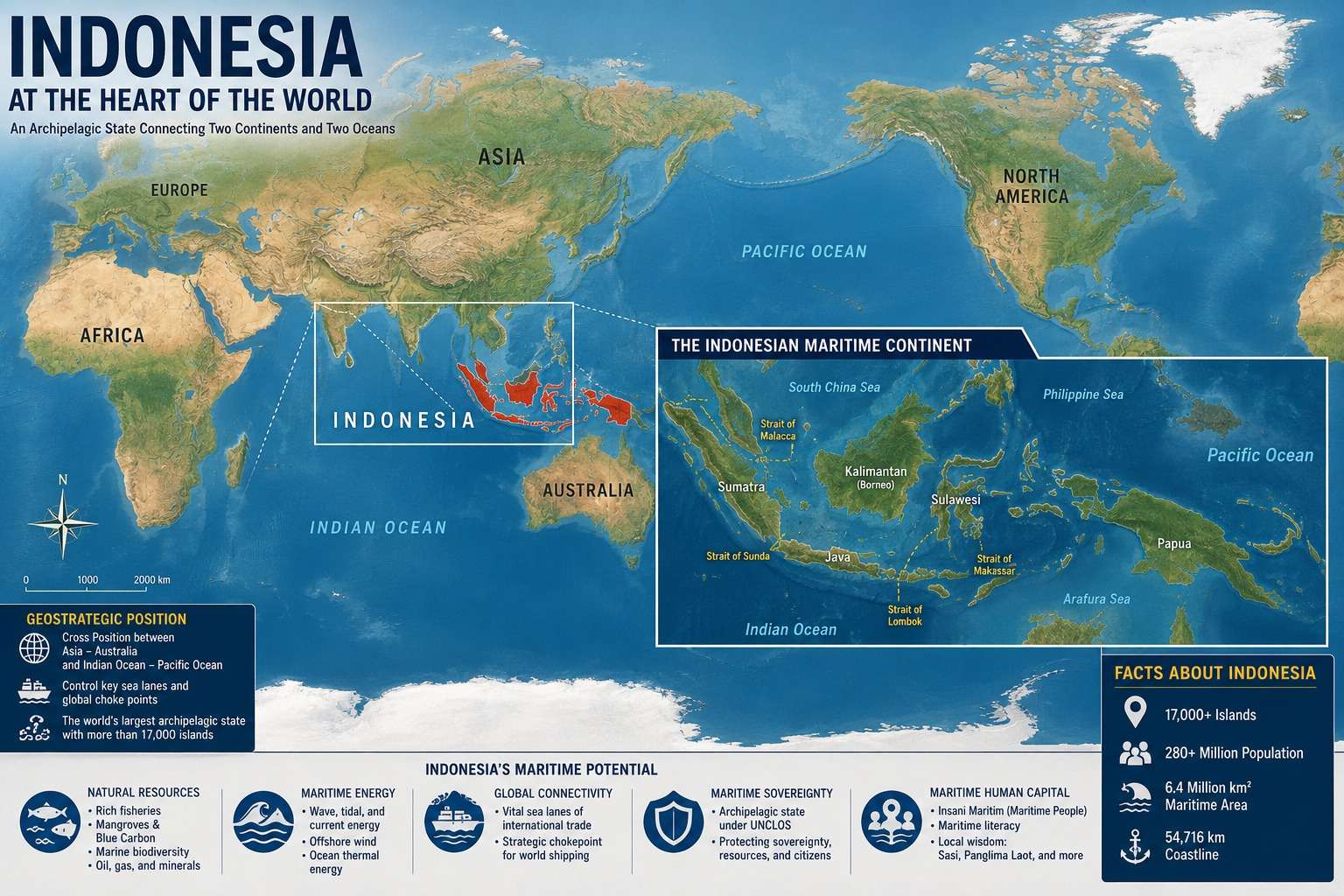
Modern globalization transformed those same waters into arteries of global trade. Today, Indonesia sits astride one of the most strategic maritime crossroads on Earth, controlling vital chokepoints such as the Malacca, Sunda, Lombok, and Makassar Straits. Nearly every major power—the United States, China, Japan, India, and Australia—has strategic interests flowing through Indonesian waters.
But geography alone does not create power. Discourse does.
French philosopher Michel Foucault argued that power operates not merely through force, but through the production of “truth.”
Whoever defines reality controls the framework through which society thinks. In the context of the Indonesian Maritime Continent, this means that the way Indonesia talks about the sea determines how Indonesians understand themselves.
If the sea is framed as a “barrier,” then islands become isolated fragments.
If the sea is framed as a “bridge,” Indonesia becomes an integrated civilization.
If the sea is framed as a “highway,” maritime connectivity becomes national destiny.
If the sea is framed merely as a resource warehouse, exploitation follows.
If the sea is framed as heritage, stewardship emerges.
This is why maritime discourse matters.
The Indonesian Maritime Continent is not only an oceanic geography between Asia and Australia, between the Indian and Pacific Oceans. It is also a conceptual space where national identity is continuously negotiated.
Through discourse, Indonesia attempts to transform itself from a land-oriented republic into a maritime civilization.
For decades, Indonesia suffered from what many scholars call a “land-based bias.” Political power, economic concentration, and population density became overwhelmingly centered on Java. The sea—despite covering the majority of the national territory—was psychologically marginalized.
Maritime communities remained peripheral in development discourse, even though fishermen, coastal societies, and island populations formed the historical backbone of Nusantara civilization.
This imbalance produced a dangerous paradox: Indonesia possessed one of the world’s richest maritime domains, yet often behaved like a continental state.
Critical discourse theory exposes how this paradox was socially constructed. British scholar Norman Fairclough explains that discourse operates across three dimensions: text, discourse practice, and socio-cultural practice.
Applied to maritime Indonesia, this means the words used by politicians, academics, media institutions, and corporations shape how maritime space is governed and imagined.
When the government promotes the “Blue Economy,” it is not merely proposing economic policy. It is constructing a new maritime identity. The phrase implies that the ocean is not a frontier to conquer, but a living ecosystem requiring sustainability, innovation, and resilience.
Yet every discourse carries ideology.
The Blue Economy can become emancipatory, empowering coastal communities and protecting marine ecosystems. But it can also become technocratic rhetoric masking extractive capitalism. Under the banner of “green growth,” large-scale industrial projects may continue displacing traditional fishing communities, privatizing coastal zones, and concentrating wealth among elites.
Thus the real question is not whether maritime development occurs, but whose interests define maritime development.
This is where discourse becomes political struggle.
Political theorists Ernesto Laclau and Chantal Mouffe argued that societies constantly compete to “lock in” meaning through hegemony. In Indonesia’s maritime context, multiple forces compete to define the sea:
- Is the sea primarily a geopolitical defense zone?
- Is it a global trade corridor?
- Is it a carbon sink and climate buffer?
- Is it sacred ancestral territory?
- Is it industrial space for ports and mining logistics?
- Or is it the living space of coastal civilizations?
The answer depends on who controls the narrative.
Indonesia’s strategic “Cross Position” amplifies this struggle. Situated between two continents and two oceans, Indonesia occupies one of the world’s most critical geopolitical intersections. This position grants enormous leverage—but also immense vulnerability.
The world sees Indonesia as a choke point. Global powers see Indonesian waters as strategic corridors. International markets see the archipelago as a logistics chain. Extractive industries see mineral wealth beneath the sea and beneath the islands.
But Indonesians themselves must decide whether they will see the maritime continent merely as commodity space—or as civilizational space.
The stakes are enormous because Indonesia is entering an era where maritime geopolitics intersects with climate crisis, energy transition, and resource wars.
The sea contains fisheries, nickel routes, offshore energy potential, and blue carbon ecosystems such as mangroves and seagrass meadows. Indonesia’s maritime zones increasingly shape global conversations about renewable energy, biodiversity, and climate mitigation.
At the same time, Indonesia’s position within the Pacific Ring of Fire creates a profound duality: extraordinary wealth alongside permanent vulnerability.
Volcanoes enrich the soil yet threaten catastrophe. Tectonic dynamics produce minerals yet trigger earthquakes and tsunamis. The sea feeds millions yet becomes increasingly threatened by overfishing, pollution, and rising temperatures.
Thus maritime identity in Indonesia cannot be separated from resilience.
The concept of Insani Maritim—maritime humanity—emerges as a response to this reality. A maritime nation requires not merely infrastructure, but a maritime mentality: adaptive, resilient, outward-looking, ecologically conscious, and capable of surviving uncertainty.
Indonesia’s traditional maritime wisdom already contains this philosophy.
In Maluku, the Sasi tradition regulates resource use through communal ecological ethics. In Aceh, the Panglima Laot institution historically governed maritime order through customary authority. These systems demonstrate that sustainability is not a modern invention imported from global institutions. Coastal societies across the archipelago practiced maritime governance long before modern environmental discourse emerged.
Yet modernization frequently marginalizes this wisdom.
Industrial development often frames traditional systems as “backward,” while technocratic discourse monopolizes authority over maritime management. Here again, discourse shapes power: whoever defines “modernity” controls policy legitimacy.
Indonesia therefore faces a historic choice.
Will the Indonesian Maritime Continent become merely an operational zone within global capitalism? Or can it become the foundation of an independent maritime civilization rooted in sovereignty, ecological balance, and social justice?
The answer will not be determined solely by naval fleets, ports, or trade statistics. It will be determined by imagination—by the stories Indonesians tell about the sea.
Because nations are ultimately built not only through territory, but through meaning.
If Indonesia continues viewing the sea as peripheral, exploitation will continue. Coastal inequality will deepen. Maritime wealth will enrich external powers and domestic oligarchies while fishing communities remain vulnerable.
But if Indonesia truly internalizes the sea as the center of national consciousness, then the maritime continent can become more than a geopolitical asset. It can become a civilizational project.
The future of Indonesia may therefore depend on one fundamental transformation: not merely governing the sea, but learning once again to think like a maritime nation.
Editorial Team
___
This article is a synthesis developed after attending the lecture on the Indonesian Maritime Continent and the Discourse Theory Surrounding It by Prof. Muhammad Saleh S. Ali, M.Sc., in the Development Studies Program at the Graduate School of Hasanuddin University.