
- Through partnerships with local governments, he has contributed to developing healthy city indicators, strengthening community participation, and helping numerous municipalities earn the prestigious Swasti Saba National Award.
- His approach views public health not simply as a hospital-centered responsibility but as the outcome of collaboration among multiple sectors—including environmental management, education, urban planning, economic development, and active citizen participation.
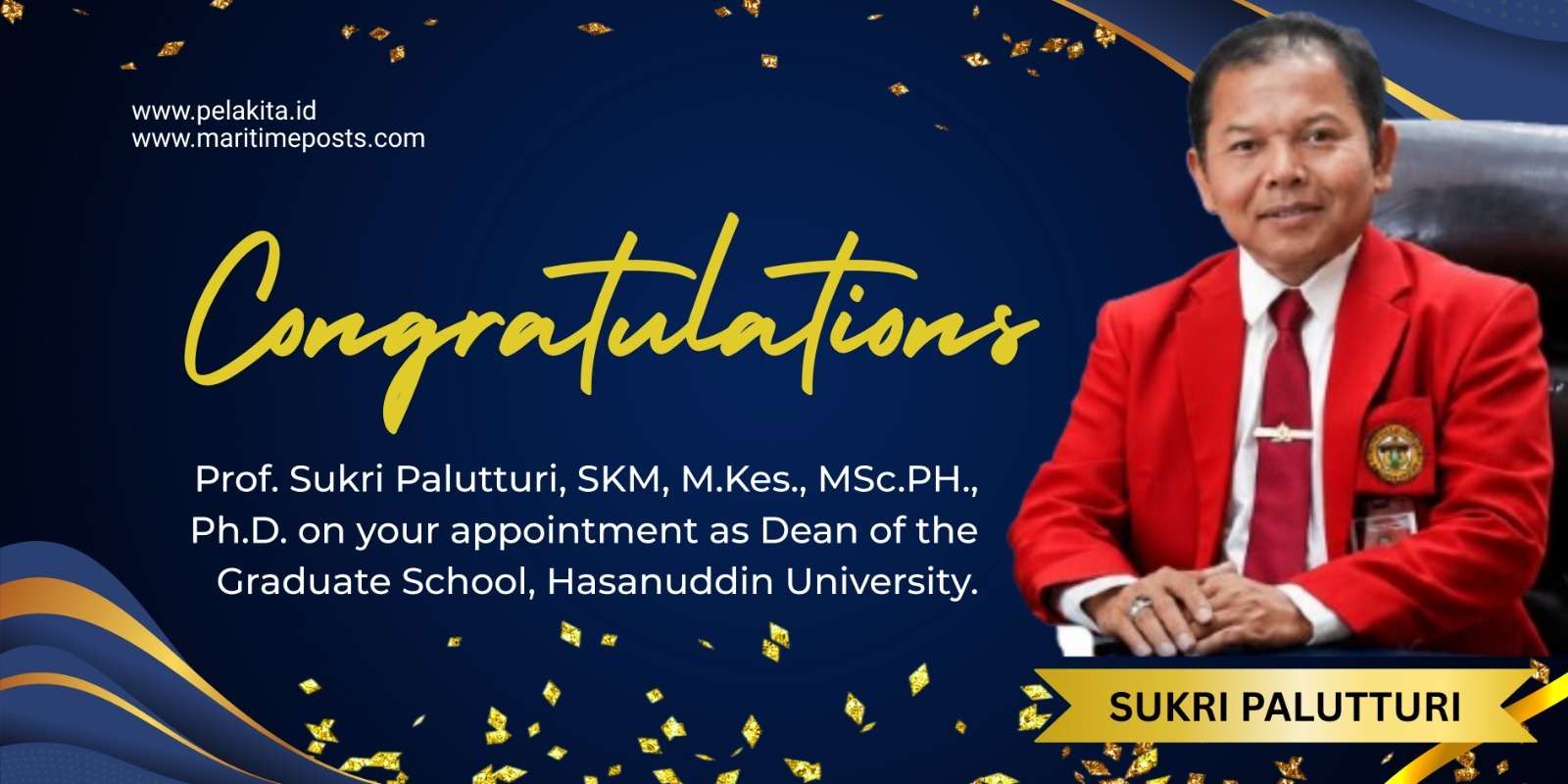
MARITIMEPOSTS.COM – The appointment of Prof. Sukri Palutturi, SKM, M.Kes., MSc.PH., Ph.D. as Dean of the Graduate School of Hasanuddin University (Unhas) on July 7, 2026, marks a new chapter in higher education leadership at one of Eastern Indonesia’s most prestigious universities.
Widely recognized as a Professor of Health Policy and former Dean of the Faculty of Public Health (FKM) at Hasanuddin University, Prof. Sukri has been entrusted with steering the Graduate School through his extensive experience in academia, research, and institutional governance.
His appointment is expected to further strengthen the Graduate School as a leading center for multidisciplinary education and research.
His selection is far from incidental. Over more than two decades, Prof. Sukri has established himself as a prolific academic, accomplished researcher, and visionary leader who has significantly elevated the Faculty of Public Health into one of Indonesia’s foremost public health institutions.
His contributions extend well beyond lecture halls and research laboratories. He has played an influential role in shaping health policy, advancing the Healthy Cities movement, and fostering international academic collaboration.
From Hasanuddin University to Australia
Prof. Sukri Palutturi was born in Tanatoa, South Sulawesi, on May 29, 1972. His educational journey reflects a lifelong commitment to public health.
He earned his Bachelor of Public Health (SKM) in 1998 and Master of Health (M.Kes.) in 2002 from the Faculty of Public Health at Hasanuddin University.
Driven by a desire to broaden his global perspective, he pursued graduate studies at Griffith University, Australia, where he obtained a Master of Science in Public Health (MSc.PH.) in 2009, followed by a Doctor of Philosophy (Ph.D.) in 2013 through the Centre for Environment and Population Health.
In 2022, he further strengthened his strategic leadership capacity by completing the 63rd Regular Education Program (PPRA LXIII) at Indonesia’s National Resilience Institute (Lemhannas RI).
His academic career has advanced steadily since joining Hasanuddin University as a permanent faculty member in 2001. Throughout the years, he has held several key leadership positions, including Secretary of the Department of Health Administration and Policy, Vice Dean for Student Affairs, Alumni, and Partnerships, before serving as Dean of the Faculty of Public Health from 2022 to 2026.
In 2017, he was inaugurated as a Full Professor, becoming one of Hasanuddin University’s youngest professors at the time.
A Legacy of Transforming Public Health Education
Prof. Sukri’s greatest legacy at Hasanuddin University lies not merely in the positions he has held, but in the institutional transformation he has led.
Under his leadership, the Faculty of Public Health has become increasingly recognized as a national center for evidence-based public health policy development.
He has consistently encouraged faculty members and students to produce research that goes beyond academic publication, serving instead as a foundation for government policymaking on issues such as National Health Insurance (JKN), stunting prevention, primary healthcare services, and environmental health.
Another defining legacy is his pioneering work in promoting the Healthy Cities concept across Indonesia.
Through partnerships with local governments, he has contributed to developing healthy city indicators, strengthening community participation, and helping numerous municipalities earn the prestigious Swasti Saba National Award.
His approach views public health not simply as a hospital-centered responsibility but as the outcome of collaboration among multiple sectors—including environmental management, education, urban planning, economic development, and active citizen participation.
Within the university, Prof. Sukri has also championed institutional reform. One of his key initiatives was advancing the establishment of an Integrity Zone toward achieving Corruption-Free (WBK) and Clean and Service-Oriented Bureaucracy (WBBM) status within the Faculty of Public Health.
His commitment to transparency, academic excellence, and bureaucratic reform has made the faculty one of Hasanuddin University’s leading examples of good governance.
An Internationally Recognized Scholar
Prof. Sukri is equally known for his impressive scholarly productivity.
He holds a Scopus H-index of 12 with more than 2,100 citations, while his Google Scholar H-index stands at 25.
His research spans a wide range of fields, including health politics, health administration, stunting, primary healthcare, environmental health, and the integration of Bugis local philosophy into modern healthcare systems.
Beyond publishing numerous scientific papers, he has authored several influential books widely used by students and public health practitioners. His publications include Health is Politics, Public Health Leadership, Health Politics: Theory and Practice, Healthy Cities: Global Concept, Local Implementation for Indonesia, and Indonesia’s War Against COVID-19.
These works demonstrate his commitment to bridging academic theory with practical public policy.
National and International Contributions
Prof. Sukri’s influence reaches well beyond academia.
Nationally, he has served as a respected expert and keynote speaker on health policy development, the Healthy Living Community Movement (GERMAS), strengthening Indonesia’s National Health Insurance (JKN) system, and improving primary healthcare services.
Internationally, he has participated in conferences and collaborative forums across Australia, Malaysia, Thailand, Nepal, Tunisia, Switzerland, and several other countries, focusing on Healthy Cities, urban health governance, and cross-sector collaboration to improve public well-being.
Leading Hasanuddin University’s Graduate School
Entrusted by Rector Prof. Jamaluddin Jompa to lead Hasanuddin University’s Graduate School, Prof. Sukri’s appointment is widely seen as the natural continuation of his distinguished leadership journey.
His responsibilities extend beyond enhancing the quality of master’s and doctoral programs. He is expected to strengthen multidisciplinary research, expand international partnerships, increase high-impact scholarly publications, and foster innovations that address Indonesia’s pressing development challenges.
With his extensive experience as an academic, researcher, administrator, and institutional leader, Prof. Sukri Palutturi is well positioned to elevate the Graduate School’s competitiveness on both the national and global stage.
His appointment represents more than a change in leadership—it symbolizes the continuation of Hasanuddin University’s commitment to excellence in higher education, research, and innovation, reinforcing its position as one of Indonesia’s premier academic institutions.
Editorial Team