
MARITIMEPOSTS.COM – In every successful community development initiative, scientific research project, or participatory planning process, one principle remains constant: good decisions begin with good information. Yet information does not simply appear.
It must be carefully observed, thoughtfully gathered, critically analyzed, and translated into collective action.
Whether working in environmental conservation, public health, education, disaster management, or rural development, three foundational skills distinguish effective practitioners from ineffective ones: fact observation, fact-based interviewing, and analysis and facilitation for decision-making.
Together, these skills form a continuous learning cycle. Observation helps us understand reality. Interviews reveal the human experiences behind observable facts. Analysis transforms data into knowledge, while facilitation enables groups to convert knowledge into informed decisions.
These competencies are not merely technical tools—they are essential practices rooted in decades of research across the social sciences, management, and participatory development.
Fact Observation: Learning to See What Is Really There
Observation is one of humanity’s oldest methods of learning. Long before written records existed, people understood their environment by carefully watching seasons, animal behavior, weather patterns, and human interactions.
Modern observation follows the same principle but applies systematic methods.
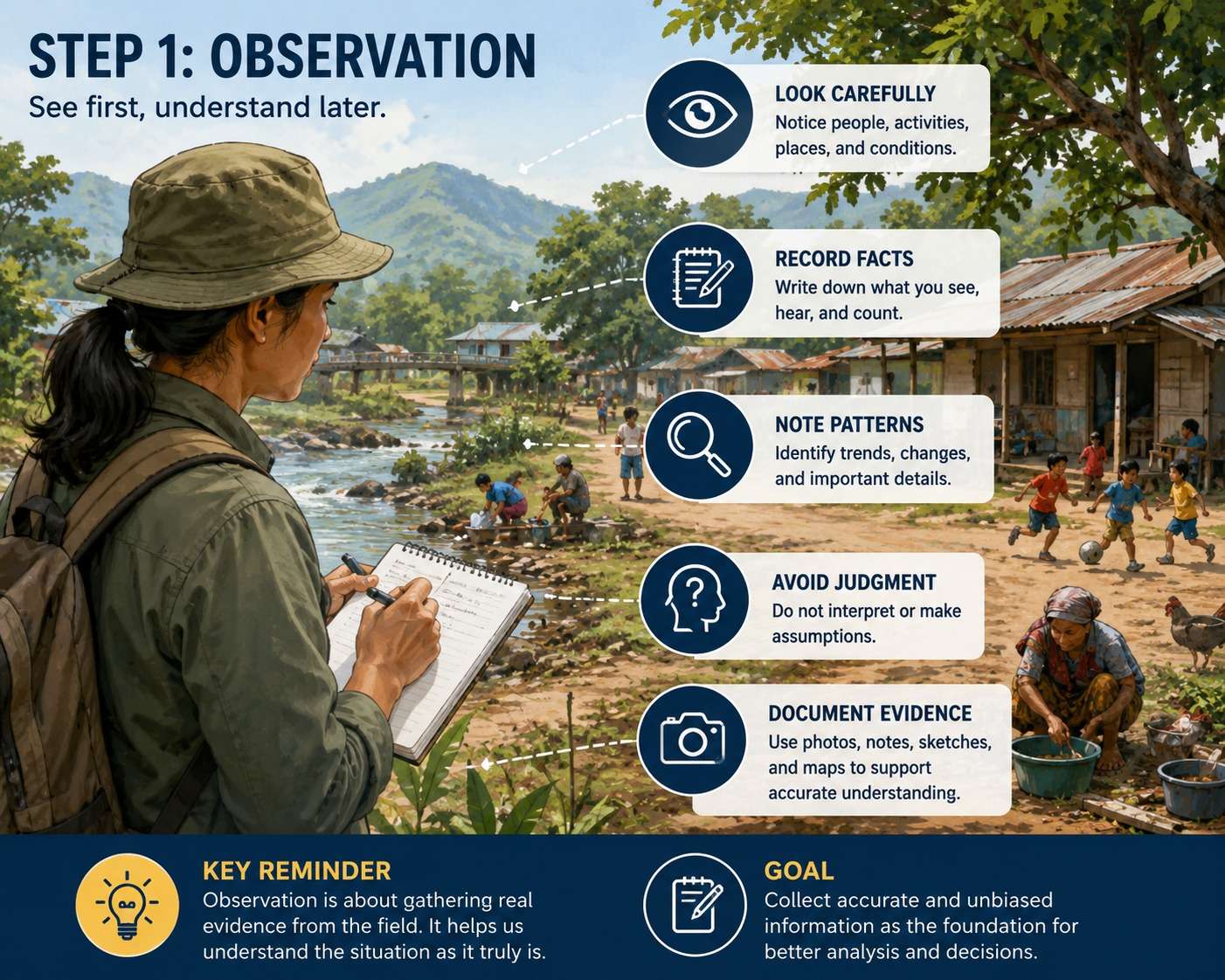
Observation means collecting evidence directly from reality rather than relying on assumptions or hearsay. It requires practitioners to distinguish between facts and interpretations.
For example, saying “the village is poor” is an interpretation. Saying “twenty-five houses have damaged roofs, three wells are dry, and only one health clinic serves five villages” is observation.
The distinction is crucial.
The American psychologist Carl Rogers emphasized that effective understanding begins with accurate perception rather than premature judgment. Similarly, management scholar Peter Drucker famously argued that “what gets measured gets managed.” Without careful observation, planners often solve the wrong problems.
Observation skills include:
- noticing physical conditions;
- identifying patterns and trends;
- documenting evidence objectively;
- recognizing what is absent as well as what is present; and
- avoiding personal bias.
Development practitioners often refer to this as “seeing before concluding.”
Participatory Rural Appraisal (PRA), developed by Robert Chambers, relies heavily on observation. Chambers argued that outsiders frequently misunderstand local realities because they observe too quickly and speak too much. Effective facilitators first watch, listen, and learn before offering solutions.
Observation therefore becomes the foundation of evidence-based action.
Fact-Based Interviewing: Understanding the Human Story Behind the Data
Observation tells us what is happening.
Interviews help explain why.
Even the most detailed observations cannot fully reveal people’s motivations, experiences, fears, or aspirations. This understanding emerges only through meaningful conversation.
Interviewing is far more than asking questions.
It is the art of creating trust so that people feel comfortable sharing accurate information.
The sociologist Earl Babbie, one of the leading authorities on social research methods, describes interviewing as a systematic conversation designed to gather reliable information while minimizing bias.
Good interviewers ask open-ended questions rather than leading questions.
Instead of asking:
“You don’t like this program, do you?”
they ask:
“How has this program affected your daily life?”
The difference is profound.
Fact-based interviewing seeks evidence rather than confirmation of existing beliefs.
Experts generally recommend several principles:
- listen more than you speak;
- avoid interrupting;
- ask follow-up questions;
- verify information from multiple sources;
- separate facts from opinions; and
- respect local knowledge.
The communication scholar Stephen Covey summarized this principle beautifully in The 7 Habits of Highly Effective People:
“Seek first to understand, then to be understood.”
This habit is fundamental to effective interviewing.
In community development, interviews often uncover invisible realities that statistics alone cannot reveal.
A declining fish catch, for example, may initially appear to result from overfishing. Interviews with local fishers, however, might reveal pollution, changing currents, damaged mangroves, or conflicts over fishing grounds.
Without interviewing, planners risk addressing symptoms instead of causes.
Analysis and Facilitation: Turning Information into Collective Decisions
Collecting information is only the beginning.
The real challenge lies in interpreting evidence and helping groups make informed decisions.
Analysis involves organizing observations and interview findings into meaningful patterns.
Questions commonly include:
- What problems appear repeatedly?
- Which issues are most urgent?
- What evidence supports each conclusion?
- What alternative explanations exist?
- What solutions are realistic?
Critical thinking plays an essential role during this stage.
The educator John Dewey argued that reflective thinking enables people to move beyond immediate impressions toward reasoned judgment.
Similarly, economist Herbert Simon, Nobel Prize winner and pioneer of decision science, explained that effective decisions depend upon gathering sufficient information before selecting among alternatives. While people rarely possess perfect information, systematic analysis significantly improves the quality of decisions.
Yet even the best analysis has little value if stakeholders cannot agree on a way forward.
This is where facilitation becomes indispensable.
Facilitation is the process of helping groups think together, communicate respectfully, evaluate evidence, and reach shared decisions.
Unlike a lecturer, a facilitator does not provide all the answers.
Instead, the facilitator creates conditions in which participants discover answers collectively.
Organizational development expert Sam Kaner, author of Facilitator’s Guide to Participatory Decision-Making, argues that high-quality decisions emerge when diverse perspectives are openly discussed rather than suppressed.
Effective facilitators encourage participation, manage conflict constructively, summarize key points, and guide groups toward consensus based on evidence rather than authority.
This process strengthens both decision quality and community ownership.
Integrating the Three Skills
These three competencies are not independent.
They reinforce one another in a continuous cycle:
Observe → Interview → Analyze → Facilitate → Decide → Learn.
Weak observation produces incomplete data.
Poor interviews generate unreliable information.
Faulty analysis leads to ineffective solutions.
Weak facilitation results in decisions that lack legitimacy and public support.
Conversely, when all three skills are practiced together, organizations become more adaptive, communities become more engaged, and policies become more responsive to real needs.
Conclusion
Observation, interviewing, and analysis with facilitation are far more than professional techniques. They represent a disciplined way of understanding reality before attempting to change it.
As Robert Chambers reminded development practitioners, effective change begins by putting the last first—listening carefully to those whose voices are often overlooked.
Peter Drucker emphasized measuring what matters. Stephen Covey taught the importance of understanding before persuading. John Dewey highlighted reflective inquiry, while Sam Kaner demonstrated that inclusive dialogue produces better decisions.
Together, their lessons converge on a simple but powerful truth: better decisions come from better evidence, and better evidence comes from skilled observation, thoughtful interviewing, and collaborative analysis.
In an increasingly complex world, these three foundational skills remain among the most valuable competencies anyone can develop—whether they are researchers, teachers, extension workers, government officials, community leaders, or students seeking to solve real-world problems.
___
References
- Babbie, E. (2021). The Practice of Social Research.
- Chambers, R. (1997). Whose Reality Counts? Putting the First Last.
- Covey, S. R. (1989). The 7 Habits of Highly Effective People.
- Kaner, S. (2014). Facilitator’s Guide to Participatory Decision-Making.
- Patton, M. Q. (2015). Qualitative Research & Evaluation Methods.
- Simon, H. A. (1977). The New Science of Management Decision.
- Creswell, J. W., & Poth, C. N. (2018). Qualitative Inquiry and Research Design.