
MARITIMEPOSTS.COM – For millions of people worldwide, the day does not truly begin until the first sip of coffee. While this ritual feels personal and local, the liquid in your cup is often the product of a massive, sophisticated economic engine located thousands of miles away.
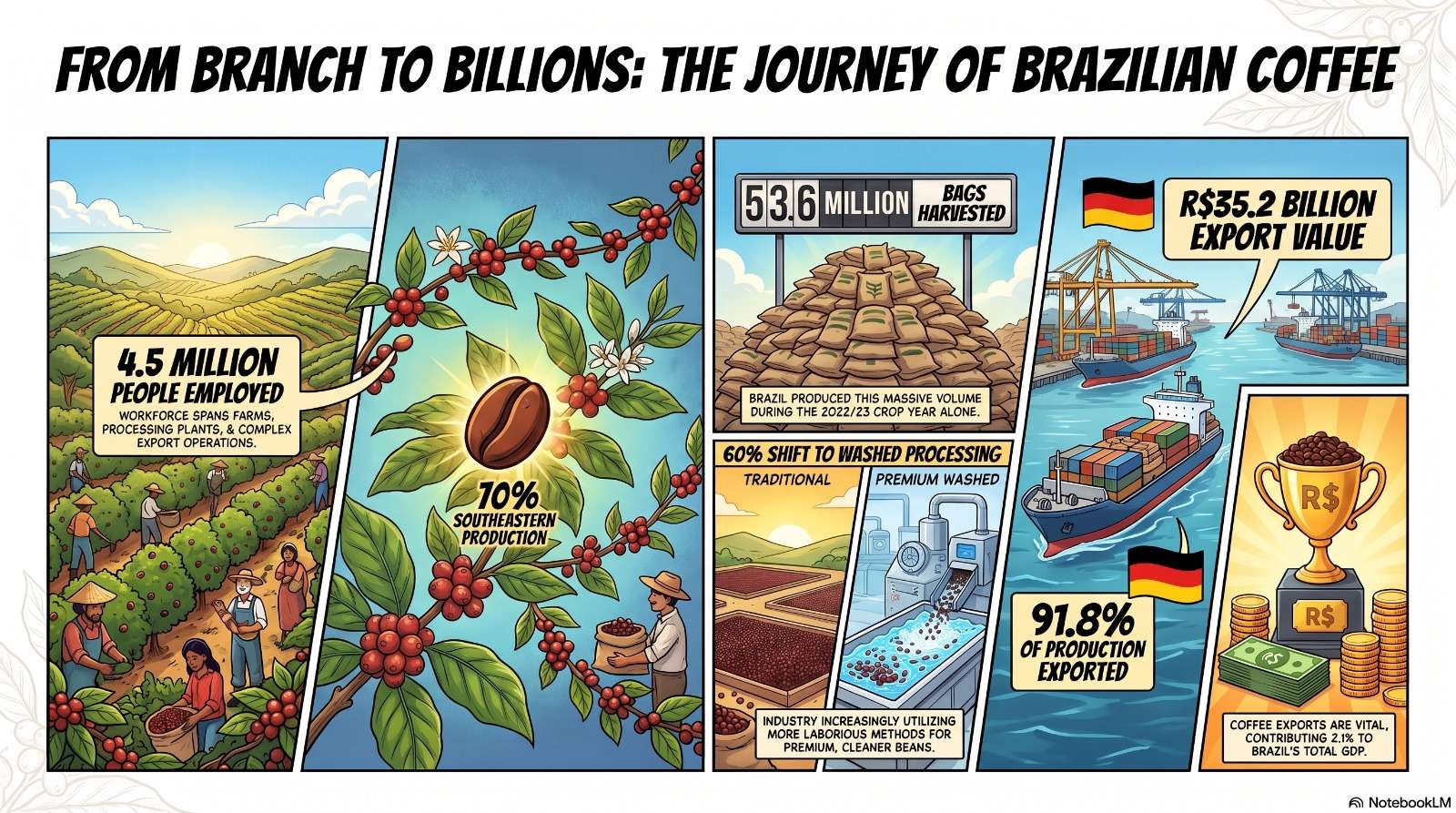
Brazil is not merely a coffee producer; it is the world’s primary provider, yielding a staggering 53.6 million bags in the 2022/23 crop year.
This industry is a cornerstone of the Brazilian economy, driving employment, influencing international trade, and dictating global supply with unparalleled gravity.
The German Connection: A Surprising Destination
While many consumers might assume the United States or Italy serves as the primary hub for Brazilian beans, the trade data reveals a more complex reality. In the 2022/23 period, Germany emerged as Brazil’s top export destination, absorbing 12% of total volume, narrowly edging out the United States at 11%.
The scale of this export operation is breathtaking. Brazil exported 49.2 million 60kg bags last year, meaning that 91.8% of its total production is destined for the global market.
European demand, in particular, dictates the pace of Brazilian production. The European Union collectively imports 32% of Brazil’s exports, and recent trends show a 10% increase in volume to the EU driven by a pivot toward higher sustainability standards.
This highlights Brazil’s role not just as a bulk supplier, but as an agile partner responsive to the tightening regulatory requirements of the Global North.
Beyond the Cup: Coffee as a Currency Mover
The coffee sector is far more than an agricultural pursuit; it is a vital macroeconomic force. In 2022/23, coffee exports contributed 2.1% to Brazil’s total GDP, generating approximately US6.9 billion (R35.2 billion) in value. The industry is a massive social stabilizer, supporting 4.5 million people across the supply chain, from rural smallholders to urban logistics experts.
Perhaps the most striking evidence of coffee’s power is its direct influence on the national currency. For currency traders, the bean is a bellwether: a 10% increase in global coffee prices typically leads to a 0.5% appreciation of the Brazilian Real.
“While a Brazilian coffee bean may journey from a farmer earning modest wages to become a minor but mighty pillar of the national economy, employing millions and even swaying currency values, it underscores a brew of profound socio-economic importance percolating far beyond the morning cup.”
The Science of the Sip: The Rise of Washed Processing
Brazil is currently navigating a strategic shift in processing to capture more value in the specialty market. Historically known for the “Natural” method, the industry is increasingly embracing more intensive techniques:
- Washed (60%): Now the most prevalent method, producing the clean, bright acidity preferred by premium roasters.
- Natural/Dry (30%): The traditional method, prized for fruitier, heavy-bodied profiles.
- Honey (10%): A specialized hybrid method gaining traction for its unique sweetness.
As an analyst, I see this as a clear move toward margin protection. While “Washed” coffee costs roughly US5 per bag to process compared to US3 for “Natural,” the investment is justified by the expansion of the specialty sector—which has grown from 8% to 12% of total production since 2019.
With an average profit of US40 per bag, the extra US2 in processing cost is a minor toll for entry into the high-value specialty tier. However, a significant “value-add” gap remains: 95% of exports are still green (unroasted) coffee. The next frontier for the Brazilian engine lies in moving further down the value chain into domestic roasting and finished goods.
The Yield Gap: Brazil’s Untapped Potential
Despite its current dominance, Brazil is operating well below its theoretical ceiling. In 2022/23, the average yield was 3,800 kg per hectare, yet the estimated potential stands at 5,000 kg per hectare. This represents a 26% “yield gap.”
The economic implications are massive. If Brazil were to close this gap and reach its full potential, it could represent an additional US$1.8 billion in export value for the national economy.
For the global market, this untapped capacity represents the world’s most significant safety net for price stability. Even with current inefficiencies, the country saw an 8.2% production increase year-over-year, proving that Brazil’s upward trajectory is far from plateauing.
A Tale of Two Regions: Southeast vs. Northeast
The geography of Brazilian coffee is a study in economic and botanical contrasts. The industry is anchored in the Southeast (Minas Gerais, São Paulo, Rio de Janeiro), which produces 70% of the national crop.
This region is the heartland of Arabica, where favorable climates allow farmers to earn up to 50% more than their counterparts in other regions. Minas Gerais alone contributes 35% of the nation’s total output.
In contrast, the Northeast (including Bahia and Ceará) accounts for 25% of production and is increasingly defined by the hardier Robusta variety, which makes up 70% of the region’s crop. These farmers face a harsher reality; due to lower yields and the commodity nature of Robusta, they often earn 30% less than the national average. While the Southeast fears the frost, the Northeast is constantly battling erratic rainfall and prolonged droughts.
“While the south rests on its refined, high-quality laurels and the drought-plagued northeast bets its beans on hardy Robusta, the coffee crown remains firmly—and rather heavily—upon the southeastern brow of Minas Gerais, whose vast, mature plantations humbly produce over a third of the nation’s caffeinated wealth.”
The Future of the Brew
The trajectory for the Brazilian coffee engine is clear: a relentless march toward 55 million bags by 2025 and a sophisticated transition from volume to value. By narrowing the yield gap and expanding specialty processing, Brazil is proving that it can brew a richer, more profitable cup for its citizens and the world alike.
As you enjoy your next cup, consider the 4.5 million workers whose livelihoods depend on those beans. How does your choice of a morning brew impact the economic divide between the high-tech plantations of Minas Gerais and the resilient Robusta farms of the Northeast? Your daily ritual is, in fact, the fuel for one of the most vital agricultural engines on the planet.
Source: https://worldmetrics.org/brazil-coffee-production-statistics/