
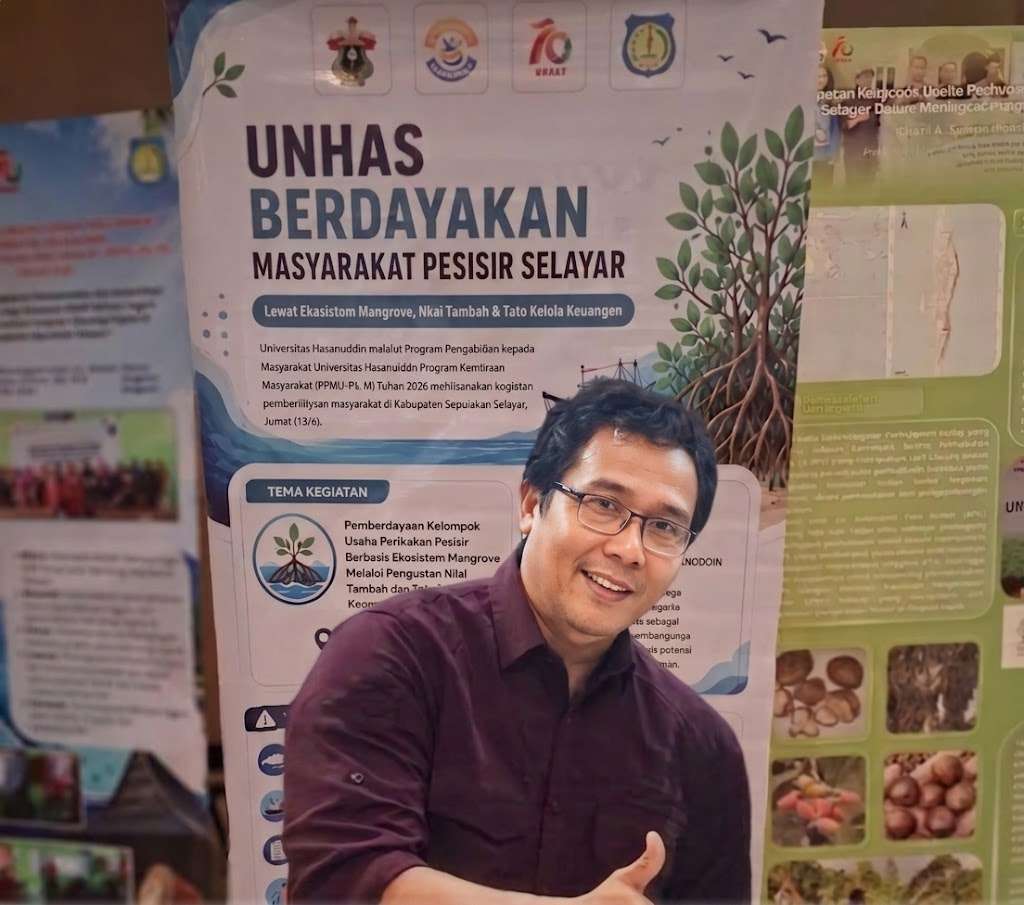
Hasanuddin University’s community engagement programme in Bontosunggu shows why healthy ecosystems, stronger local enterprises and coastal prosperity must be developed together.
MARITIMEPOSTS.COM – SELAYAR, INDONESIA — To the untrained eye, a mangrove forest can appear to be little more than an inconvenient stretch of mud and tangled roots—land that is wet, difficult to access and, perhaps, waiting to be cleared for something considered more productive.
That perception is not only misleading. It can be economically disastrous.
A mangrove ecosystem is far from an “empty space”. It is living natural infrastructure: a nursery for fish and other marine species, a protective barrier for coastlines, a source of livelihood and an ecological foundation supporting the economies of coastal communities.
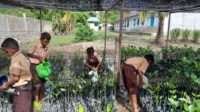
In Bontosunggu Village, Bontoharu District, Kepulauan Selayar Regency, South Sulawesi, a community engagement team from Hasanuddin University (Unhas) is helping local communities rethink that relationship.
Led by Prof. Abdul Rasyid Jalil, widely known as Prof. Cido, the University Community Service Programme (PPMU) team consists of five lecturers and five students. Their work brings together two issues that are too often treated separately: ecosystem protection and local economic development.
The central idea is straightforward, but its implications are profound: communities are more likely to protect nature when healthy ecosystems become a visible and sustainable source of prosperity.
From “Swamp” to Natural Capital
For generations, mangroves have often been undervalued. They have been described as swamps, wastelands or undeveloped areas—places that would supposedly become more valuable if converted for other uses.
But beneath their dense canopies and intricate root systems lies a highly productive ecological economy.
Mangrove roots provide shelter and feeding grounds for juvenile fish, shrimp, crabs and numerous other species. In effect, the ecosystem functions as a natural nursery that supports fisheries and the livelihoods connected to them.
When mangroves are degraded, the consequences extend well beyond the forest itself. Fish populations may decline, coastal vulnerability can increase, and communities can face the economic costs of losing an ecosystem that quietly supported their livelihoods for generations.
Prof. Cido argues that this requires a fundamental change in perspective.
“Mangroves should not be seen as empty spaces waiting to be converted, but as natural capital with long-term economic value.”
The language of natural capital is particularly important. It helps move the discussion beyond conservation as an abstract environmental objective and toward a clearer understanding of economic risk.
Destroying a productive ecosystem is not simply an environmental issue that can be placed outside the balance sheet. It is the loss of an asset.
The consequences may initially remain invisible, but they eventually appear in declining fisheries, increased coastal damage, falling incomes and higher costs for restoration and adaptation.
Protecting mangroves, therefore, is not an obstacle to development. It is an investment in the ecological infrastructure on which long-term development depends.
Beyond Extraction: Creating More Value with Less Pressure
One of the greatest challenges facing coastal economies is dependence on the extraction of raw natural resources.
When fishers and producers sell products with limited processing and low added value, their incomes remain vulnerable to fluctuating prices. Under such conditions, increasing income often means increasing the volume of extraction.
The economic logic becomes dangerous for the ecosystem: earn more by taking more.
The PPMU Unhas programme in Bontosunggu promotes a different direction.
Rather than encouraging communities to depend solely on increasing the volume of production, the programme strengthens local capacity to develop higher-value products, improve processing, enhance packaging and build stronger community-based enterprises.
The objective is to shift the economic equation from volume to value.
When a community earns more value from each unit of production, it may reduce the pressure to continuously increase extraction. Better processing and stronger business management can create wider economic benefits while allowing ecosystems more space and time to regenerate.
This is where conservation and enterprise development become part of the same strategy.
A healthy mangrove ecosystem supports coastal resources. Those resources can support local economic activity. Stronger enterprises can generate higher and more stable incomes. And greater economic security can reduce the pressure on communities to over-exploit the ecosystem.
The challenge is not simply to produce more.
It is to create more value from existing resources while reducing the ecological pressure created by the pursuit of short-term income.
Why Bookkeeping Can Help Protect a Forest
At first glance, financial administration and mangrove conservation may seem unrelated.
Yet one of the most important aspects of the programme in Bontosunggu is the attention given to financial literacy and business management among community enterprises.
The programme involved 32 participants from four community business groups, focusing on strengthening administrative capacity and financial management.
This includes basic but essential skills: separating personal and business finances, recording transactions, calculating production costs, monitoring cash flow and understanding whether an enterprise is actually making a profit.
These may appear to be routine administrative tasks. In reality, they can have important environmental implications.
A business that does not understand its own costs and income may experience repeated cash shortages. When financial pressure becomes acute, short-term extraction often becomes the easiest response.
Take more fish. Harvest more. Cut more. Expand more.
Financial literacy can help break this cycle.
When communities understand the actual performance of their businesses, they are better positioned to plan, save, reinvest and make decisions based on long-term economic sustainability rather than immediate necessity.
In this sense, sound financial management becomes part of environmental governance.
A community cannot be expected to protect its natural resources indefinitely if the enterprises supporting local households are structurally weak.
The lesson from Bontosunggu is therefore significant: economic resilience and ecological resilience are deeply interconnected.
Building a Coastal Economy That Supports Conservation
The work in Bontosunggu also demonstrates that lasting environmental protection cannot depend on a single institution.
Universities can provide research, knowledge and technical innovation. Governments can create supportive policies and programmes. Communities, however, remain the primary actors who live with and manage the consequences of environmental change.
This collaboration can be understood as a triple-helix approach, bringing together universities, government and communities.
Hasanuddin University contributes knowledge transfer, research-based approaches, innovation and human resources. The Selayar Fisheries Department provides policy support and institutional alignment. Meanwhile, the community of Bontosunggu plays the central role as the owner of local knowledge, economic activity and stewardship of the coastal environment.
This model represents a shift away from purely top-down conservation.
Environmental protection cannot rely only on prohibitions, restrictions and enforcement. These remain important, but long-term conservation becomes far more sustainable when communities see a direct connection between ecological health and their own economic wellbeing.
Zul Janwar, Head of the Selayar Fisheries Department and an alumnus of the Faculty of Marine Sciences and Fisheries at Hasanuddin University, underlines the importance of this approach.
“What is far more important is ensuring that the trees that have grown remain alive, the ecosystem continues to function, and the community benefits from the existence of a healthy environment—especially in Selayar’s mangrove greenbelt.”
The emphasis is crucial. Planting trees is only the beginning. The real measure of success is whether those trees survive, whether the ecosystem continues to function, and whether local communities develop sufficient incentives and capacity to protect them.
A mangrove programme that ends with the ceremonial planting of seedlings but fails to ensure their survival is incomplete. A successful programme is one in which the ecosystem becomes integrated into the social and economic life of the community.
A Model Beyond Bontosunggu
The experience in Bontosunggu offers a broader lesson for coastal development in Indonesia and beyond.
Sustainable development is often discussed as a balance between environmental protection and economic growth. Yet this framing can be misleading because it suggests that nature and prosperity are opposing priorities.
In reality, many coastal economies cannot remain prosperous without healthy ecosystems.
Mangroves protect the natural productivity of coastal waters. Coastal resources support fisheries and community enterprises. Better-managed businesses can generate more value with less ecological pressure. Stronger incomes can create the conditions for long-term environmental stewardship.
The system is interconnected.
This is what makes the Bontosunggu approach potentially relevant beyond Selayar. It provides a practical model for integrating ecological restoration, livelihood development, financial literacy, community empowerment and collaborative governance.
The model does not treat mangroves as scenery to be protected from a distance.
It recognises them as productive natural assets around which stronger and more resilient local economies can be built.
For coastal communities facing the combined pressures of climate change, resource depletion and economic uncertainty, this perspective may become increasingly important.
The future of coastal development will depend not only on how much nature communities can protect, but also on whether they can build economic systems that make environmental protection worthwhile and sustainable.
The roots of a mangrove forest may be hidden beneath the water and mud. So, too, are many of the ecosystem services that sustain coastal prosperity.
The challenge for policymakers, universities, businesses and communities is to make those invisible connections visible—and to ensure that development does not destroy the very natural capital on which it depends.
In Bontosunggu, the lesson is beginning beneath the mangrove canopy: the healthiest coastal economies may not grow by clearing their natural assets, but by understanding, protecting and creating greater value from them.