
One of the clearest messages from the data is that affordability remains the primary driver of fish consumption in Indonesia. The fish species occupying the top ranks are generally inexpensive, easy to find in traditional markets, and familiar in daily household cooking.
MARITIMEPOSTS.COM – An infographic released by Indonesia’s Ministry of Marine Affairs and Fisheries (KKP) on “Fish Consumer Preferences 2025” offers more than just statistics.
Behind the numbers lies a deeper story about Indonesia’s food culture, economic realities, fisheries structure, and the future direction of national food security.
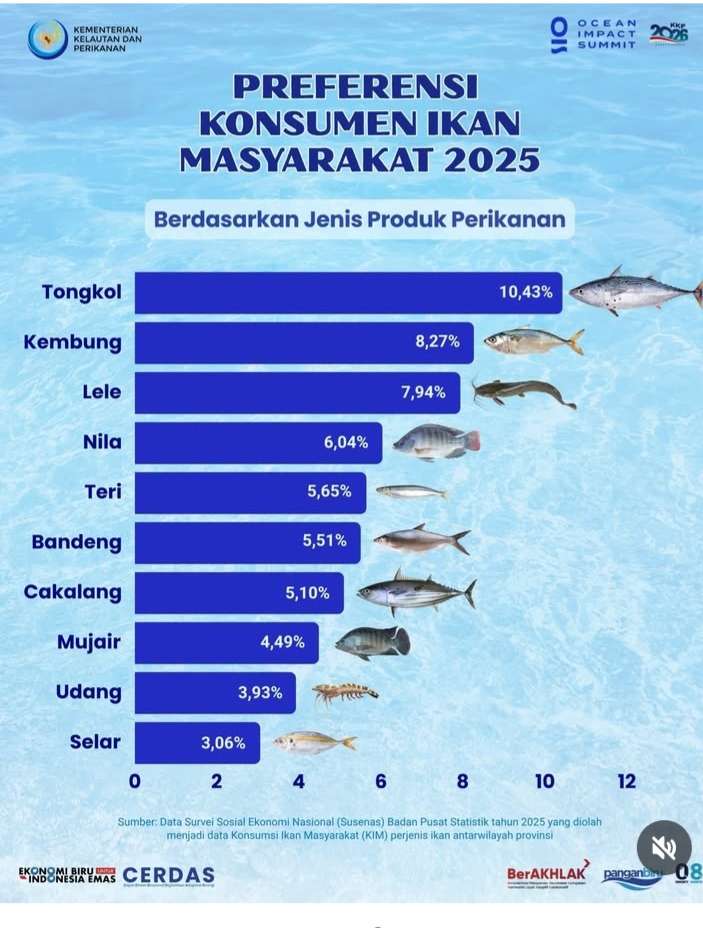
Based on data from the 2025 National Socio-Economic Survey (Susenas) processed into the Indonesian Fish Consumption (KIM) dataset, the infographic shows the types of fish most preferred by Indonesian consumers.
At the top of the list is Tongkol with 10.43%, followed by Kembung at 8.27%, Lele at 7.94%, and Nila at 6.04%.
At first glance, the rankings may appear ordinary. But they actually reveal important insights into how Indonesians consume seafood and how the fisheries sector continues to evolve.
Affordable Fish Still Dominate the Indonesian Table
One of the clearest messages from the data is that affordability remains the primary driver of fish consumption in Indonesia. The fish species occupying the top ranks are generally inexpensive, easy to find in traditional markets, and familiar in daily household cooking.
Tongkol, for example, has long been a staple protein source for millions of Indonesian families. Its popularity reflects not only taste preferences but also accessibility. The same pattern applies to kembung and lele, which are widely available across urban and rural areas.
This suggests that Indonesian consumers continue to prioritize practical and economical food choices amid fluctuating economic conditions. Fish that are easy to process, cook, and distribute naturally gain a stronger position in the domestic market.
Small Pelagic Fish Remain the Backbone of National Nutrition
The strong presence of tongkol, kembung, selar, and teri in the rankings highlights the continued importance of small pelagic fisheries in Indonesia’s food system.
These species are not merely commodities; they are essential sources of affordable animal protein for millions of households. Their dominance underscores the critical role of small-scale fishers and coastal fishing communities in maintaining national food resilience.
In this context, policies aimed at protecting traditional fishers, improving cold-chain infrastructure, and ensuring sustainable fish stocks become increasingly important for Indonesia’s long-term nutritional security.
Aquaculture Is Becoming More Strategic
Another interesting trend is the strong position of freshwater aquaculture products such as lele, nila, and mujair. Their inclusion among the most preferred fish indicates that aquaculture is no longer a secondary sector but a strategic pillar of Indonesia’s food future.
Compared to marine fisheries, aquaculture offers more controlled production systems and relatively stable supply chains.
As climate change and ocean uncertainties intensify, fish farming could become increasingly important in ensuring consistent protein availability.
The rising popularity of freshwater fish also reflects changing consumer behavior, especially in urban areas where farmed fish are often more accessible and affordable.
Export Commodities Are Not Always Domestic Favorites
One surprising insight from the infographic is the relatively low ranking of Udang, which stands at only 3.93%.
This is notable because shrimp is one of Indonesia’s most valuable seafood export commodities. The contrast reveals an important economic reality: products with high export value do not necessarily dominate domestic consumption.
Shrimp tends to be more expensive and is often associated with restaurants, processed foods, or export markets. Meanwhile, everyday consumers continue to rely more heavily on affordable local fish species.
A Reflection of Indonesia’s Diverse Culinary Culture
The infographic also serves as a cultural map of Indonesia’s food habits. Different fish species reflect regional culinary traditions and local identities.
Bandeng remains closely associated with Java, while Cakalang reflects the strong seafood culture of Eastern Indonesia. Lele dominates urban street-food ecosystems, while teri continues to support low-cost household nutrition.
In many ways, fish consumption patterns mirror Indonesia itself: diverse, regionally rooted, and strongly connected to local ecosystems.
Opportunities for the Value-Added Seafood Industry
The dominance of affordable fish species also opens enormous opportunities for downstream seafood industries. Products such as canned fish, fish nuggets, shredded fish, frozen seafood, and ready-to-eat meals could expand significantly if supported by innovation and investment.
Species like tongkol, lele, nila, and bandeng are especially promising for value-added processing due to their stable supply and broad consumer acceptance.
This aligns with Indonesia’s broader goal of strengthening domestic food industries while increasing the economic value of fisheries products.
Beyond Consumption: A Roadmap for the Future
Ultimately, the “Fish Consumer Preferences 2025” infographic is more than a list of favorite fish. It is a snapshot of Indonesia’s socio-economic realities, nutritional priorities, and fisheries transformation.
The data suggests that the future of Indonesia’s fisheries sector will not depend solely on export performance. It will also depend on strengthening domestic food systems, supporting small-scale fishers, expanding sustainable aquaculture, and developing innovative seafood industries that meet the needs of a growing population.
In the end, the story behind Indonesia’s fish preferences is also the story of how a maritime nation feeds itself, adapts to change, and prepares for the future.