
This piece is a synthesis of a lecture delivered by Prof. Saleh Ali, M.Sc., Professor of Agriculture at Hasanuddin University, in a Graduate School of Development Studies class on the Indonesian Maritime Continent. It reopens a long-folded layer of awareness.
MARITIMEPOSTS – Indonesia, with all its geographical grandeur, is not merely an archipelagic state. It is a civilization shaped from the very beginning by the sea—by currents, winds, and the courage to cross horizons.
Amid this reality, a fundamental question arises: why is our maritime identity fading?
This paradox is palpable. Two-thirds of Indonesia’s territory is ocean, yet our development orientation and mindset remain largely land-centric.
We appear like a nation turning its back on the sea, even though it is where the pulse of our history began. In the past, the greatness of Nusantara did not rest on vast land, but on the ability to master the seas.
Great kingdoms such as Sriwijaya and Majapahit stand as clear evidence.
They were not merely political entities, but maritime powers capable of controlling international trade routes. The key to their success lay in their courage to embrace the sea as a living space, not a boundary.
Furthermore, this glory was not mere historical romanticism. It was the result of advanced technology and well-developed systems.
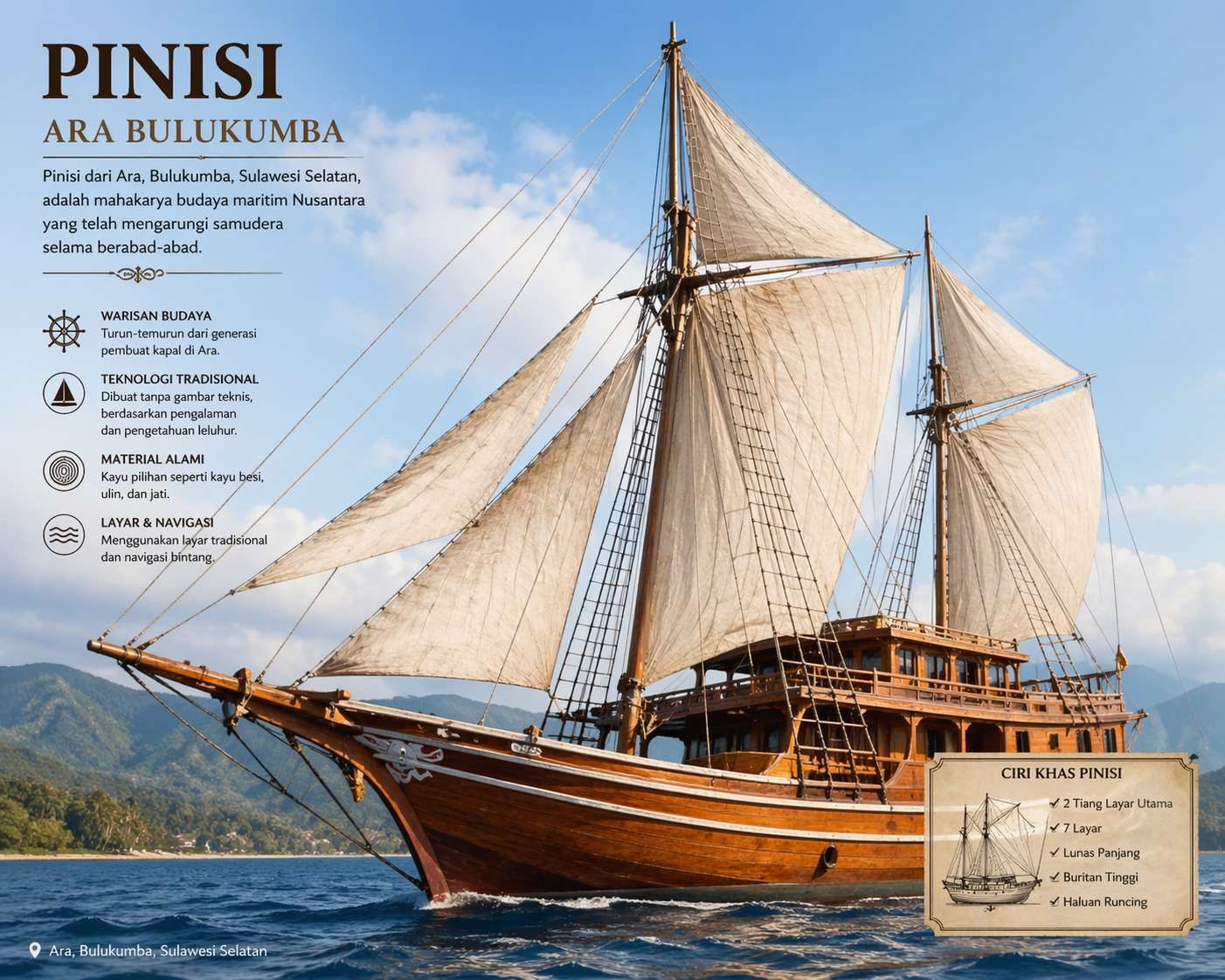
Reliefs at Borobudur Temple depict outrigger ships capable of navigating vast oceans. Nusantara sailors had mastered star-based navigation long before modern technology, reaching India, the Middle East, and even Africa.
The maritime ecosystem at the time was also highly sophisticated. Ports such as Sunda Kelapa served as hubs of global trade.
The role of the “Orang Laut” communities as guardians of the waters reflects an organized maritime security system. All of this affirms that Nusantara was once a respected center of maritime civilization.
Interestingly, Majapahit demonstrated a unique model of land-sea integration. Although based inland, the kingdom utilized rivers such as Brantas River and Bengawan Solo as primary logistical routes to the sea.
These rivers functioned as “highways” connecting agrarian production centers with maritime trade networks.
According to Saleh Ali, ports such as Tuban and Gresik evolved into dynamic economic centers. From these nodes, Majapahit expanded its reach across Nusantara and into Southeast Asia.
At its peak during the reign of Hayam Wuruk, Majapahit did not merely trade—it controlled the spice trade routes, the most valuable commodities of the time. Its strategies included territorial expansion, tribute systems, and strict maritime law enforcement. The sea was not only an economic space, but also a domain of power.
So, where did the turning point occur?
History shows that colonialism, particularly under the Dutch East India Company and the Dutch East Indies government, systematically shifted the nation’s orientation. An independent maritime economy was transformed into an agrarian system focused on export commodities. The sea was no longer the center of life, but the periphery.
This legacy persists today. Java-centric development, the migration of coastal communities inland, and limited maritime infrastructure have widened the gap between the nation and its seas.
As Prof. Saleh notes, we now face multiple paradoxes: an archipelagic state dependent on imports, underutilized marine wealth, and a struggling national shipping sector.
Beyond that, there is an intangible loss: the erosion of identity. Traditional maritime knowledge is fading, and with it, the pride of being a seafaring nation.
Yet history delivers a clear message. The glory of Nusantara has always been directly proportional to its ability to manage the seas. The integration of land and sea is not an option—it is a foundation.
Prof. Saleh Ali’s lecture serves as a reminder that Indonesia is, in essence, a Maritime Continent—an entity that cannot be understood solely from a land-based perspective. The sea is both its past and its future.
Today, we stand at a crossroads. Will we continue to turn our backs on the sea, or dare to face it once more?
This question is not merely historical reflection. It is a call to determine Indonesia’s future direction—whether to remain a spectator in its own oceans, or to reclaim its role as the helmsman of civilization.
Editor: K. Azis