
MARITIMEPOSTS.COM — Universities are often seen as “ivory towers”—grand institutions that produce complex theories yet feel distant from the sweat of fishermen at sea. There is a clear divide between air-conditioned classrooms and the harsh realities of coastal waves.
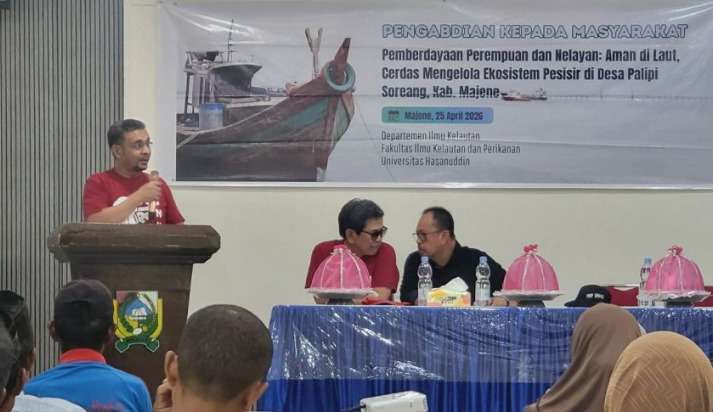
However, the situation felt different on Saturday, April 25, 2026. That divide collapsed in Palipi Soreang Village, Majene Regency.
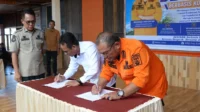
The Department of Marine Science at Hasanuddin University (Unhas) demonstrated that the most valuable knowledge is grounded knowledge, through a concrete initiative titled “Empowering Women and Fishermen: Safe at Sea, Smart in Managing Coastal Ecosystems.”
One of the most striking aspects of the Unhas Marine Science team’s approach was their intellectual humility.
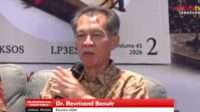
The Head of the Department of Marine Science, Prof. Dr. Rahmadi Tambaru, M.Si, emphasized that the relationship between academics and village communities must be equal.
Fishermen who engage with the sea daily possess empirical understanding—a “natural laboratory”—that is not always found in textbooks. The synergy between scientific theory and field experience is the key to sustainable community development.
“We are here not to lecture or patronize, but to share. What we know and have researched, we want to share and implement with the community. On the other hand, the community—especially fishermen—certainly has a wealth of experience and real problems at sea that they can share with us,” Prof. Rahmadi explained.
Amid increasingly challenging global economic dynamics, the role of universities is required to evolve.
The Dean of the Faculty of Marine and Fisheries Sciences (FIKP) Unhas, Prof. Dr. Mahatma Lanuru, M.Sc—an academic trained at Kiel University, Germany—brings global standards of expertise to address local problems.
He stressed that universities must now deliver direct impact (real intervention) rather than focusing solely on theoretical research publications.
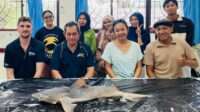
Imagine the scale: more than 20 experts, ranging from lecturers to postgraduate students, “descended to the field” to serve a village covering just 4.12 square kilometers.
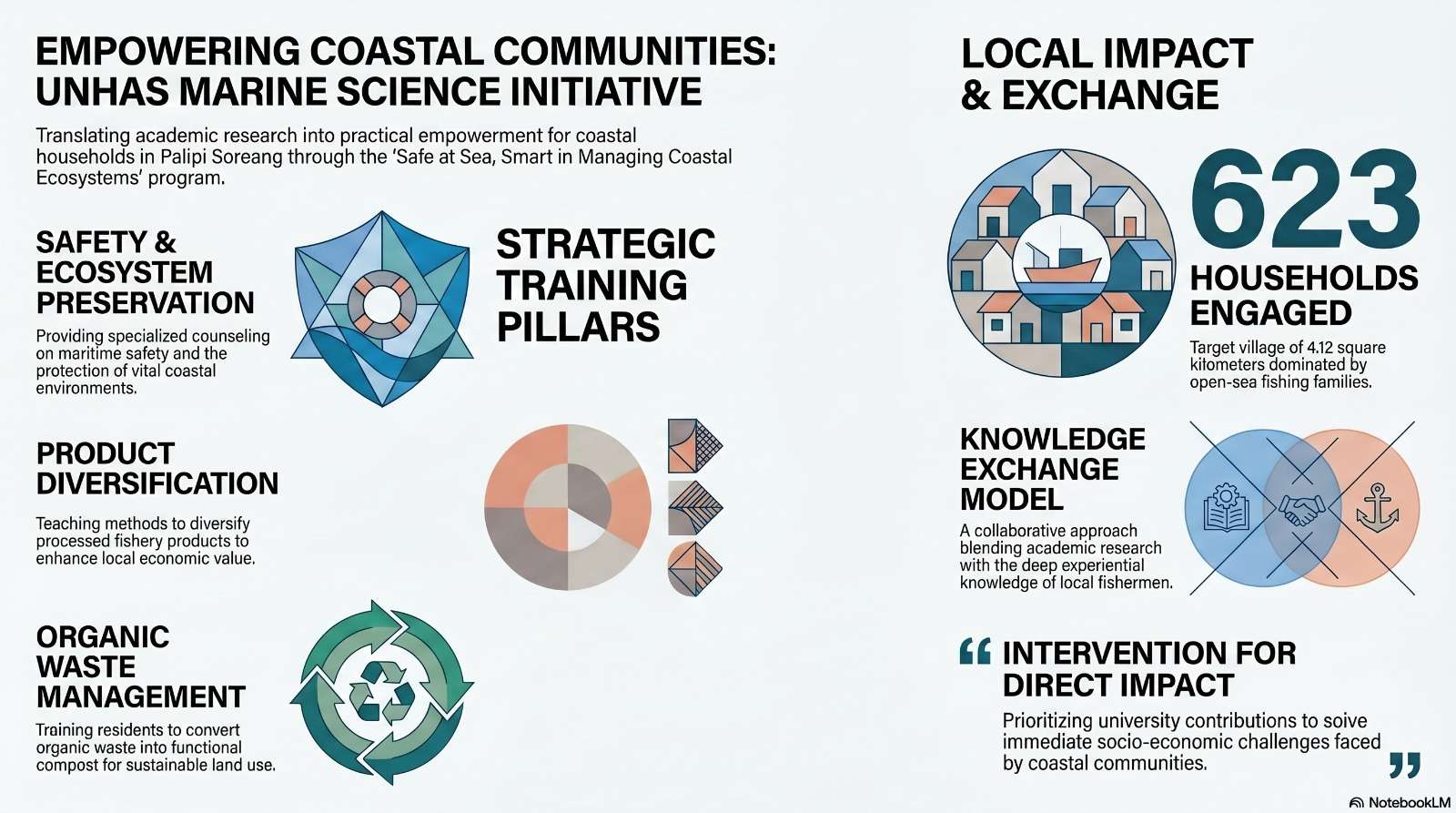
With a population of 623 households, this high ratio of experts to residents reflects Unhas’ seriousness in delivering precise economic interventions through maritime expertise.
So how does this economic intervention materialize in practice? It is manifested in three practical pillars designed to address the most pressing challenges in Majene’s coastal areas.
Innovations Reaching Unexpected Sectors
In collaboration with the Head of Palipi Soreang Village, Wardin Wahid, SH, the Unhas team focused on three parallel working groups. These innovations go beyond technical training—they are science-based solutions:
Fisher Safety and Ecosystem Conservation Education
Ensuring the safety of fishermen at sea while providing scientific understanding that protecting coral reefs and seagrass beds is a long-term investment in sustaining fish stocks.Diversification of Fishery Products
Training women’s groups to transform fish catches into value-added products. Economically, this diversification is crucial to stabilize household income, which often fluctuates with the volatile price of raw fish.Organic Waste Processing into Compost
A key step in building a circular economy. Scientifically, composting in coastal areas serves a dual function: reducing waste that would otherwise become marine debris and preventing excessive nutrient runoff (especially nitrogen) into the sea, which can disrupt coastal ecosystem balance.
A Relaxed Atmosphere: High-Level Knowledge with Warm Laughter
Community empowerment often fails when delivered in overly formal and rigid ways. In Palipi Soreang, the atmosphere was refreshingly relaxed.
Technology transfer and safety education were delivered casually, filled with laughter, yet rich in substance.
This warm and sociable approach proved far more effective in building emotional connection. When communities feel comfortable and respected, important messages about marine innovation are more easily accepted and implemented in daily life. This is the essence of successful science communication: breaking down walls of formality to build bridges of understanding.
Dear readers, the activities in Palipi Soreang Village represent a model for the future of Indonesia’s maritime collaboration.
When academic intellectuals bring global standards to sit side by side with field practitioners, our long-hidden maritime potential can truly flourish.
This smart intervention proves that universities can serve as real driving forces, transforming coastal villages into communities that are both economically resilient and ecologically sustainable.
Reflecting on this successful collaboration, a question arises for all of us: if a small village can transform through the right application of knowledge, are we willing to begin dismantling our own “ivory towers” of privilege to help strengthen the local ecosystems around us?
Editor: Denun