
He had secured accolades from prestigious institutions, including San Diego State University and Dresden University in Oslo. These international endorsements were the catalyst that finally turned local heads, including the Ministry of Communication and Digital Affairs (Komdigi).
MARITIMEPOSTS.COM – On May 4, 2026, the courtyard of the Pinrang Regent’s office in South Sulawesi was a study in profound contrasts.
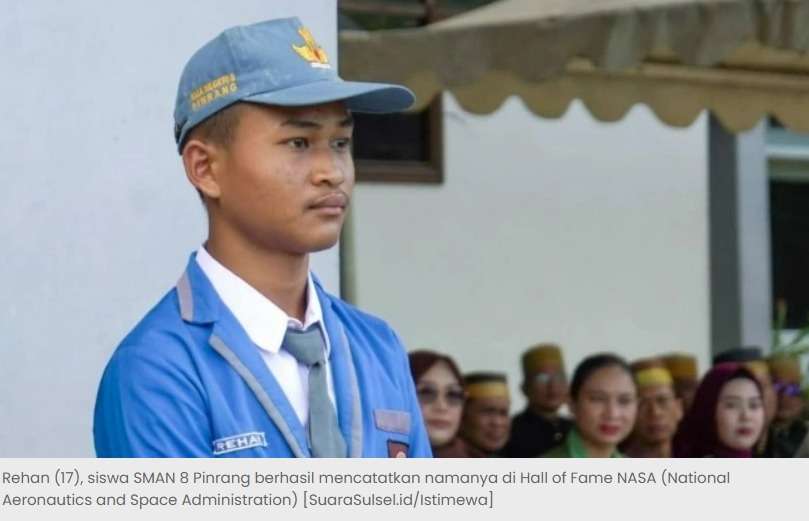
Rows of students stood in their Baju Seragam—the crisp, standard school uniforms of Indonesia—to commemorate National Education Day. Among them was Rehan, a 17-year-old whose unassuming presence masked a feat of digital architecture that has stunned the global cybersecurity community.
While his peers were focused on local exams, Rehan’s name was being etched into the NASA Hall of Fame.
This teenager from a remote regency, armed with little more than curiosity and a persistent internet connection, had successfully navigated the defenses of the world’s most prestigious space agency.
It is a story that redefines the “hacker” archetype, proving that human grit can dismantle the complexities of elite digital infrastructure from the most unexpected places.
The “YouTube University” Effect
Rehan’s gateway to the stars was not a high-tech laboratory or an elite private academy; it was a flickering five-inch smartphone screen.
His journey began in the second year of junior high school, where he transformed YouTube into a private university.
Before he ever touched a laptop keyboard, Rehan was mastering the syntax of code and the logic of penetration testing through a mobile device.
This transition from a consumer of content to a high-level bug hunter is the ultimate testament to the democratization of information.
In the modern era, passion acts as a solvent, dissolving the traditional gatekeepers of institutional knowledge. Rehan didn’t wait for a curriculum to be handed to him; he studied the scars of the internet to learn how to heal them.
“I often see leaked websites. From there I learned how to fix it.”
The Philosophy of Digital Imperfection
The achievement that landed Rehan in the NASA Hall of Fame was born from the Vulnerability Disclosure Program (VDP).
In April 2026, Rehan identified a critical flaw in a NASA subdomain that allowed for the unauthorized takeover of usernames. While NASA’s reputation for security is legendary, Rehan approached the system with a clinical, almost philosophical detachment.
His success was predicated on a fundamental truth: complexity breeds vulnerability.
Rehan understood that no organization, regardless of its multi-billion-dollar budget or elite personnel, is immune to the “human factor” in code. By accepting that every digital fortress has a crack, he found the one flaw that tens of thousands of other researchers had overlooked.
“I know that no digital system is truly perfect.”
The Visibility Gap in Traditional Education
There is a jarring disconnect between Rehan’s global status and his everyday life at SMAN 8 Pinrang.
His principal, Handia Asyik, candidly admitted that the school initially categorized Rehan as an “ordinary” student. To the academic system, he was a face in the crowd; to the digital world, he was a virtuoso.
This reveals a significant recognition divide in traditional education. Academic metrics—attendance, general testing, and standard curriculum—frequently fail to capture specialized digital talents.
In a village located 250 kilometers from the tech hub of Makassar, Rehan’s genius existed in a blind spot, hidden because he was being measured by an outdated yardstick that values conformity over specialized brilliance.
Global Validation vs. Local Constraints
Before the local government recognized his talent, the international academic world had already verified Rehan’s capabilities.
He had secured accolades from prestigious institutions, including San Diego State University and Dresden University in Oslo. These international endorsements were the catalyst that finally turned local heads, including the Ministry of Communication and Digital Affairs (Komdigi).
The scale of Rehan’s social mobility is staggering when viewed against his family background.
As the son of a construction worker and a housewife, Rehan’s ascent into the NASA Hall of Fame represents a triumph over geographic and economic gravity. His story suggests that international recognition is often the only way for students from humble backgrounds to force their way into the sightlines of their own local bureaucracies.
From Bug Hunter to National Shield
Despite his proven ability to find the “holes” in global systems, Rehan’s ultimate ambition is defensive. He has set his sights on becoming a cybersecurity expert dedicated to protecting Indonesian government infrastructure.
Having identified vulnerabilities in domestic domains, he views his skills not as a weapon of disruption, but as a necessary tool for national resilience.
There is a powerful, inspiring irony here. The “bug hunter” who could have easily used his talents for personal gain or digital mischief is instead choosing to become a guardian of the state. Rehan’s desire to pivot from finding flaws to building shields illustrates a sense of civic duty that matches his technical prowess, proving that the best defenders are often those who know exactly how a system breaks.
Beyond the Hall of Fame
Rehan’s induction into the NASA Hall of Fame is more than a personal milestone; it is a signal of a shifting global landscape where talent is universal, but opportunity is not.
He remains a vocal advocate for equal access to education and facilities, hoping his journey will inspire a more equitable distribution of resources for children in remote areas.
As we look at the 17-year-old student from Pinrang who outsmarted a space agency, we are forced to confront a haunting question: How many other hidden geniuses are currently sitting in remote classrooms, waiting only for an internet connection and a spark of curiosity to change the world?
Rehan has shown us that the next great digital breakthrough may not come from a Silicon Valley boardroom, but from a quiet village in South Sulawesi.