

As a son of Bugis-Makassar heritage, he firmly upholds the seafaring philosophy: “Pura Babbara Sompe’ku, Pura Tangkisi Gulikku, Kualeanggi Tallanga Na Toalia”—once the sails are set, there is no turning back to shore.
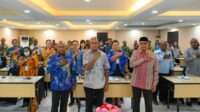
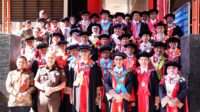
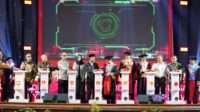
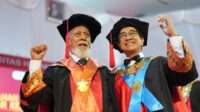
MARITIMEPOSTS.COM — In his opening remarks, the Rector of Hasanuddin University, Jamaluddin Jompa, expressed his appreciation and respect to all invited guests who attended the historic moment of his inauguration for a second term (2026–2030).
He emphasized that their presence was not merely ceremonial, but a symbol of collective commitment in carrying out the constitutional mandate: to educate the nation.
According to him, leading Hasanuddin University (Unhas) is akin to captaining a large ship sailing across an ocean full of challenges.
As a son of Bugis-Makassar heritage, he firmly upholds the seafaring philosophy: “Pura Babbara Sompe’ku, Pura Tangkisi Gulikku, Kualeanggi Tallanga Na Toalia”—once the sails are set, there is no turning back to shore.
Post-Pandemic Resilience and Collective Strength
His leadership journey, which began in 2022, unfolded amid the pandemic. Yet, he sees that crisis as a testament to the resilience of the Unhas academic community in adapting and innovating.
From this emerged a key strength: adaptive and progressive human capital.
He stressed that Unhas’ achievements are not the result of individual effort, but of collaboration free from sectoral ego. This principle is reinforced by theological and cultural values, including a reference to Surah As-Shaff verse 4 on the importance of unity and discipline.
Local values such as Sipakainge, Sipakalebbi, and Sipakatau—also studied by Mattulada—serve as the foundation of organizational culture. From these values arises the spirit: “Unhasku Bersatu, Unhasku Kuat” (My Unhas United, My Unhas Strong).
Legacy and Global Leap in Achievements
Over the past four years, Unhas has recorded significant milestones:
- Ranked #951–1000 in QS World University Rankings 2026
- Ranked #201 in QS Asia University Rankings
- Ranked #601–800 in Times Higher Education Asia
- Recognized in QS by Subject:
Agriculture & Forestry (#251–300), Politics (#301–400), Medicine (#601–650) - Ranked #85 globally in UI GreenMetric
- Ranked #52 globally for SDG-14 (Life Below Water)
In addition, Unhas received:
- SNI Award (Gold) for two consecutive years (2023–2024)
- “Informative” status from the Central Information Commission
- 1st Place in Indonesia SDGs Action Awards 2025 by Bappenas
Students, Innovation, and Institutional Independence
Student achievements also stand out. Unhas won the Grand Champion title at PIMNAS in 2024 and 2025, and for the first time in history, brought the Adikarta Kertawidya Trophy outside Java Island.
In innovation:
- Smart farming drones ordered by the Ministry of Agriculture
- Bulletproof vests passed testing by Infantry Division 3 Kostrad
- Electric vehicles and solar-powered fishing boats developed
- Agro-products such as superior corn, Alope chicken, chocolate, and premium coffee reached global markets
Meanwhile, through PT Hadin Metavisi Akademika, Unhas strengthened its financial independence, including transforming Bank Unhas into a digital banking service.
Commitment to Inclusivity and Human Resources
The Rector reaffirmed a firm commitment: no student should drop out due to financial constraints. As of 2026:
- More than 39,900 students have received scholarships
- 28% of Unhas students are scholarship recipients
In terms of human resources:
- 730 permanent staff appointed (2025)
- 393 employees granted legal employment status
Strategic Direction: Toward the Global Top 500
Looking ahead, Unhas aims to enter the Top 500 QS World University Rankings by 2030, with strategies including:
- 500 lecturers pursuing overseas studies
- 200 international visiting scholars
- Expansion of double/joint degree programs
- Increasing international student ratio to 2%
Research is also being consolidated through:
- 315 Thematic Research Groups (TRG)
- 1,523 researchers
- 532 international partners across 77 countries
Unhas also serves as co-lead of the PAIR Sulawesi consortium with the Australia-Indonesia Centre, advancing policy-driven research on circular economy, climate change, and public health.
Major Transformation: Innovation, Campus, and Sustainability
To strengthen research commercialization:
- Development of a Science Techno Park (STP)
- Expansion of spin-offs and university venture capital
In education:
- Launch of UNHAS WORKLINC (Work Integrated Learning)
In governance:
- Implementation of Smart Multi-Campus Governance across regions (from Gowa to the new capital, IKN)
In sustainability:
- Development of Green Campus Masterplan 2026–2030
- Target of 50% green buildings and energy efficiency
- Integration of ESG (Environmental, Social, Governance) principles
A Call for Unity and Personal Closing
In closing, Prof. Jompa highlighted that global higher education challenges—as noted by McKinsey & Company—require universities to be adaptive, relevant, and impactful.
He called on all elements of Unhas to set aside sectoral ego and strengthen collaboration to realize the vision of Indonesia Emas 2045.
On a personal note, he expressed heartfelt gratitude to his family—his parents, siblings, wife, children, and grandchildren—for their unwavering support.
He concluded by quoting Nelson Mandela:
“Education is the most powerful weapon which you can use to change the world.”
The speech ended with a powerful call:
“Unhasku Bersatu! Unhasku Kuat!” and a prayer that all efforts may be blessed by Almighty God.
Editor: Denun