
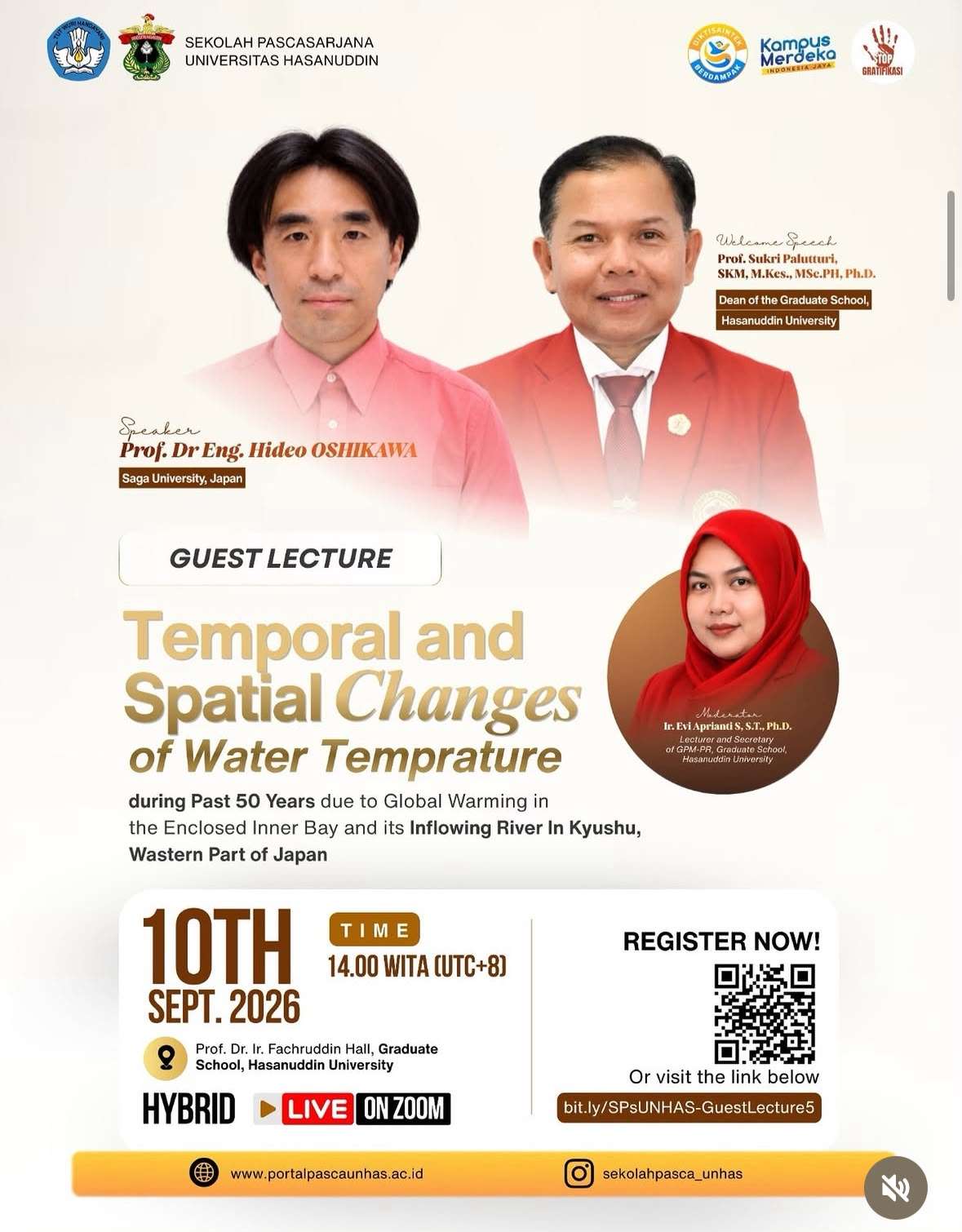
MARITIMEPOSTS.COM— Makassar, September 10, 2026 — The Graduate School of Hasanuddin University (Unhas) hosted an international guest lecture titled “Temporal and Spatial Changes of Water Temperature during the Past 50 Years due to Global Warming in the Enclosed Inner Bay and Its Inflowing River in Kyushu, Western Part of Japan.”
The event featured Prof. Dr. Eng. Hideo Oshikawa from Saga University, Japan, as the keynote speaker.
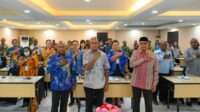
The guest lecture was held in a hybrid format at the Prof. Dr. Ir. Fachruddin Hall, Graduate School of Hasanuddin University, and was also streamed online via Zoom.
Beginning at 2:00 p.m. Central Indonesia Time (WITA), the session was moderated by Ir. Evi Aprianti, S.T., Ph.D., and attended by students, lecturers, researchers, and participants interested in climate change, aquatic environments, and natural resource management.
Dean of the Graduate School of Hasanuddin University, Prof. Sukri Palutturi, S.KM., M.Kes., M.Sc.PH., Ph.D., expressed his support for the event as part of efforts to strengthen internationalization and promote multidisciplinary research at Unhas.
According to Prof. Sukri, climate change is a global challenge that requires contributions from multiple academic disciplines and higher education institutions.
“Climate change is not merely about rising air temperatures. It also affects aquatic ecosystems, environmental health, coastal communities, and the sustainability of development. Therefore, universities need to encourage research capable of producing scientific evidence as a foundation for policymaking,” Prof. Sukri said.
He added that international guest lectures provide an important platform for students and researchers to learn about scientific developments while building global collaborative networks.
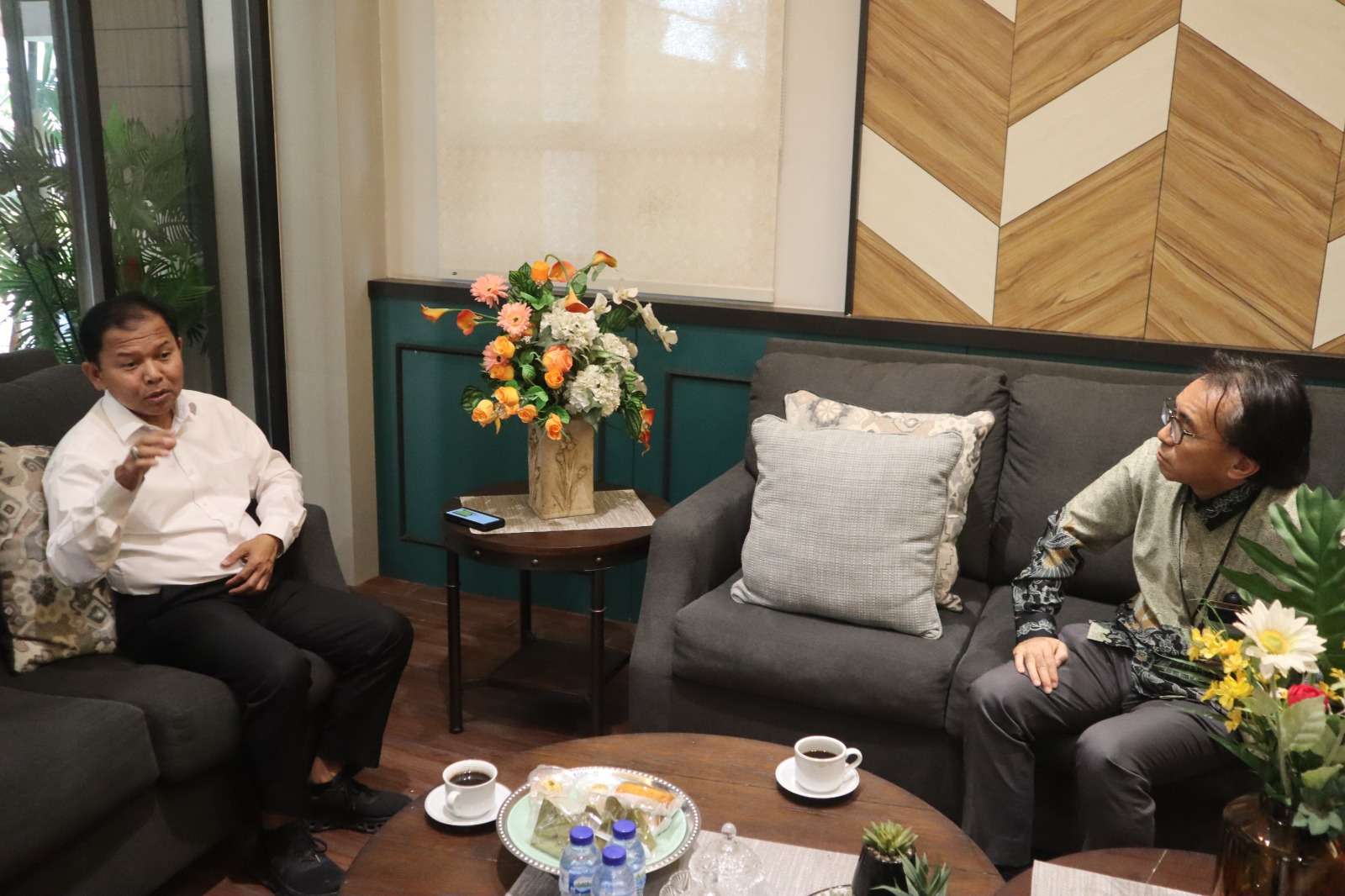
In his presentation, Prof. Hideo Oshikawa discussed temporal and spatial changes in water temperature over approximately 50 years in an enclosed inner bay and the river flowing into the area in Kyushu, western Japan.
The long-term study provides insights into how global warming can affect the thermal characteristics of rivers, estuaries, and interconnected coastal areas.
According to Prof. Oshikawa, changes in water temperature do not necessarily occur uniformly across locations and periods.
Such variations are influenced by a range of factors, including the geographical characteristics of water bodies, river flows, seawater exchange, seasonal patterns, and changes in ambient temperatures.
“Long-term data are essential for understanding the direction of environmental change. Without consistent observations, it is difficult to distinguish natural variability from changes that are genuinely associated with global warming,” he explained.
He also emphasized that changes in water temperature can affect water quality, ecosystem balance, the distribution of aquatic organisms, and the productivity of coastal resources.
Relatively enclosed bays require particular attention because they have more limited water circulation and may therefore face greater environmental pressures. For this reason, analysis needs to be conducted through an integrated approach that considers the interconnectedness of rivers, estuaries, bays, and the sea.
The event also provided an opportunity to discuss the importance of sustainable environmental monitoring systems, the management of historical datasets, and the use of spatial and temporal approaches in climate change research.
Participants also gained insights into how research findings from Japan could provide valuable lessons for Indonesia, an archipelagic country with extensive coastal areas and significant exposure to various climate-related risks.
Prof. Sukri expressed hope that the event would encourage joint research between Hasanuddin University and universities in Japan, particularly in the fields of climate change, coastal management, environmental quality, and sustainable development.
“Environmental challenges transcend geographical and national boundaries. We need international collaboration to share data, methodologies, experience, and innovations in developing stronger solutions,” Prof. Sukri concluded.