
MARITIMEPOSTS.COM — Hasanuddin University (Unhas) and The University of Queensland (UQ), Australia, have agreed to strengthen their longstanding collaboration, which has been ongoing for several years.
The academic collaboration currently includes double-degree programs in International Relations and Communication Studies.
Several Unhas students have already completed their studies and graduated from UQ after completing their undergraduate theses in Indonesia.
The double-degree program operates under a 2+2 system, in which students spend two years studying at Unhas before becoming full-time students for four semesters at UQ’s St Lucia campus.
The collaboration will continue to expand to include double-degree programs in Development Economics and Management, as well as other study programs that have achieved the highest level of accreditation.
This commitment was reaffirmed on the sidelines of the IndOz Conference in Brisbane on September 1, 2026.
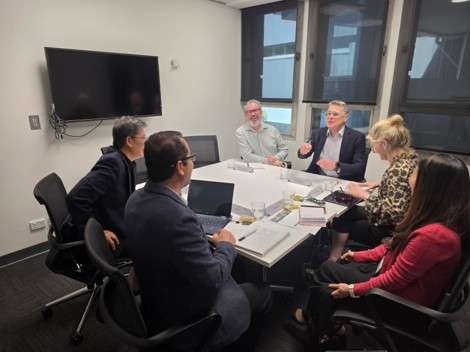
The Dean of the Faculty of Public Health (FKM) at Unhas, Ansariadi, PhD, together with Unhas Director of Communications, Dr. Sawedi Muhammad, met with Deputy Head of the School of Public Health at UQ, Associate Professor Paul Gardiner, and UQ Pro Vice-Chancellor (Global Partnerships), Professor Brett Lovegrove.
During the meeting, the two institutions discussed a number of potential areas for collaboration, including plans to jointly submit a proposal under the New Colombo Plan (NCP) in 2027.
FKM Unhas offered several programs for students from UQ’s School of Public Health, including an introduction to Indonesia’s health care system, community-based health interventions such as posyandu (community health posts), and participation in the Free Health Check (Cek Kesehatan Gratis/CKG) program currently being implemented by the Indonesian Government.
“These programs are expected to provide new experiences for UQ students participating in the NCP. In addition, Unhas offers a range of other programs that UQ students can explore, including forest conservation in Kajang, traditional Pinisi boatbuilding in Bulukumba, and silk weaving in Sengkang,” said Ansariadi.
UQ also highly appreciated the initiative launched by Unhas through the Emerging Public Health Research Talent and Postdoctoral Program of the FKM faculty.
Through this program, young FKM lecturers who have completed their master’s degrees have the opportunity to undertake a two- to three-month research internship at UQ under the supervision of senior researchers.
During the internship, the young lecturers will write scientific articles while participating in a number of training activities at UQ. Under the Postdoctoral Program, FKM lecturers will also conduct research and develop scientific publications at UQ, while having the opportunity to supervise master’s and doctoral students at the university.
The two institutions also discussed opportunities for double-degree programs, international exposure for FKM students, and joint supervision, a scheme involving co-supervision of postgraduate students.
UQ academics will supervise FKM Unhas master’s and doctoral students, while FKM Unhas academics will serve as supervisors for UQ master’s and doctoral students conducting research in Sulawesi. The scheme is expected to lead to joint scientific publications between the two institutions.
FKM Unhas Dean Ansariadi, PhD, said that the experience of several FKM lecturers who previously studied at UQ represents an important foundation for continuing and expanding the partnership.
“We have at least four lecturers who completed their master’s or doctoral studies at UQ, and there has already been research collaboration with colleagues at UQ. This will certainly facilitate the implementation of academic and research collaboration between FKM Unhas and UQ,” Ansariadi said.
Meanwhile, Professor Brett Lovegrove and Associate Professor Paul Gardiner expressed their appreciation for the collaboration proposals put forward by FKM Unhas. They said UQ would prepare several travel grant schemes to enable FKM Unhas lecturers to visit the UQ School of Public Health for periods of up to three months.
In addition to academic collaboration, opportunities for research partnerships were also discussed. Dr. Sawedi Muhammad proposed research collaboration in the field of critical minerals, which are essential resources needed globally to support the sustainability of the military, semiconductor, electric vehicle, and other strategic industries.
“Unhas has a strategically important position in critical minerals research because it is located on Sulawesi, where geological evidence suggests that mineral resources are buried in various locations. The research collaboration is planned to be formalized in October,” said Dr. Sawedi.
The renewed commitment to strengthening collaboration between Unhas and UQ is tangible evidence of Unhas’s growing international reputation and further reinforces its position as one of Indonesia’s leading universities. (* / sm / ans / ir)