
Communities Behind the Lens and the Politics of Seeing Coastal Lives
MARITIMEPOSTS.COM – MAKASSAR — A photograph of a fishing community can tell a story in a fraction of a second. A fisherman standing beside his boat, a woman sorting fish, children playing along the shoreline, or a diver returning from the sea can immediately communicate something about poverty, resilience, livelihood or culture.
But there is another question behind every image: who took the photograph, and whose story is being told?
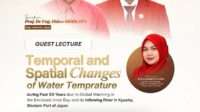
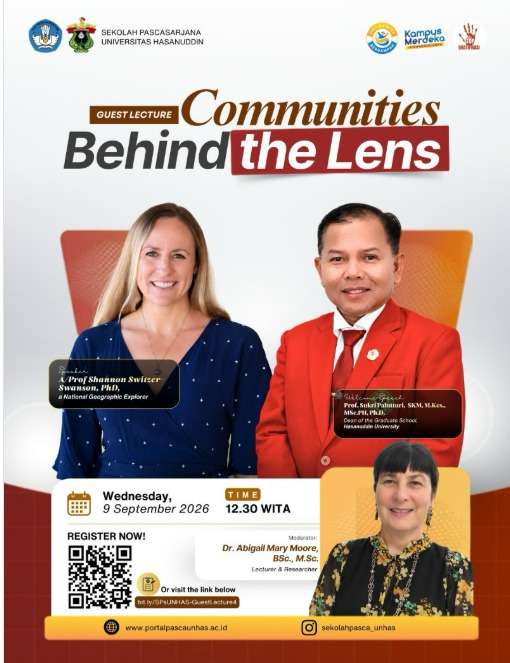
That question sits at the heart of “Communities Behind the Lens,” a guest lecture to be hosted by the Graduate School of Hasanuddin University on Wednesday, September 9, 2026.
The event will feature Associate Professor Shannon Switzer-Swanson, Ph.D., a National Geographic Explorer, with Prof. Sukri Palutturi, Dean of the Graduate School, delivering the welcome address and Dr. Abigail Mary Moore serving as moderator.
The title of the lecture itself is provocative. A community is usually presented as the subject of research, journalism, photography or documentary production. Researchers arrive with cameras, notebooks and questions; communities provide information, stories and images. The finished product then circulates in academic journals, media platforms, exhibitions or institutional reports.
But what if the community itself could hold the camera?
That is precisely where Swanson’s academic and professional journey becomes interesting.
Swanson describes herself as a marine social ecologist, photojournalist and “water woman.” Her work explores the relationship between people and oceans, combining scientific research with visual storytelling. She says her research examines the psycho-cultural dimensions of communities and works in partnership with them to develop conservation approaches grounded in local context.
Her connection with Indonesia is particularly significant. National Geographic describes her as a marine social ecologist whose work has included research on sustainable Indigenous fishing in Indonesia. Her field experience has taken her into coastal communities where livelihoods, culture and marine conservation are deeply interconnected.
One of her major research interests has been the marine aquarium fish trade in Indonesia. National Geographic documented her work tracing tropical fish from Indonesian fishermen and coastal communities through international supply chains to aquarium hobbyists in the United States. The project sought to understand not simply the fish trade itself, but the people and relationships behind it.
That distinction matters.
A conventional photograph of a fisherman might show the result of a livelihood. A participatory visual approach asks the fisherman to show us what the livelihood means to him.
Those are not necessarily the same story.
This thinking is also reflected in Swanson’s academic work. In a 2021 article in Biological Conservation, written with Nicole M. Ardoin, she examined Visual Participatory Methods (VPMs) in biodiversity conservation. The research reviewed 24 conservation studies using approaches such as participatory photography, participatory video and other community-generated visual methods.
The central argument is powerful: photographs and videos created by community members can reveal dimensions of social and ecological life that conventional research methods may overlook.
Visual methods can help researchers understand how residents perceive their environment, how historical events have shaped their communities, how people understand their relationship with nature and where their perspectives may differ from those of governments, conservation organizations or researchers.
This becomes particularly relevant in coastal Indonesia.
Consider a fishing village experiencing declining catches. An outside researcher may document declining fish stocks, damaged reefs or changing fishing practices. A government report may measure income, boat ownership or production. A journalist may photograph fishermen returning with empty baskets.
All of these provide useful information. But ask the community to document the same reality, and another story may emerge.
A fisherman might photograph the place where his father taught him to fish. A woman may photograph the market where she has sold fish for twenty years. A young person may photograph a shoreline dominated by plastic waste. Another resident may document a mangrove area that disappeared during his lifetime.
Suddenly, the community is not merely being observed. It is interpreting its own social-ecological landscape. This is where the issue of gender also becomes important.
Who holds the camera matters because communities are not composed of a single voice. Men and women often experience coastal economies differently. Fishermen may spend their days at sea, while women frequently participate in processing, trading, household financial management and other parts of the fisheries value chain. Young people may experience the coast differently again, particularly when migration, education and changing aspirations enter the picture.
A camera placed in the hands of different members of a community can therefore produce different versions of the same village.
Swanson’s own reflections on women she encountered in Indonesia point toward this dimension. She has written about women she met in Indonesia who demonstrated remarkable capacity to create livelihoods from difficult circumstances and described women change-makers as important actors in responding to environmental and social challenges.
The lesson is important for conservation, but it extends beyond conservation.
It is equally relevant to coastal development, blue economy programs, fisheries governance and community empowerment. When governments design programs for coastal communities, the danger is often to define communities through statistics: number of fishers, household income, fishing vessels, production volume or poverty rates.
These indicators are necessary. But they do not necessarily tell us how people experience their own lives.
Visual participatory methods can complement those statistics by allowing residents to document what matters to them. Swanson and Ardoin argue that such approaches can contribute to more inclusive and equitable conservation by bringing community perspectives into knowledge production and decision-making.
For Indonesia, this offers an intriguing possibility.
Programs such as Kampung Nelayan Merah Putih, coastal restoration, marine protected areas and sustainable fisheries could potentially incorporate community-generated visual documentation as part of their social assessment and monitoring.
Instead of outsiders documenting whether a program has changed a village, residents could document the transformation themselves.
Before and after photographs could record changes in beaches, fishing grounds, mangroves, markets and household livelihoods. Women could document changes in processing and trading. Young people could document aspirations and environmental concerns. Fishers could document changes at sea.
The result would not simply be a collection of photographs. It would become community-generated evidence.
That may be the deeper meaning behind Communities Behind the Lens.
The lens is not neutral. It determines what becomes visible and what remains outside the frame. When researchers, journalists or institutions control the lens, they also exercise a degree of control over the narrative.
Giving communities the lens does not automatically make every story accurate or representative. Communities themselves contain differences, inequalities and competing interests. But participatory visual methods create another avenue through which those differences can become visible.
For a university such as Hasanuddin University, with its strong connection to marine science, public health, coastal communities and development research, this conversation is particularly timely.
The challenge is no longer simply to study communities. It is to learn how to study with communities and perhaps, increasingly, to let communities tell us what they see. That is the real promise behind the lens: not merely better photographs, but a different relationship between knowledge, representation and power.
The question, ultimately, is not only who is in the picture. It is who gets to decide what the picture means.
Sources and further reading
- National Geographic Education — Explorers at Work: Shannon Switzer Swanson — background on Swanson’s marine social ecology and Indonesian conservation work. (National Geographic Education)
- Shannon Switzer Swanson — Research & Expertise — publications and research profile. (Shannon Switzer Swanson)
- Communities Behind the Lens — Biological Conservation — Swanson & Ardoin’s 2021 review of visual participatory methods. (ScienceDirect)
- National Geographic — How Tropical Fish Get From Coral Reefs to Your Aquarium — reporting on Swanson’s Indonesian marine aquarium-trade research. (National Geographic)