
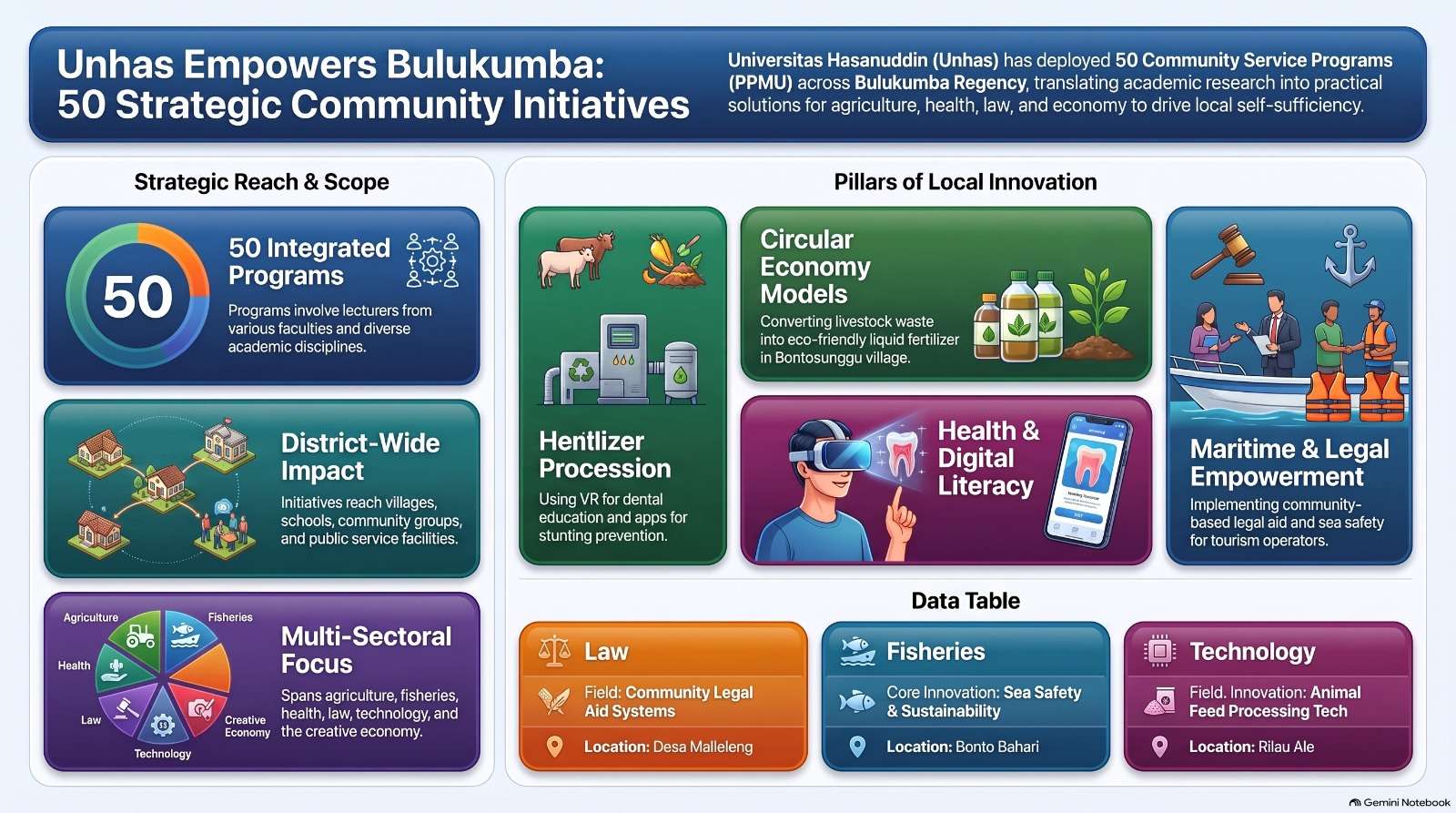
The traditional image of a university is a sanctuary of quiet libraries and secluded laboratories—an “ivory tower” tucked safely away from the dust, sweat, and unpredictable variables of rural life. But in the Regency of Bulukumba, Universitas Hasanuddin (Unhas) is effectively dragging the laboratory into the light of the South Sulawesi sun.
Through 50 distinct Pengabdian kepada Masyarakat Unhas (PPMU) programs, the university is executing a massive “hilirisasi” (downstreaming) project, where academic theory finally meets the road.
MARITIMEPOSTS.COM – Through 50 distinct Pengabdian kepada Masyarakat Unhas (PPMU) programs, the university is executing a massive “hilirisasi” (downstreaming) project, where academic theory finally meets the road.
This isn’t just about publishing papers; it’s about translating high-level research into tools that villagers can hold in their hands. It is a living laboratory where the bridge between complex theory and the real world is built with local materials.
The Circular Gold: Turning Bio-Slurry into a Bank Account
In Desa Bontosunggu, Kecamatan Gantarang, the local poultry industry used to struggle with the environmental burden of its own success.
Today, thanks to the work of Dr. Andi Ratna Sari Dewi and Dr. Ir. Anie Asriany, farmers are learning to see a bio-hazard as a potential bank account.
By introducing a circular economy model, researchers have taught the community to process “bio-slurry”—the liquid byproduct of chicken manure—into organic liquid fertilizer and high-efficiency “bio-tablets.”
The analysis here is simple but profound: this is a “win-win” for both environmental sustainability and village economic independence. By converting a waste stream into a revenue stream, the program reduces reliance on industrial fertilizers while sanitizing the local ecosystem. As the researchers noted during their intervention:
“Knowledge will have greater value when it is able to bring about real change for the community.”
But economic independence is only half the battle; the university is also bringing high-tech solutions to the very physical health of the community.
High-Tech Healing: VR Dentists and Democratized Wellness
One might not expect to find Virtual Reality (VR) headsets in the coastal village of Bira, but Prof. Dr. Muh. Harun Achmad is using this tech to revolutionize dental education.
By immersing coastal residents in digital environments, the program bypasses traditional literacy barriers to make oral health engaging.
The digital shift extends deep into the community’s daily habits. At SDN Appasarenge, Dr. Tuti Seniwati’s “G-STAMP” program (Healthy Gamers Without Insults and Bullying) addresses the mental health and conduct of the digital generation.
Meanwhile, at Puskesmas Bontobangun, mothers use the “Sehati” app for stunting prevention, and youth groups (Karang Taruna) use a web-based food-photo analysis app developed by Dr. Nuurhidayat Jafar to prevent pre-diabetes.
This represents a fundamental democratization of healthcare. By moving diagnostic power from the hospital into the hands of the coastal community, digital literacy has become a core component of modern wellness, ensuring that geography no longer dictates the quality of one’s health education.
Yet, physical health is often tied to legal security, which is why Unhas is also stepping into the village square.
Justice in the Village: Administrative Literacy as a Shield
Legal disputes over land and minor offenses can paralyze a village’s social harmony.
Rather than relying on distant courtrooms, Muhammad Djaelani Prasetya and Dr. Tri Fenny Widayanti are empowering villagers to handle justice internally. Their work focuses on three pillars of legal impact:
Community-Based Legal Aid: Establishing restorative justice systems in Desa Malleleng that align with the latest legal codes, allowing for local resolution of criminal acts.
Land Rights Protection: Empowering residents in Desa Tambangan, Kajang, through rigorous administrative literacy to ensure their heritage is documented.
Participatory Legal Mapping: Led by Eka Merdekawati Djafar in Desa Tambangan, this involves community-led mapping of non-certified land to prevent agrarian conflicts before they ever reach litigation.
By prioritizing administrative literacy over litigation, these programs provide a shield for rural populations against the legal complexities that often lead to marginalization.
However, protecting a village’s land is only one way to safeguard its future; one must also protect its soul.
The Maritime Soul: Reviving Identity as a Development Anchor
In the rush toward modernization, regions often risk losing the very identity that makes them unique. The Faculty of Cultural Sciences (FIB) at Unhas argues that cultural preservation is as critical for development as physical infrastructure.
Through the “Walenrengnge” model, Prof. Dr. AB. Takko and Dr. Dra. St. Nursa’adah are using maritime character to shape the values of students at SMKN 3 and youth in Desa Garanta, Kecamatan Ujung Loe.
Perhaps the most evocative example of this “hilirisasi” of culture is Faisal Oddang’s “Etnopuitika” program at SMAN 9 in Kelurahan Dannuang.
Here, students are taught to adapt traditional oral literature (sastra lisan) into modern declamation.
This cultural “anchor” is vital. Without a clear sense of identity, economic development can lead to community displacement or a loss of agency.
By grounding Bulukumba’s youth in their maritime soul, Unhas ensures that the region grows without drifting away from its roots. This resilience, however, must also be defended against the invisible threats of the modern age.
Safeguarding the Future: From Seaweed Snacks to Democratic Defense
Unhas is currently “future-proofing” Bulukumba against a spectrum of risks—from the biological to the digital. In Kelurahan Bintarore, Kecamatan Ujung Bulu, Dr. Magdalena Litaay has developed fortified snacks using Ulva sp. (seaweed) to tackle stunting with local, sustainable nutrition.
Simultaneously, in Caile, Kecamatan Ujung Bulu, the university is addressing a more invisible threat.
Endang Sari has launched training on protecting personal data and the constitutional rights of voters from AI-driven “micro-targeting” and algorithmic manipulation in politics.
This is more than just data privacy; it is a “democratic defense.” By contrasting physical nutrition with digital health, Unhas demonstrates that a university’s role is not just to solve today’s crises, but to prepare a community for the sophisticated risks of tomorrow.
The Living Laboratory of Innovation
The 50 programs running across Bulukumba, from the shores of Bira to the ancient forests of Kajang, share a single red thread: knowledge only gains its true value when it creates tangible change.
Whether it is turning bio-slurry into profit, using VR to save teeth, mapping land to prevent conflict, reviving maritime poetry, or protecting voters from AI, Unhas has turned this regency into a living laboratory of social innovation.
The success of these interventions suggests that the gap between the university and the village is merely a lack of imagination. If a university can transform 50 different facets of a single regency through localized research, what untapped potential is sitting in the libraries of our own communities waiting to be unleashed?