
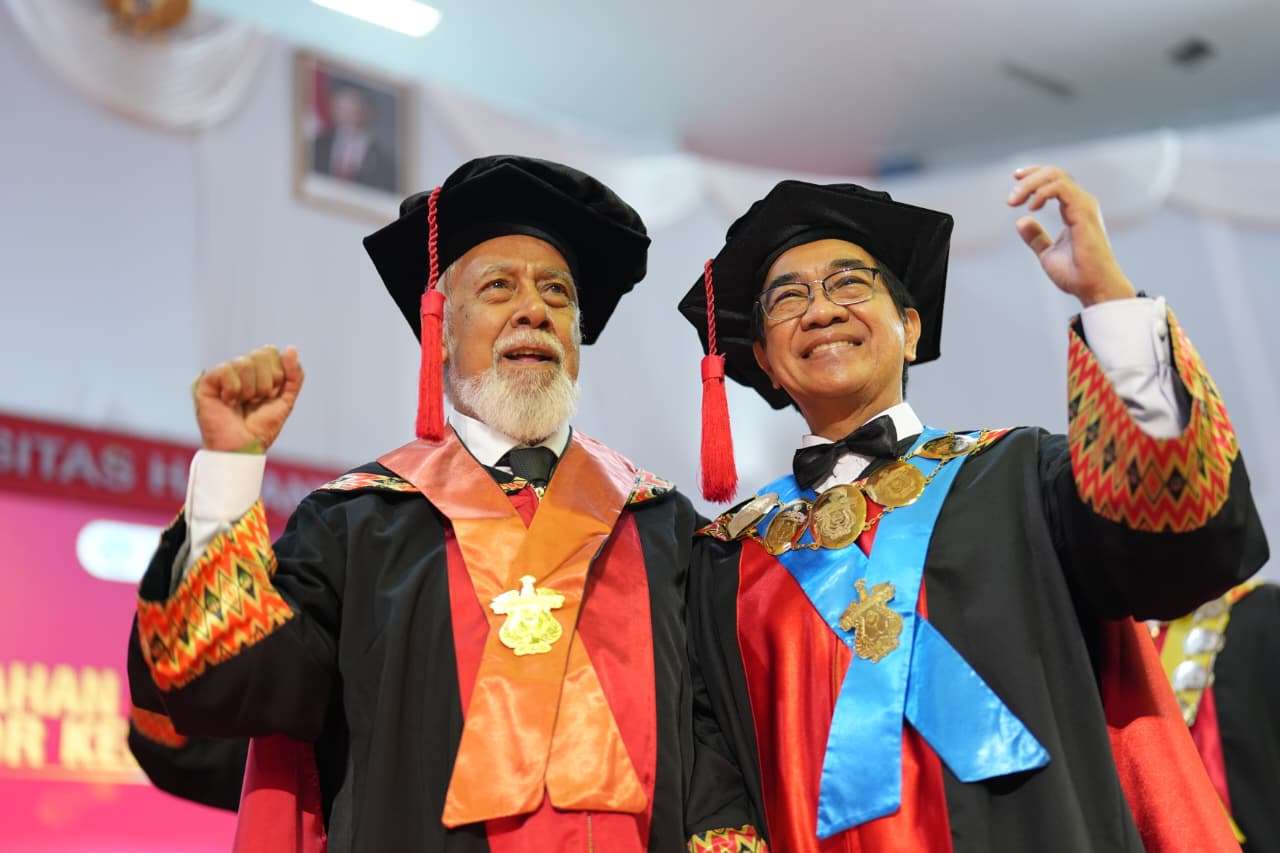
PELAKITA.ID – MAKASSAR — Hasanuddin University (Unhas) has conferred an honorary Doctor Honoris Causa (Dr. HC) degree upon the Prime Minister of Timor-Leste, H.E. Kay Rala Xanana Gusmao, during an Open Session of the Academic Senate at Baruga A.P. Pettarani, Unhas Tamalanrea Campus, Makassar, on Saturday (05/09).
The honorary degree was awarded following an academic assessment of Xanana’s life journey, leadership, and contributions to Timor-Leste, the region, and humanity. Unhas considers his journey to embody universal values of courage, steadfastness, reconciliation, peace, democracy, and humanity.
The university’s promoter for the honorary degree, Prof. Hafid Abbas, M.Sc., explained that four main considerations underpinned the decision to confer the Doctor Honoris Causa upon Xanana.
1. A Symbol of the Struggle That Gave Birth to a Nation
Xanana is regarded as one of the key figures in the struggle that led to the birth of the Democratic Republic of Timor-Leste. His journey unfolded through a long and difficult period, from armed resistance to diplomacy. This placed him at a pivotal point in Timor-Leste’s history, as he led his people through one of the most challenging periods in their struggle for independence.
“Xanana was not merely a witness to the birth of the Democratic Republic of Timor-Leste; he was one of its principal architects. He led his people through the most difficult years of the struggle for independence, from the resistance movement to the diplomatic arena,” Prof. Hafid explained.
2. Transforming the Wounds of Conflict into a Bridge for Reconciliation
The second consideration concerns Xanana’s ability to foster reconciliation following the conflict between Indonesia and Timor-Leste. Rather than allowing a painful history to become a source of intergenerational hatred, Xanana, together with leaders from Indonesia and Timor-Leste, helped create a new space for relations based on mutual respect and friendship.
For Prof. Hafid, this choice carries profound significance in the history of peacebuilding. Moving from the battlefield to reconciliation presented its own challenges. A former freedom fighter must be able to preserve relationships, rebuild trust, and create space for peace after conflict.
“Not every freedom fighter is capable of becoming a peacemaker. Yet Xanana chose the more difficult path: to forgive without forgetting, to remember without passing hatred on to future generations. He taught the world that the greatest victory is not defeating an opponent, but winning a shared future,” Prof. Hafid added.
3. From Freedom Fighter to Statesman
The third consideration lies in Xanana’s role after Timor-Leste achieved independence. The struggle shifted from the battlefield to the task of nation-building. Prof. Hafid noted that Xanana played a role in institution-building, strengthening democracy, advancing national development, and pursuing Timor-Leste’s interests through legal and diplomatic channels.
This journey demonstrates leadership capacity in navigating the post-conflict period. Independence requires strong institutions, functioning democracy, and policies capable of delivering hope and dignity to the people.
4. Passing on the Values of Peace and Humanity
The fourth consideration relates to the values represented by Xanana. Courage, steadfastness, reconciliation, peace, democracy, and humanity are regarded as being closely aligned with the values promoted by Unhas.
“Unhas respects the values represented by an individual. In Xanana, we find courage combined with humility, a struggle that ultimately led to reconciliation, and leadership grounded in humanity,” Prof. Hafid explained.
These four considerations demonstrate that the Doctor Honoris Causa was conferred based on an assessment of Xanana’s track record, contributions, leadership, and the humanitarian values reflected throughout his journey.
Science Diplomacy
For Unhas, the conferment carries broader strategic significance. The honorary degree creates an opportunity to strengthen academic relations with Timor-Leste through education, research, knowledge exchange, student mobility, and alumni networks.
Unhas Rector, Prof. Dr. Ir. Jamaluddin Jompa, M.Sc., placed the conferment within the broader context of strengthening relations between the two nations through academic engagement.
“This conferment has strategic significance for Unhas. We want to strengthen relations between Indonesia and Timor-Leste through education, research, and academic networks. Science can create broader opportunities for cooperation between the younger generations of both countries. This is a model of science diplomacy,” Prof. JJ explained.
Unhas believes that science and knowledge can create new avenues for engagement. Students, academics, researchers, and alumni can help fill these spaces through education, research, and the exchange of ideas.
The conferment of the Doctor Honoris Causa upon Xanana carries a dual meaning. It represents academic recognition of the journey and contributions of a prominent statesman, while simultaneously serving as an opportunity to strengthen Unhas’s academic diplomacy with Timor-Leste. (* /mir)