

Notes from Pulau Rajuni and the Taka Bonerate Atolls
___
MARITIMEPOSTS.COM – There are photographs that simply capture landscapes. And then there are photographs that quietly preserve memory, emotion, and unfinished questions about the future.
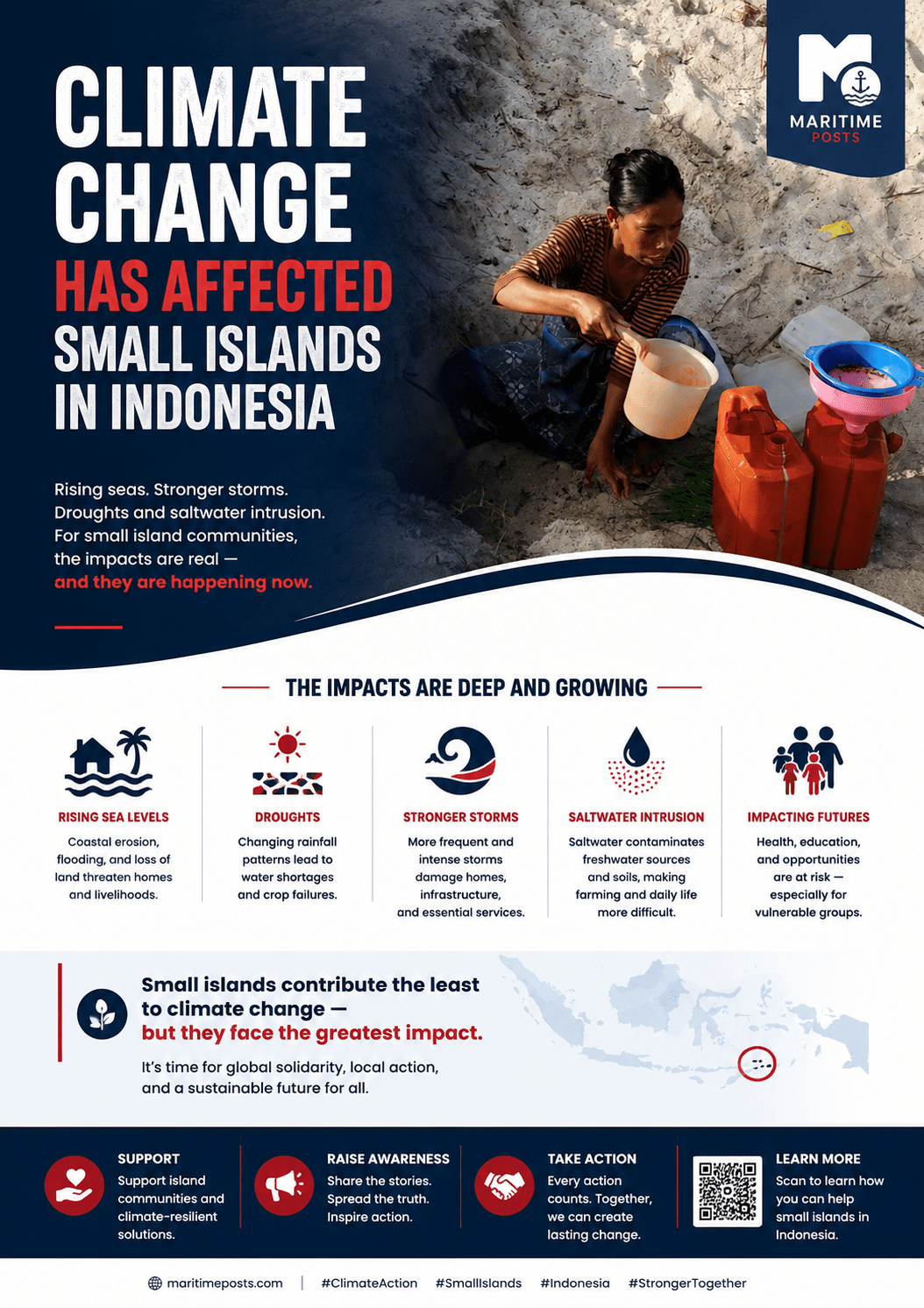
This photograph was taken by me many years ago on a small island called Pulau Rajuni, part of the vast Taka Bonerate Atolls in the Flores Sea — probably around 2003.
At that time, I never imagined the image would one day carry a deeper meaning beyond nostalgia. Looking at it today, the photograph feels timeless, almost prophetic. It speaks not only about the beauty of small islands, but also about their fragility in the era of climate change.
The Taka Bonerate Atolls are among the world’s largest coral atoll systems — a remote maritime landscape shaped by coral reefs, tidal rhythms, monsoon winds, and generations of island communities who have learned to live in close relationship with the sea. Life there has never been easy.
Freshwater is limited, transportation depends on weather, and livelihoods are deeply tied to marine ecosystems. Yet precisely because of those conditions, island communities developed resilience long before the modern world popularized the term.
I spent seven years in the atolls beginning in 1995. Those years became more than a professional or academic experience; they became a personal journey of understanding how humans survive through adaptation, solidarity, and ecological wisdom. Living among island communities taught me that resilience is not merely about infrastructure or technology. It is about culture, memory, social trust, and the ability to continuously adjust to uncertainty.
Long before climate change dominated international conferences and policy discussions, people in small islands were already living with environmental instability.
Fishermen understood seasonal shifts through the movement of clouds and currents. Families learned to manage limited freshwater during long dry periods. Communities rebuilt homes after storms and reorganized livelihoods when fish stocks changed. Adaptation was not a project; it was part of everyday life.
Today, however, the scale of environmental change is becoming far more complex. Rising sea levels, coral bleaching, coastal erosion, unpredictable weather, and marine ecosystem degradation are increasingly threatening small island communities across Indonesia and the world. Places like Rajuni are now standing on the frontline of the global climate crisis, despite contributing almost nothing to global carbon emissions.
This paradox is one of the greatest injustices of climate change: those who contribute least to environmental destruction are often the ones who suffer first and most severely.
Yet amid those vulnerabilities, small islands continue to offer important lessons to humanity. They teach us about limits, simplicity, ecological balance, and collective survival. In highly urbanized societies, people often believe resilience comes from speed, expansion, and endless growth.
Island communities remind us that resilience can also emerge from cooperation, restraint, and harmony with nature.
That is why I have long imagined conducting deeper research on community resilience to climate change in the atolls — tracing how island societies have adapted from the mid-1990s until today. Such research would not only examine environmental transformation, but also document social memory, local knowledge, cultural adaptation, and intergenerational change.
How are younger generations responding to environmental uncertainty?
What traditional ecological knowledge is disappearing?
How do island communities negotiate modernization while maintaining social cohesion?
What forms of local wisdom remain relevant in confronting global climate disruption?
These questions become increasingly important as climate discourse often remains dominated by technical language, global statistics, and institutional frameworks, while the voices of small island communities are frequently overlooked.
In reality, small islands are not peripheral spaces. They are living laboratories of adaptation. They are places where humanity can learn how to survive with dignity under ecological pressure.
Looking again at this old photograph from Pulau Rajuni, I realize it is more than documentation from the past. It is a quiet reminder of the urgency of the present and the uncertainty of the future. The image captures not only scenery, but also a relationship between people, sea, and time — a relationship now being tested by climate change.
Perhaps that is why the photograph still feels relevant today.
It could easily become the visual face of a campaign on climate adaptation, environmental resilience, or sustainable island futures.
But beyond its visual appeal, the image carries a deeper message: that protecting small islands is not only about saving landscapes. It is about protecting cultures, memories, livelihoods, and ways of life that have endured for generations.
And perhaps, in the coming decades, the future of humanity’s relationship with nature will be learned not from the centers of power, but from places like Rajuni — small islands surrounded by sea, silence, and wisdom.
___
Kamaruddin Azis
Founder MaritimePosts.com