
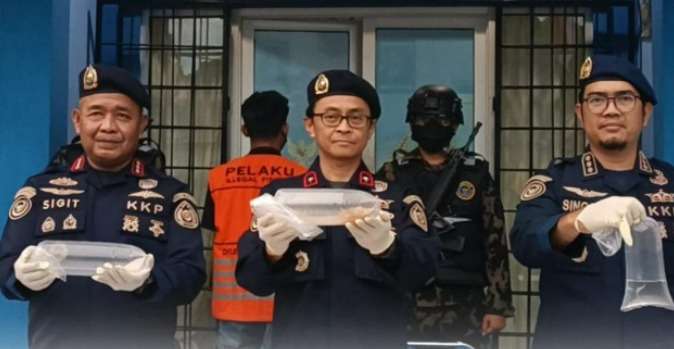
- To a casual observer, it was just another vehicle in the flow of Sumatran traffic. To the authorities from the Ministry of Marine Affairs and Fisheries (KKP), it was a mobile vault containing 31,255 “Benih Bening Lobster” (BBL)—the translucent, high-value larvae known in the criminal underworld as “clear gold.”
- The KKP estimated that the 31,255 seeds carried a potential state loss of Rp 4.7 billion. To put that in perspective, each tiny larva, barely visible to the naked eye, represents roughly Rp 150,000 in black market value before it even leaves the country.
- “As many as 31,255 Clear Lobster Seeds were successfully secured, and the potential state losses that were saved are estimated at Rp 4.7 billion,” stated Ardiansyah, Director of Fisheries Resource Surveillance at the KKP.
MARITIMEPOSTS.COM – On the afternoon of Saturday, May 23, 2026, a silver Mitsubishi Xpander with the license plate BE 1961 ALM was intercepted while navigating the cross-city roads leading toward Bandar Lampung.
To a casual observer, it was just another vehicle in the flow of Sumatran traffic. To the authorities from the Ministry of Marine Affairs and Fisheries (KKP), it was a mobile vault containing 31,255 “Benih Bening Lobster” (BBL)—the translucent, high-value larvae known in the criminal underworld as “clear gold.”
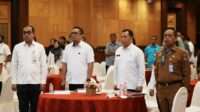
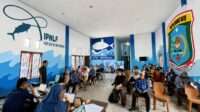
This intercept, later detailed in a press conference at the Satwas PSDKP Pesawaran office in Lampung, was not a lucky break.
It was a surgical strike against a sophisticated smuggling operation that treats Indonesia’s biological heritage as a high-stakes commodity.
In this world, microscopic organisms are packed into oxygenated bags and moved with the precision of narcotics, driven by a global demand that bridges the gap between rural Indonesian coasts and the multi-billion dollar aquaculture markets of Southeast Asia.
The valuation of this single seizure is staggering.
The KKP estimated that the 31,255 seeds carried a potential state loss of Rp 4.7 billion. To put that in perspective, each tiny larva, barely visible to the naked eye, represents roughly Rp 150,000 in black market value before it even leaves the country.
The astronomical price tag is driven by a biological bottleneck: while Vietnam has mastered the “grow-out” phase of lobster aquaculture, their industry remains almost entirely dependent on wild larvae sourced from Indonesian waters, as they cannot yet hatch these seeds at a commercial scale.
This makes Indonesian BBL the essential “raw material” for a foreign industry. The scale of the drainage is immense; in 2025 alone, authorities intercepted 1.314 million seeds valued at Rp 114 billion—a figure that likely represents only a fraction of the total illegal outflow.
“As many as 31,255 Clear Lobster Seeds were successfully secured, and the potential state losses that were saved are estimated at Rp 4.7 billion,” stated Ardiansyah, Director of Fisheries Resource Surveillance at the KKP.
The Ghost Chain: Mapping the “Disconnected” Land Route
Modern smugglers have moved away from direct maritime departures, which are easily monitored by coastal patrols. Instead, they employ what investigators call a “disconnected system” (sistem terputus).
In this model, the product is moved through a series of anonymous hand-offs between “collectors” (pengepul) to ensure that if one link is broken—as happened with the Xpander in Lampung—the rest of the syndicate remains invisible.
Lampung has emerged as a critical “choke point” in this land-based logistics strategy. It serves as a transit hub where seeds harvested from the rugged west coast are consolidated before being moved north through the Sumatran interior.
The Smuggling Transit Path:
- Origin: Pesisir Barat, Lampung (Harvesting grounds)
- Transit Hub: Bandar Lampung (Consolidation and vehicle swaps)
- Secondary Collection: Jambi (Final domestic staging)
- International Exit: Singapore (The regional gateway)
- Final Destination: Vietnam (The aquaculture grow-out centers)
Criminal Persistence: The Reality of the Repeat Offender
The arrest of the courier in the BE 1961 ALM vehicle pulled back the curtain on the professionalization of this trade.
Sigit Bintoro, Head of the Jakarta Marine Resources and Fisheries Resources Surveillance Base, revealed that the suspect was no novice. This was a “professional” driver who had successfully completed similar runs multiple times.
The persistence of these couriers highlights a grim economic reality: the rewards of the BBL trade are so high that the risk of capture is viewed merely as a manageable business expense.
For the syndicates, a seized Xpander and a jailed courier are small prices to pay for the massive profits generated by the shipments that actually reach the nurseries of Vietnam.
“Further investigation reveals that this suspect has not only done this once, but several times,” noted Sigit Bintoro.
The Hammer Falls: A 1.5 Billion Rupiah Warning
The Indonesian government is attempting to shift the risk-reward calculus by escalating legal consequences.
Under the new regulatory landscape, the authorities are no longer treating BBL smuggling as a minor administrative infraction but as a serious economic crime.
The legal framework is now two-pronged: Ministerial Regulation Number 7 of 2024 establishes the strict management and “clear-path” requirements for lobster larvae, while Law Number 6 of 2023 provides the “hammer” for enforcement.
Fast Fact: Legal Penalties
- Governing Laws: Law Number 6 of 2023 & Ministerial Regulation Number 7 of 2024.
- Maximum Imprisonment: 8 years.
- Maximum Fine: Rp 1.5 billion.
Securitizing the Seas: An “All-Hands” Enforcement Strategy
Perhaps the most telling sign of the crisis is the composition of the National Task Force (Satgas) formed to combat the trade.
The KKP has moved beyond traditional fisheries patrol, enlisting the Ministry of Finance, the Ministry of Transportation, the TNI (Military), and the National Police (Polri).
Most notably, the involvement of the State Intelligence Agency (BIN) signals a fundamental shift in how Indonesia views environmental crime.
By bringing intelligence and military assets to the table, the government is acknowledging that BBL smuggling is a national security threat orchestrated by organized syndicates rather than a series of isolated poaching incidents.
Mapping these “disconnected” networks requires the same level of surveillance and intelligence-gathering used to dismantle terror cells or drug cartels.
Can Regulation Keep Up with Demand?
Indonesia currently finds itself in a desperate race. On one side is a robust regulatory push to protect natural resources; on the other is a relentless global market that values a single bag of water and larvae more than a luxury vehicle.
The “disconnected” nature of these land routes makes them notoriously difficult to fully eradicate.
While the intercept in Lampung was a victory for the Satgas, it also serves as a reminder of the sheer volume of traffic moving through the Sumatran corridor.
As the government tightens the noose on transit hubs, we must ask, can enforcement ever truly extinguish a trade where the “raw material” is so small and the profit margins are so vast, or will Indonesia’s “clear gold” continue to fuel the economies of its neighbors at the expense of its own?
Source: KKP