

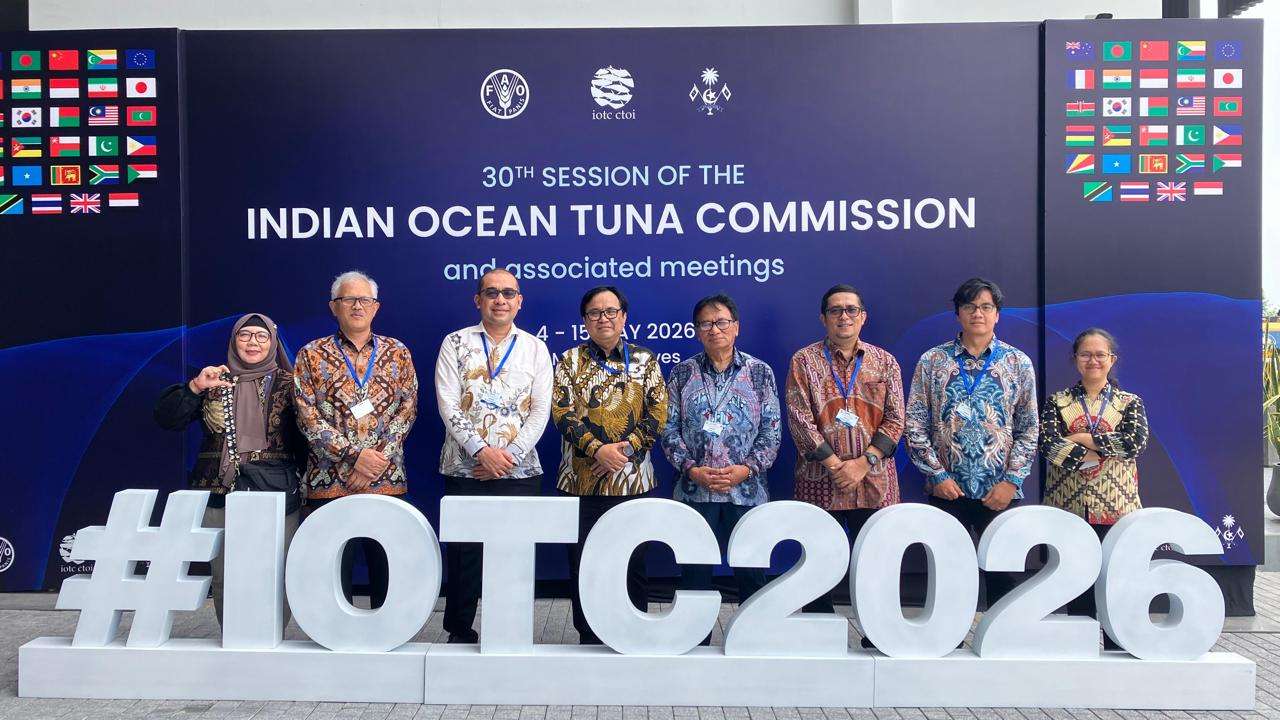
MARITIMEPOSTS.COM – The Indonesian Government has successfully safeguarded its national interests in the capture fisheries sector during The 30th Session of the Indian Ocean Tuna Commission (IOTC), held from 10–15 May 2026 in Malé, Maldives.
During the international forum, as reported by Director General of Capture Fisheries Lotharia Latief, Indonesia not only managed to maintain its yellowfin tuna catch quota, but also secured a significant increase in its swordfish catch limit for the 2027–2028 period.
The annual IOTC meeting was chaired by Adam Ziyad of the Maldives and attended by 22 member states, two non-member countries, and 27 international observers.
Indonesia’s delegation participated both in person and virtually, involving representatives from the Ministry of Marine Affairs and Fisheries (KKP), the National Research and Innovation Agency (BRIN), as well as several experts and stakeholders related to fisheries resource management.
The Indonesian delegation was led by the Minister’s Expert Staff for Economic, Social, and Cultural Affairs. Indonesia’s participation in the forum was considered crucial given the country’s position as one of the largest tuna fishing nations in the Indian Ocean region.
Indonesia’s Swordfish Quota Increases by 30 Percent
According to the report from the Directorate General of Capture Fisheries (DJPT-KKP), one of Indonesia’s key achievements during the session was the successful increase in its swordfish catch limit.
Under the initial proposal, Indonesia was only allocated a quota of 2,728 tons. However, following intensive negotiations, Indonesia ultimately secured an allocation of 3,263 tons for 2027–2028.
This figure represents an increase of around 30 percent compared to Indonesia’s actual catch in 2024, which was recorded at 2,511 tons.
The quota increase is viewed as a strategic opportunity to strengthen the national fisheries industry, particularly for fishers and businesses engaged in large pelagic fisheries.
Indonesia Maintains Yellowfin Tuna Quota
In addition to its success regarding swordfish, Indonesia also succeeded in maintaining its yellowfin tuna catch quota at 45,426 tons until 2029.
Previously, the proposal had suggested reducing Indonesia’s quota by 11 percent to 41,819 tons. The proposed reduction targeted countries with the largest tuna catches, including the European Union, Maldives, and Indonesia, in order to create opportunities for countries with smaller catch volumes.
However, through diplomatic efforts and technical arguments, Indonesia successfully defended its existing quota. Nevertheless, the IOTC still allows for possible quota adjustments in 2029 if the 2028 management procedure recommends changes to the total allowable catch (TAC).
Indonesia Exempted from Payback Mechanism
In another discussion, several countries had pushed for the implementation of a payback mechanism against Indonesia over alleged yellowfin tuna overcatch during the 2020–2024 period.
However, data consolidation between Indonesia and the IOTC Secretariat showed that Indonesia had never experienced overcatch during that period. Based on the verification results, the commission ultimately agreed not to impose the payback mechanism on Indonesia.
The decision is considered important because it directly affects the stability of Indonesia’s future fishing quotas.
Strengthening Mobula Ray Conservation
The IOTC session also produced new agreements related to mobula ray conservation. The commission approved guidelines for the safe release of mobula rays as well as mandatory use of specialized release equipment for purse seine vessels.
The required equipment includes mobulid sorting grids, stretchers, cargo nets or canvas slings that can be attached to cranes, and large straps. Indonesia received a special exemption delaying the mandatory implementation of these release tools until 2030.
This policy gives Indonesia additional time to prepare technical aspects and the readiness of its national fishing fleet before full implementation takes effect.
Challenges in Improving Indonesia’s Fisheries Data System
Beyond quota and conservation issues, the IOTC also agreed on additional obligations related to fisheries data reporting. Member countries are required to submit catch data based on national jurisdiction areas, high seas, and other countries’ Exclusive Economic Zones in time-series format.
In addition, member states must also provide vessel statistical data covering fishing type, vessel type, engine type, onboard preservation methods, and vessel size classifications.
Indonesia successfully proposed an adjustment period until 2030 to improve its national fisheries data system in line with IOTC standards and requirements.
The Indonesian Government views the improvement of fisheries data systems as an important task moving forward. Enhancing spatial data and vessel statistics is considered crucial for strengthening Indonesia’s position in international fisheries negotiations.
Government Follow-Up Measures
As a follow-up to the IOTC session outcomes, the government will revise national regulations concerning technical guidelines for mobula ray release and the mandatory use of release equipment on purse seine vessels.
In addition, the government will accelerate comprehensive improvements to the national capture fisheries data system, including the preparation of a data improvement timeline through 2030.
These efforts are expected to strengthen Indonesia’s fisheries governance, ensure the sustainability of tuna resources in the Indian Ocean, and protect the economic interests of fishers and the national fisheries industry amid the evolving dynamics of global fisheries management.
Source: DJPT-KKP Release