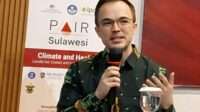

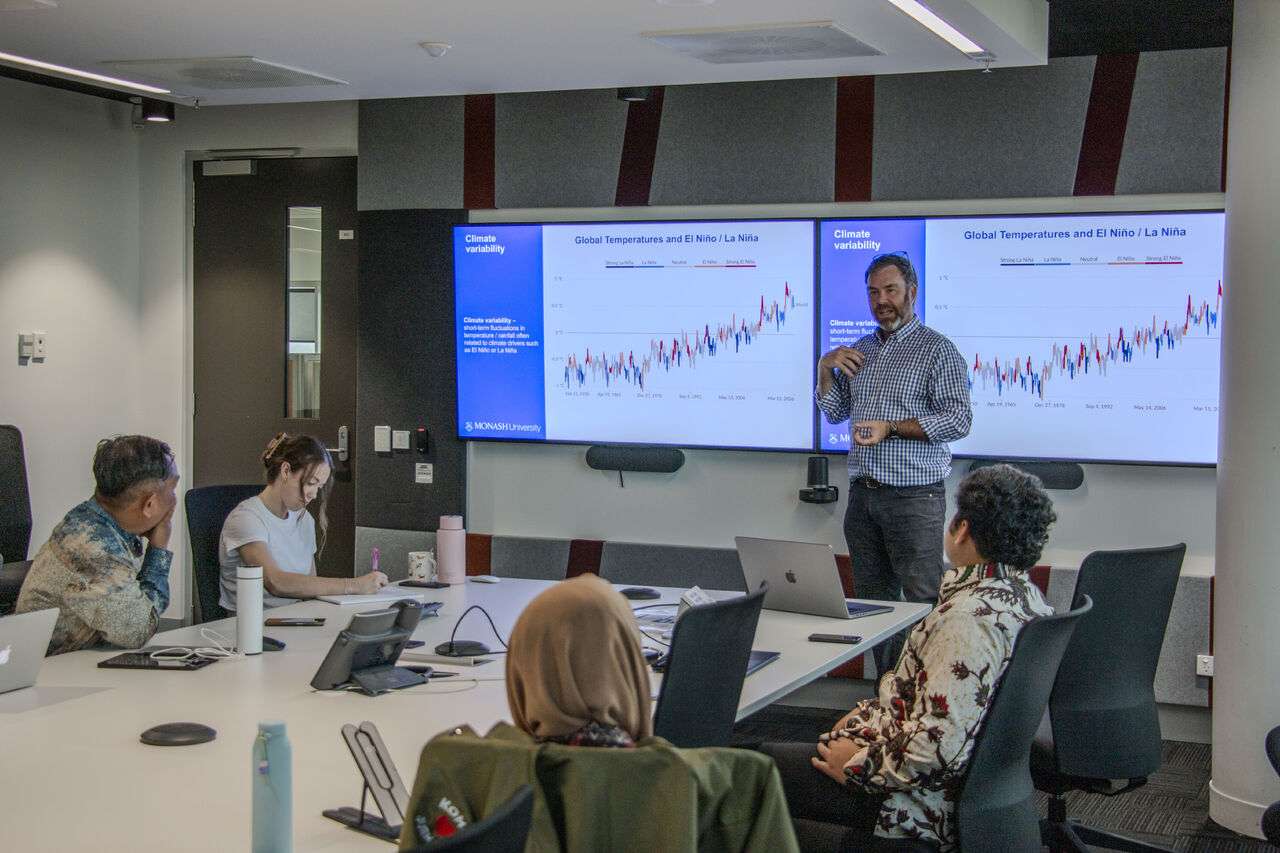
Dr. Andrew B Watkins, Adjunct Professor (Practice) – Monash University School of Earth, Atmosphere & Environment.
MARITIMEPOSTS.COM – Climate change is often discussed through scientific reports, graphs, and technical terminology. Yet one of the greatest challenges today is not only understanding climate science, but communicating it in ways that connect with society.
During a presentation and discussion session in Melbourne, Andrew B. Watkins emphasized the importance of translating complex climate science into language that ordinary communities can understand and relate to.
One of the clearest messages from his presentation was the distinction between weather and climate. Dr. Watkins explained that weather refers to short-term atmospheric conditions, while climate describes long-term patterns and expectations.
In simple terms, he noted that weather tells people what clothes to wear today, while climate tells communities what conditions they should generally expect over time. This kind of explanation demonstrates how scientific communication becomes more effective when connected to everyday experience.
Dr. Watkins also highlighted that understanding climate change requires a basic understanding of atmospheric chemistry.
Earth’s atmosphere naturally contains greenhouse gases such as carbon dioxide and water vapor, which help retain heat and keep the planet habitable.
Without these gases, he explained, Earth would be approximately 33 degrees Celsius colder. This statement serves as an important reminder that greenhouse gases are naturally essential for life.
The problem emerges when human activities significantly increase their concentration in the atmosphere.
According to the presentation, carbon dioxide levels have increased dramatically since the industrial era. Atmospheric carbon dioxide concentrations, which were around 280 parts per million before industrialization, have now surpassed 420 parts per million.
Dr. Watkins stressed that this increase has accelerated rapidly within a relatively short period of human history.
He described how the warming trend observed today is directly linked to rising greenhouse gas emissions produced by industrial activity, fossil fuel consumption, and land-use change.
An important aspect of Dr. Watkins’ communication approach was his effort to place climate science within a historical and human context. He noted that scientists have understood the relationship between carbon dioxide and global temperature for nearly two centuries.
He also referred to the overlooked contributions of early women scientists in climate research, likely referencing pioneering figures such as Eunice Newton Foote, who first identified the heat-trapping properties of carbon dioxide long before climate science became globally recognized.
Beyond scientific explanation, Dr. Watkins connected climate change to visible impacts already experienced around the world, particularly in Southeast Asia.
He discussed the influence of climate phenomena such as El Niño, describing it as so large and powerful that it can even slightly affect Earth’s rotation.
More importantly, he explained how El Niño contributes to delayed monsoon seasons, prolonged droughts, declining rainfall, and water shortages across the region.
The presentation also emphasized environmental changes occurring in marine ecosystems. Rising ocean temperatures are shifting fish populations and contributing to widespread coral bleaching along coastal regions.
These changes affect not only biodiversity but also fishing communities whose livelihoods depend on stable marine ecosystems.
Through these examples, Dr. Watkins demonstrated that climate change is not a distant or abstract issue, but one already influencing food systems, economies, and daily life.
Another significant element of the session was the recognition of Indigenous and First Nations knowledge systems. Dr. Watkins acknowledged that Indigenous communities have long understood environmental patterns through seasonal calendars and close observation of nature.
This perspective reinforces the idea that climate communication should not rely solely on scientific institutions, but also respect local ecological knowledge that has existed for generations.
Perhaps the most important lesson from Dr. Watkins’ presentation is that effective climate communication requires clarity, accessibility, and human connection. Scientific facts alone are often insufficient if communities cannot relate them to their own experiences.
By using simple explanations, relatable examples, and regional realities, climate science becomes more understandable and meaningful to broader audiences.
In an era where misinformation and climate skepticism continue to circulate, the role of scientists, journalists, educators, and communicators becomes increasingly important.
Climate science communication is no longer only about presenting data; it is about building public understanding, encouraging awareness, and helping societies prepare for environmental change that is already unfolding across the globe.
___
Written by K. Azis