
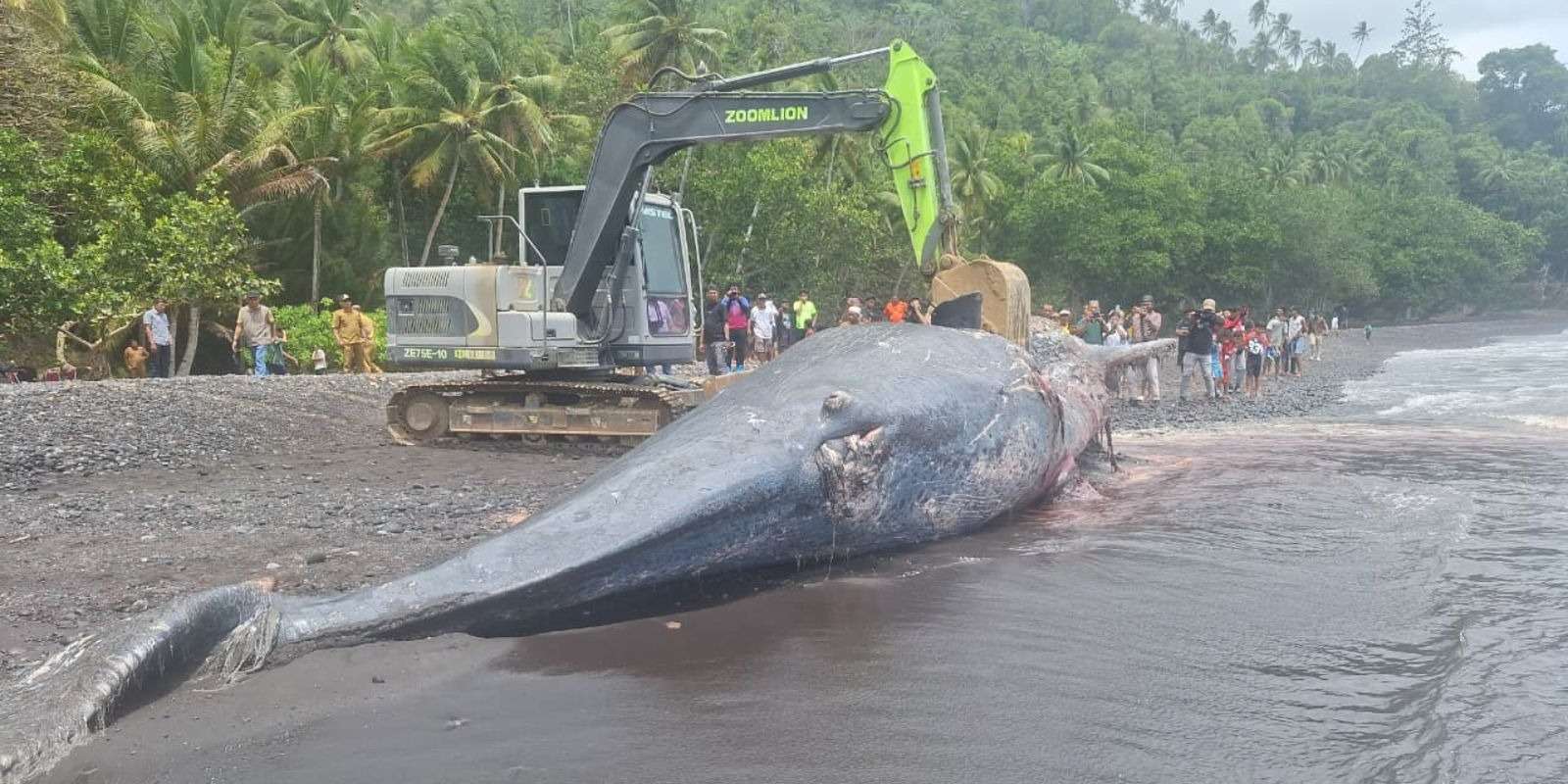
MARITIMEPOSTS.COM – TERNATE — A sperm whale was found stranded along the coast of Afe-Taduma Beach, Afe-Taduma Village, Pulau Ternate District, Ternate City, North Maluku. The Ministry of Marine Affairs and Fisheries (KKP), together with the local government and community, immediately responded to the stranding.
The response involved several stages, including identifying the species and condition of the whale, conducting morphometric measurements, and relocating and burying the carcass near the site where it was found.
The report of the stranded whale was received by the Ternate Working Area team of the Sorong Field Unit of the Kupang Marine Management Center (Balai Pengelolaan Kelautan/PK Kupang) from local residents on Tuesday, September 8, 2026.
Upon receiving the report, the team immediately went to the site and coordinated with the Ternate City Regional Secretary, the Marine and Fisheries Agency, the Environmental Agency, district and village authorities, as well as members of the local community.
Head of the Kupang Marine Management Center Imam Fauzi praised the swift response from the local government and residents in reporting the incident.
“We greatly appreciate the Ternate City Government and local residents for promptly reporting the incident. The awareness and cooperation of various parties in the field greatly supported the identification and burial of the whale carcass, allowing the entire process to proceed smoothly and in accordance with established procedures,” Imam said in an official statement issued in Jakarta on Sunday, September 13, 2026.
Field identification confirmed that the whale was a female sperm whale. The carcass was in a moderate stage of decomposition, classified as code 3, with the outer layer of skin already peeling away.
Morphometric measurements showed that the whale had a total length of 9.8 meters and a body girth of 6.6 meters. Its pectoral fin measured 75 centimeters, the dorsal fin 40 centimeters, and the tail reached 2.8 meters in length.
The whale’s considerable size required specialized equipment for the response. The team, working with the local government, used an excavator to move the carcass and prepare the burial site.
The carcass was subsequently buried not far from where it was originally discovered. Locating the burial site near the stranding area is intended to facilitate monitoring and allow periodic inspections following the burial.
The stranding also highlights the important role of local communities in responding to marine mammal incidents along coastal areas. Prompt reporting enables authorities to assess the animal’s condition and determine appropriate response measures.
From a coastal ecosystem management perspective, information about stranded marine mammals is also valuable for monitoring the condition of marine life.
Community participation, therefore, together with local government and relevant technical agencies, remains essential to ensuring that such incidents are addressed quickly, appropriately, and in accordance with established procedures.
Source: Public Relations Office, Directorate General of Marine Management, KKP