


Warida argued that the AMDAL preparation process should not be focused solely on economic considerations and investment feasibility. More importantly, AMDAL must ensure that development protects people’s rights, particularly those of women and children.
MARITIMEPOSTS.COM — The preparation of Environmental Impact Assessment (AMDAL) documents should be positioned as an inclusive and participatory process, ensuring that the voices of women, children, and vulnerable groups are taken into consideration from the planning stage.
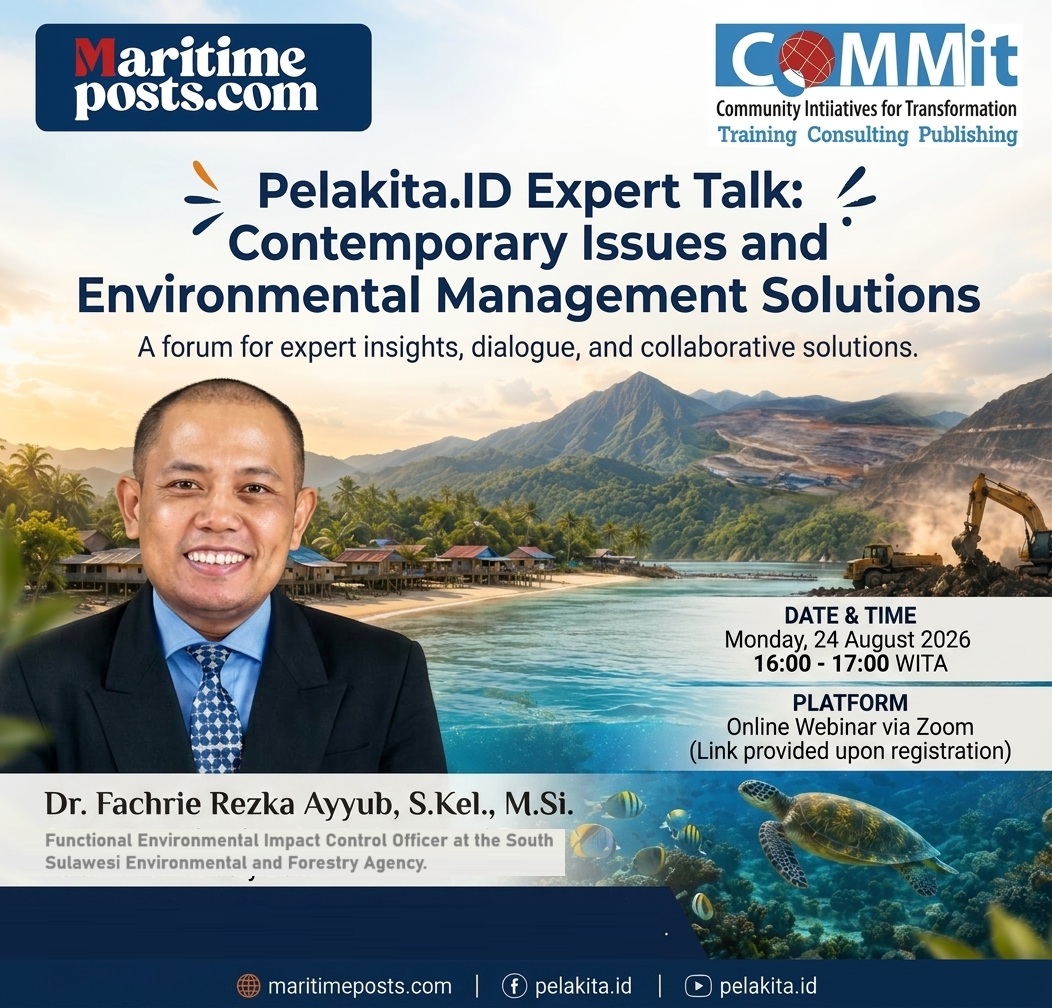
This view was expressed by Warida Safie, an activist with the South Sulawesi Child Protection Institute (LPA), during the Pelakita.ID Expert Talk titled “Contemporary Issues and Solutions for Environmental Management in South Sulawesi” on Monday, August 24, 2026.
The discussion featured Dr. Fahrie Reska Ayyub, an environmental impact control analyst with the Ministry of Environment and Forestry (KLHK) of South Sulawesi Province, and was moderated by Kamaruddin Azis of Pelakita.ID.
The event was jointly organized by The MaritimePosts.com and The COMMIT Foundation.
Warida argued that the AMDAL preparation process should not be focused solely on economic considerations and investment feasibility. More importantly, AMDAL must ensure that development protects people’s rights, particularly those of women and children.
“Development from the perspective of women and children must be incorporated into every sector,” said the activist, popularly known as Ida Safie, during the discussion.
According to her, the protection of women and children is an essential component of inclusive and equitable development. This principle is also consistent with the spirit of the Sustainable Development Goals (SDGs), particularly the principle of “no one left behind.”
Therefore, community involvement in AMDAL preparation should not be treated merely as a formality.
Communities need meaningful opportunities to express their views, particularly groups that may experience direct or indirect impacts from a development activity.
Warida cited coastal areas and fishing settlements around Makassar as an example. Environmental and social changes in these areas can have broader consequences for families and children if they are not anticipated during the planning stage.
Social vulnerability, she explained, can contribute to increased risks of child labor and child marriage. Therefore, the social impacts of development need to be understood more broadly and should not be limited to economic, physical, or ecological parameters alone.
“How can the process be carried out so that its impacts can be minimized?” she said, emphasizing the importance of meaningful community participation in AMDAL preparation.
More Than Just a Document
Warida also highlighted the importance of ensuring that social participation mechanisms already available within the AMDAL preparation process are genuinely implemented. The existence of participatory procedures, she argued, is insufficient if they are not followed by meaningful implementation.
She hopes that institutions concerned with the protection of children and women can be involved in the process.
The South Sulawesi Child Protection Institute (LPA), for example, could provide a child-protection perspective in document discussions and consultations related to AMDAL.
In this way, AMDAL would not merely serve as a technical document to fulfill development requirements, but also as an instrument to ensure that social risks are identified and managed from the outset.
This perspective becomes increasingly important when development activities take place in areas with high levels of social vulnerability, including coastal zones, fishing settlements, and areas undergoing changes in land and spatial use.
The Importance of Objectivity in Environmental Oversight
In the same discussion, Fahrie Reska Ayyub acknowledged that the preparation and assessment of environmental instruments do not always proceed smoothly.
Government environmental officials often operate in a complex position, as they must balance environmental protection interests with the sustainability of investment.
According to Fahrie, this position requires objectivity because the documents prepared and approved at the initial stage will later become one of the foundations for environmental monitoring and the handling of public complaints.
This situation demonstrates that the quality of an AMDAL is determined not only by the completeness of its documentation, but also by the integrity of the process, the capacity of the stakeholders involved, transparency of information, and the meaningfulness of community participation.
In this context, Warida’s perspective broadens the understanding that community participation must include groups whose voices have historically been less likely to be heard.
Toward a More Inclusive AMDAL
For Warida, good development is not simply development that generates economic growth, but development that ensures benefits while minimizing risks for all groups within society.
Including women and children in the planning perspective does not mean making children decision-makers in development. Rather, it means ensuring that their needs, protection, and potential exposure to impacts are taken into account in decision-making processes.
The same applies to women, particularly those living in coastal areas and fishing communities. Environmental and economic changes can affect their access to livelihoods, security, basic services, and the sustainability of family life.
Therefore, a more inclusive AMDAL preparation process can become an entry point for strengthening the quality of development in South Sulawesi.
When more voices are heard and social risks are mapped from the outset, development decisions have a greater opportunity to gain public acceptance and deliver sustainable benefits.
Warida’s central message is simple but important: no group within society should be left behind in the development process, including women and children.
The principle of no one left behind, therefore, should not remain merely a development slogan. It needs to be translated into planning, AMDAL preparation, environmental oversight, and impact evaluation at the project level.
___
Editor Denun