
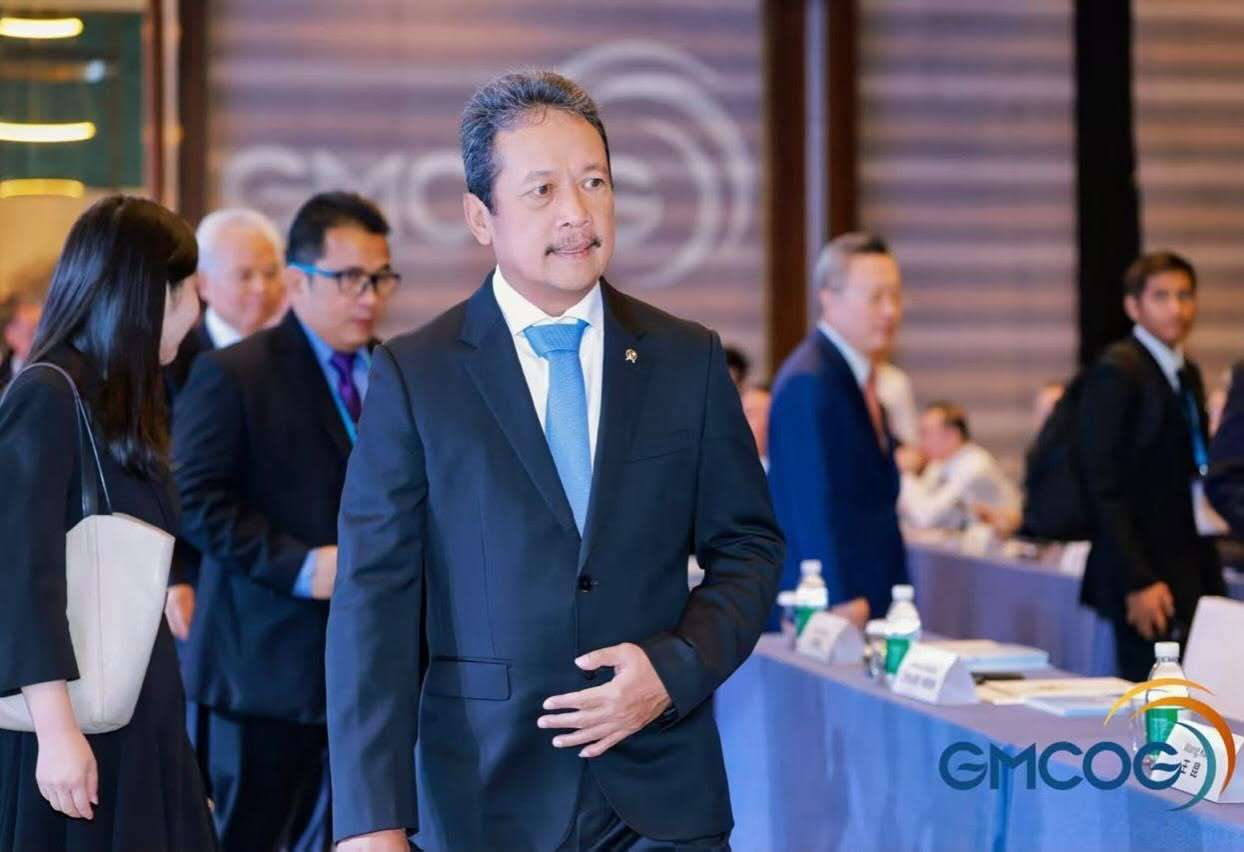
MARITIMEPOSTS.COM – SANYA, HAINAN, CHINA — Indonesia has reaffirmed its commitment to strengthening international cooperation in ocean governance, marine conservation, and sustainable fisheries, as Minister of Marine Affairs and Fisheries Sakti Wahyu Trenggono delivered a keynote address at the 7th Symposium on Global Maritime Cooperation and Ocean Governance in Sanya, Hainan, China.
The symposium brought together nearly 400 participants from more than 30 countries and regions, providing an international platform for dialogue on the future of ocean governance, shared maritime challenges, and the need for stronger global partnerships in protecting marine ecosystems.
In his address, Minister Trenggono emphasized that safeguarding the oceans requires collective action and a shared commitment among nations.
He highlighted the importance of implementing the 1982 United Nations Convention on the Law of the Sea (UNCLOS), advancing the Agreement on Biodiversity Beyond National Jurisdiction (BBNJ), combating Illegal, Unreported, and Unregulated (IUU) Fishing, and promoting the development of the Blue Economy.
These priorities reflect the growing need to align maritime development with ecological sustainability. As pressures on marine resources continue to intensify, international cooperation is essential to ensure that ocean-based economic activities remain responsible, equitable, and sustainable.
For Indonesia, the world’s largest archipelagic nation, the ocean represents far more than a source of natural resources. It serves as a vital connection between nations, communities, economies, and generations.
Minister Trenggono underscored this perspective, emphasizing that the ocean is both a shared responsibility and a common future. International collaboration, marine conservation, and sustainable fisheries must therefore remain central to global maritime policy.
The implementation of UNCLOS 1982 provides an essential foundation for international maritime cooperation, while the BBNJ Agreement represents an important step toward protecting marine biodiversity in areas beyond national jurisdiction.
Meanwhile, efforts to combat IUU fishing are critical to preserving fish stocks, protecting legitimate fishing activities, and strengthening the sustainability of the global fisheries sector.
The Blue Economy, in this context, offers an important pathway for advancing economic opportunities while maintaining the health of marine ecosystems. Its success depends on effective governance, science-based decision-making, and the active involvement of coastal communities.
Indonesia’s participation in the symposium reflects its continued engagement in international discussions on maritime affairs and its commitment to advancing a balanced approach to ocean governance—one that integrates economic development, environmental protection, and the welfare of communities dependent on marine resources.
As Minister Trenggono emphasized, the benefits of international maritime cooperation must be tangible, reaching communities while ensuring that marine ecosystems remain healthy and productive for future generations.
His message at the symposium was clear: the future of the ocean cannot be secured by individual nations acting alone. It requires a collective commitment to cooperation, conservation, and sustainable use.
“The sea connects more than it divides.”
This principle captures the essence of Indonesia’s maritime vision: a world in which the ocean serves not as a source of division, but as a foundation for shared prosperity, stronger international relations, and a sustainable future.