
MARITIMEPOSTS.COM = Sustainable shrimp farming is fundamentally not about accelerating growth or maximizing the volume of shrimp harvested. Its deeper philosophy is about creating environmental conditions that allow shrimp to live optimally, remain healthy, and follow their natural biological rhythms.
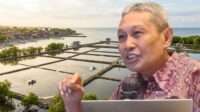
According to aquaculture expert Prof. Iqbal Djawad, shrimp are highly sensitive aquatic organisms. Farmers therefore do not actually “create life.” Instead, they provide the environmental conditions necessary for the shrimp life cycle to develop naturally and healthily.
This perspective brings an important shift in how ponds are understood. A pond is no longer treated as an isolated production unit, but as part of an interconnected ecosystem. Water quality, pond carrying capacity, stocking density, feed, energy, waste, mangroves, and the surrounding community all become components of a single system.
From Maximizing Production to Maintaining Balance
In a mass-production paradigm, the success of shrimp farming is often measured by how much shrimp can be produced in a single cycle. An ecological approach, however, places balance at the center of the production system.
Extreme stocking densities and pressure for rapid growth can increase stress on the pond environment. When the carrying capacity of the system can no longer support the biomass, various problems emerge, including declining water quality, stress, health disorders, and shrimp mortality.
The fundamental principle of sustainable farming, therefore, is not to maximize production at all costs, but to keep the system stable, consistent, and balanced.
The comfort of the cultured organism is an essential requirement that cannot be compromised. Shrimp need appropriate water quality, oxygen levels, salinity, and other environmental parameters to support their biological needs. When these conditions deteriorate, shrimp become stressed and more vulnerable to disease.
From this perspective, disease is not simply something that must be “cured.” Sick or dead shrimp can instead serve as indicators that a more fundamental problem exists within the pond system.
Prevention, therefore, becomes more important than treatment. Farmers need to identify and manage sources of stress and environmental imbalance from the very beginning.
Following Biological Rhythms
One of the greatest challenges facing the modern shrimp industry may not be technology, but mindset. The industry needs to be willing to follow the biological rhythms of shrimp rather than continuously forcing living organisms to conform to the logic of mass production.
This approach inevitably challenges the industrial tendency to prioritize high stocking densities, rapid growth, and large volumes of production inputs. The greater the degree of intensification, the greater the demands placed on the system to manage water, waste, energy, and biomass.
This is where alternative farming models become increasingly important, including Tradisional Plus, semi-intensive systems, and approaches designed to be more adaptive to climate change.
Tradisional Plus: Lower Production, More Manageable Risks
The Tradisional Plus model offers a relatively simple approach that can be adopted by small-scale farmers. Stocking density is kept low, at around 10 shrimp per square meter, while natural pond food is utilized as much as possible and supplementary feed is used on a limited basis.
The production target is approximately 500–900 kilograms per cycle, with shrimp reaching 10–15 grams within 60–90 days. With three to five cycles per year, annual productivity can reach around 2–3 tons per hectare.
The strength of this model lies in its relatively low capital and input requirements. Pond modifications are minimal, while additional aeration can be used selectively, particularly from nighttime until early morning.
For small-scale farmers, this approach can help reduce production costs while strengthening the resilience of their businesses. Tradisional Plus is also relatively compatible with the principles of the blue economy because it can be integrated with mangrove rehabilitation and other coastal livelihood activities.
Semi-Intensive Farming: Higher Productivity, More Complex Management
Unlike Tradisional Plus, semi-intensive systems operate at considerably higher stocking densities. One model developed by Ahmad Toyib in Karangrejo, for example, uses an initial stocking density of up to approximately 350 shrimp per square meter.
Such high density requires much stricter population management. One strategy is partial harvesting, in which portions of the shrimp population are harvested gradually to reduce crowding within the pond.
In practice, around 20–25 percent of the population may be harvested several times during the production cycle. This strategy helps keep biomass within the carrying capacity of the pond environment.
Semi-intensive systems also require more sophisticated water-management and monitoring technologies. A protein skimmer, for example, can help remove organic particles from the water, while parameters such as ORP (Oxidation Reduction Potential) can be used to monitor environmental conditions.
However, intensification also carries significant costs. Continuous operation of paddlewheels requires substantial energy. In some systems, electricity costs can reach approximately IDR 35 million per production cycle. For small-scale farmers, this can become a major financial burden, making cooperative arrangements an important potential solution for financing feed and operational expenses.
Nursery Ponds: Protecting the Golden Age of Shrimp
One innovation that can strengthen both farming models is the use of nursery ponds, locally known as pendederan or pencokolan. This approach moves the early rearing stage into a more controlled environment before the shrimp are transferred to larger grow-out ponds.
The early stage of shrimp development is a critical period. Within a stable nursery environment, post-larvae can receive more controlled nutrition and gradually adapt to environmental conditions.
This approach can strengthen shrimp resistance to stress and disease before they enter larger grow-out ponds. Shrimp raised through a nursery phase may also become better adapted to changes in salinity and other environmental fluctuations.
Field experience demonstrates the potential benefits of this approach. At CV Dewi Windu in Barru, for example, the nursery system achieved a survival rate of approximately 87.3 percent, compared with 73.2 percent under direct stocking. The Feed Conversion Ratio was also lower, at approximately 1.18 compared with 1.24.
At PT UMES in Tanah Bumbu, the nursery system achieved a survival rate of approximately 82.5 percent and generated nearly twice the production of the direct-stocking method.
Another example comes from the Raja Vaname group in Wringin Putih, which uses circular nursery ponds to control shrimp biomass during the early stage of development. Under certain conditions, the system has reportedly achieved survival rates of up to 100 percent before the shrimp are transferred to larger grow-out ponds.
The Pond as an Ecosystem
The most important lesson from these approaches is that the future of shrimp farming will not be determined by production technology alone. It will depend on humanity’s ability to understand ponds as ecosystems.
Integrated shrimp farming therefore becomes increasingly relevant. Ponds can be connected with wastewater treatment facilities, renewable energy systems, community-based organizations, and the protection and restoration of mangrove ecosystems.
Under such an approach, waste is not merely viewed as a by-product, but as part of a material flow that must be managed. Water is not simply a medium for shrimp production; it is also an indicator of the health of the entire system.
Ultimately, the success of shrimp farming should not be measured solely by production volume. More important questions need to be asked: Does the pond remain healthy after years of operation? Can farmers afford the production costs? Do coastal ecosystems continue to function? And does the surrounding community benefit?
If the answer is yes, shrimp farming is producing more than a commodity. It is building a healthy, resilient production system capable of sustaining both people and ecosystems across generations.
The future of shrimp farming, therefore, is not about how many shrimp can be forced to grow in a single pond, but about how well humans can create the conditions that allow life within that pond to thrive.