
Message for Local and National Stakeholders
- This industrial transformation requires a fundamental paradigm shift from mere exploitation toward ecological harmony. Shrimp farming should be viewed as an effort to provide an optimal environment, rather than simply “creating life.”
- The core philosophy is to maintain the “comfort” of aquatic organisms. Diseased shrimp are not the cause of the problem, but rather indicators (bio-indicators) of failure in the environmental management system.
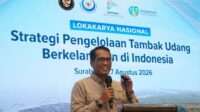
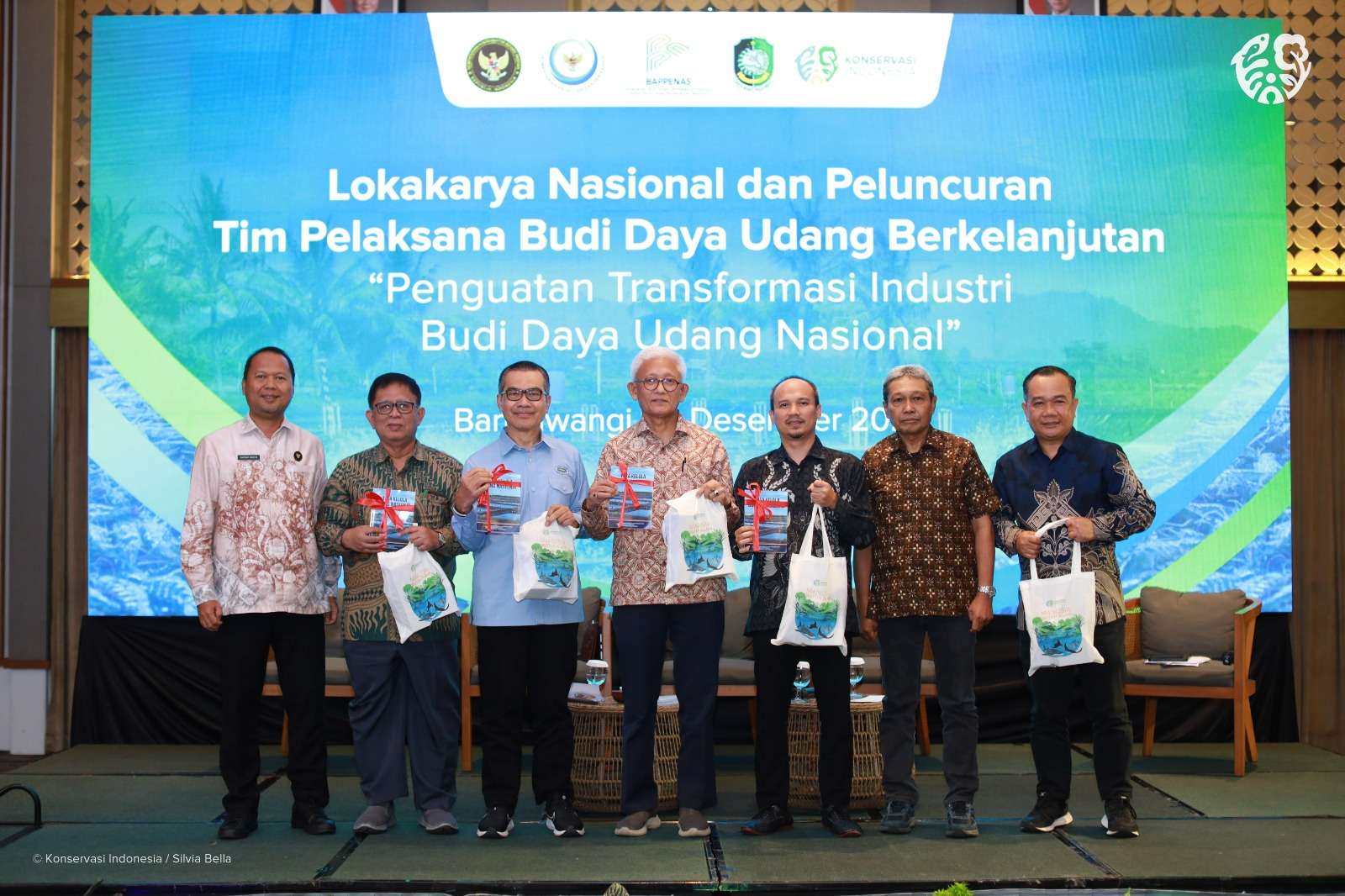
- The National Workshop and launch of the Sustainable Shrimp Farming Implementation Team on December 10, 2025, jointly organized by the Coordinating Ministry for Food Affairs, the East Java Provincial Government, and Konservasi Indonesia, marked a new milestone in strengthening Indonesia’s fisheries governance. It also provided an important lesson that needs to be continually refreshed among national shrimp-sector stakeholders.
MARITIMEPOSTS.COM — Banyuwangi is now strengthening its position not merely as a producer, but as the epicenter of a more focused, credible, and sustainable transformation of Indonesia’s shrimp-farming industry.
The National Workshop and launch of the Sustainable Shrimp Farming Implementation Team on December 10, 2025, jointly organized by the Coordinating Ministry for Food Affairs, the East Java Provincial Government, and Konservasi Indonesia, marked a new milestone in strengthening Indonesia’s fisheries governance. It also provided an important lesson that needs to be continually refreshed among national shrimp-sector stakeholders.
Deputy Assistant for Aquaculture Development at the Coordinating Ministry for Food Affairs, Cahyadi Rasyid, emphasized that the Banyuwangi initiative is tangible evidence of stronger cross-sectoral collaboration.
This initiative represents a strategic foundation for realizing the broader vision of making Indonesia the world’s number one aquaculture industry.
This transformation is crucial to supporting the national food self-sufficiency agenda outlined in the Asta Cita, positioning shrimp as a key pillar of a resilient blue economy.
Pelakita.ID identifies several important issues and messages for all stakeholders.
Field Reality: Turbulence and the Urgent Need for Industry Reform
Despite its enormous potential, Indonesia’s shrimp industry is currently experiencing a phase of technical and administrative turbulence that requires serious attention from policymakers.
Pathogen Threats and Food Safety: The sector has been shaken by the threat of White Spot Syndrome Virus (WSSV), as well as concerns over radioactive Cs-137 contamination, which have affected global market confidence in Indonesian shrimp exports, according to Cahyadi Rasyid.
Declining Technical Performance: Data presented by Budhi Wibowo, Chairman of the Indonesian Shrimp Forum (FUI), showed that the average Survival Rate (SR) declined to 56.08% during the 2020–2022 period.
Production efficiency has also deteriorated, with pond productivity declining from 11.76 tons/ha in 2021 to 10.68 tons/ha in 2022, driven by an increase in the Feed Conversion Ratio (FCR), which pushed up production costs.
Fragile Coastal Infrastructure: Blockages at river mouths in various production centers have sharply reduced water salinity, creating environmental conditions conducive to the spread of disease, according to Budhi Wibowo.
Administrative and Spatial-Planning Disorder: Based on KUSUKA data, only 16% of shrimp farmers possess a Business Identification Number (NIB).
Even more concerning, 43% of shrimp-farming locations are outside officially designated zones, with approximately 175,000 hectares still operating within forest areas, according to Cahyadi Rasyid.
Farming Philosophy: Shifting the Paradigm from Production to Environmental Management
This industrial transformation requires a fundamental paradigm shift from mere exploitation toward ecological harmony. Shrimp farming should be viewed as an effort to provide an optimal environment, rather than simply “creating life.”
The core philosophy is to maintain the “comfort” of aquatic organisms. Diseased shrimp are not the cause of the problem, but rather indicators—or bio-indicators—of failure in the environmental management system.
Therefore, maintaining stable water quality and respecting the carrying capacity of shrimp ponds are far more critical than pursuing high stocking densities that could ultimately damage the entire system.
Orchestrating Solutions: Concrete Government Measures and Upstream Innovation
The government and strategic partners have formulated systematic measures to restore the competitiveness of the industry.
Banyuwangi Sustainable Shrimp Farming Implementation Team: The team was established through Banyuwangi Regent Decree No. 100.3.3.2/252/KEP/429.011/2025.
The team has a strategic mandate covering cross-sectoral coordination, the application of environmentally friendly technologies, coastal rehabilitation, and river sedimentation management to maintain environmental carrying capacity.
Legal Certainty through Government Regulation No. 28/2025: Implementation of this regulation is intended to simplify risk-based business licensing, ensure transparency, and eliminate illegal levies that have burdened shrimp farmers.
Genetic Improvement in the Upstream Sector: The launch of the Nusa Dewa superior postlarvae brand by BPI U2K Karangasem represents an important innovation.
The technology employs selection based on Single Nucleotide Polymorphism (SNP) molecular markers to produce varieties with greater resistance to deadly diseases such as WSSV.
Strategic Synthesis: Awakening the “Sleeping Giant” through Appropriate Technology
A national revival strategy does not necessarily have to rely on large-scale capital. Drawing on Ecuador’s success in remaining competitive in the global market despite maintaining relatively low stocking densities of around 20 shrimp/m², FUI has proposed two adaptive strategies:
| Strategy | Brief Explanation | Key Benefits |
|---|---|---|
| Traditional Plus | Low stocking density of around 10 shrimp/m², relying on optimization of natural feed. | Low production costs, highly competitive, and environmentally friendly. |
| Nursery Pond | A nursery phase using specialized nursery technology to strengthen shrimp immunity. | Increases SR, reduces FCR, and improves adaptability to salinity fluctuations. |
Indonesia possesses a “Sleeping Giant” in the form of approximately 250,000 hectares of traditional shrimp ponds, whose current productivity is only around 200–400 kg/ha/year.
Through the “Traditional Plus” strategy, this potential could be increased to 2 tons/ha/year without opening new land, representing a significant production leap for national food security.
Economic Potential and Integration with National Strategic Programs
The shrimp sector is a lifeline for the regional economy. Banyuwangi Regional Secretary Guntur Priambodo noted that Banyuwangi’s shrimp exports reached USD 196 million in 2024.
Amid a Rp665 billion decline in central government transfers to local governments, optimizing the shrimp sector has become a strategic necessity for increasing locally generated revenue (PAD).
Going forward, the shrimp ecosystem will be integrated with two major national programs:
Free Nutritious Meals (MBG): Positioning shrimp as a high-quality source of animal protein for the younger generation.
Red and White Cooperatives (Koperasi Merah Putih): Transforming the coastal village economy by strengthening cooperatives as key players controlling domestic supply chains.
Strategic Recommendations for Stakeholders
To secure the future of the industry, the following integrated measures are required:
- Central Government: Establish a National Shrimp Taskforce or National Shrimp Commission as soon as possible to ensure policy consistency from upstream to downstream.
- Local Governments: Use Regent Regulations (Perbup) to provide a legal framework connecting local shrimp farmers with the supply chain for the Free Nutritious Meals (MBG) program.
- Business Sector: Improve regulatory literacy and accelerate the adoption of Good Fish Farming Practices (CBIB) standards.
- Infrastructure: Prioritize funding for dredging sediment at river mouths to maintain stable water-quality parameters in shrimp ponds.
Building an Ecosystem for Future Generations
The transformation of shrimp farming in Banyuwangi sends a powerful message: the success of the aquaculture industry can no longer be measured solely by production tonnage, but also by ecosystem health and the sustainability of partnerships.
As emphasized by Cahyadi Rasyid, what we build today is the solid foundation of Indonesian aquaculture, encompassing five key pillars: production, environment, governance, value chains, and partnerships.
This is the long road toward food sovereignty and equitable prosperity for coastal communities throughout Indonesia.
___
Written by K. Azis, Founder of Pelakita.ID