
- Evaluating fisheries development must move beyond raw production volumes and aggregate macroeconomic growth. While NTN and NTPi remain useful analytical indicators, they must be combined with direct assessments of net real income, operational cost reductions, household food affordability, energy access, work safety, and climate resilience.
- True success occurs when increased production results in lower operational expenses, protected purchasing power, and dignified living standards for coastal families.
MARITIEPOSTS.COM – In the national dialogue surrounding marine and fisheries development, macroeconomic indicators are routinely highlighted by decision-makers as definitive proof of policy success.
Production growth charts, expanding economic valuations, and positive welfare index trends regularly generate a narrative of optimism within government agencies, where index scores over 100 are celebrated as evidence of expanding coastal prosperity.
Behind these macro-level figures, however, lies a starkly contrasting reality across coastal communities. In many fishing villages, economic pressures are worsening.
Small-scale fishermen face mounting operational expenses, unpredictable fuel supplies, volatile prices for basic necessities, limited market access, and extreme weather risks that can halt fishing operations for weeks at a time. This sharp divergence between statistical optimism and daily operational hardship highlights a critical question: to what extent do macro statistics truly reflect the economic welfare of coastal fishermen?
The Fallacy of the 100+ Index (Why a Rising NTN Doesn’t Mean Prosperity)
The Fishermen’s Exchange Rate (Nilai Tukar Nelayan or NTN) and the Fish Farmers’ Exchange Rate (Nilai Tukar Pembudidaya Ikan or NTPi) are widely utilized as key metrics to gauge the economic health of fisheries operators. Metrologically, NTN measures the ratio between the price index received by producers (I_t) and the price index paid by them (I_b). An index score above 100 is conventionally interpreted to mean that revenues outweigh expenditures.
However, relying on an aggregate index score above 100 as a single measure of prosperity obscures structural poverty and masks deep variances across distinct coastal sub-groups.
Small-scale non-motorized fishers, motorized boat operators, large vessel crews, and aquaculture farmers across freshwater, brackish, and marine systems each operate under vastly different cost structures and vulnerability thresholds. An increase in fish prices at the producer level does not yield higher net income if production and living expenses rise at a faster rate.
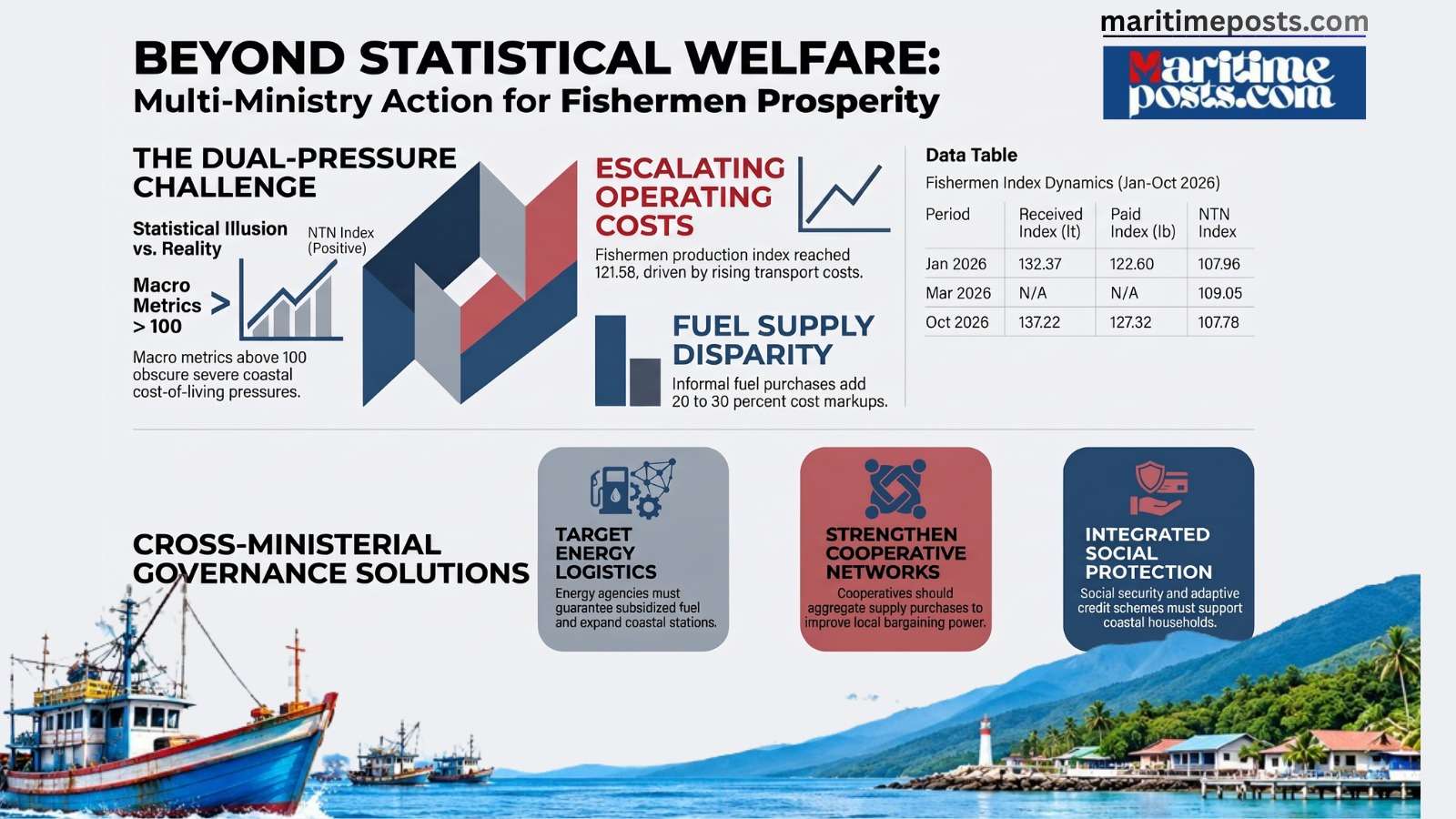
Data from the Central Bureau of Statistics (BPS) covering January through October 2026 (base year 2018=100) illustrates this dynamic clearly:
- January 2026: NTN stood at 107.96.
- March 2026: NTN peaked at 109.05.
- August 2026: NTN held at 109.04.
- September 2026: NTN adjusted downward to 108.85.
- October 2026: NTN declined to 107.78.
While the price index received by fishermen (I_t) rose from 132.37 in January to 137.22 in October, the price index paid (I_b) escalated even faster—climbing from 122.60 to 127.32. Consequently, higher gross receipts failed to improve net purchasing power, narrowing the real economic space of fishing households.
“Statistical figures are tools to read reality, not a replacement for reality itself.”
The Double Squeeze—Production Costs vs. Household Inflation
Coastal families face simultaneous financial compression on two distinct fronts: rising production inputs and escalating household consumption costs.
Production Pressure: The Production Cost and Capital Goods Addition Index (BPPBM) for fishermen increased from 117.19 in January to 121.58 in October 2026. A primary driver was the transportation and communication component, which climbed from 121.79 to 129.85, reflecting extended supply chains and inadequate coastal connectivity.
Fish farmers face similar input pressures due to reliance on commercial feed, rising seed costs, and energy expenditures for pumping and aeration.
While government interventions such as the Independent Fish Feed Movement (Gerakan Pakan Ikan Mandiri or Gerpari) aim to reduce feed costs, their long-term viability remains heavily constrained by local raw material availability, production technology, and competitive input pricing.
Household Pressure: The Household Consumption Index (IKRT) for fishermen increased from 127.46 in January to 132.43 in October 2026. The specific sub-index for food, beverages, and tobacco jumped from 132.88 to 139.12.
This double squeeze creates a severe financial trap during periods of adverse weather. When high waves force fishermen to stay ashore, household income drops to zero. However, household consumption expenses continue uninterrupted. In remote islands and isolated coastal areas, high transportation logistics exacerbate these costs, driving basic food prices far above urban market rates.
The 30% Energy Penalty in Remote Coastal Villages
Fuel—specifically subsidized diesel—represents the single largest operational cost in capture fisheries, directly determining whether a fishing voyage is economically viable.
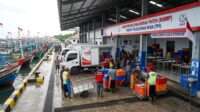
Despite its critical importance, fuel distribution to small-scale fishermen suffers from persistent systemic bottlenecks: administrative delays in obtaining official recommendation letters, an insufficient number of Fishermen Fuel Filling Stations (SPBUN), and quota uncertainties.
At the coastal village level, these logistical bottlenecks directly collide with unpredictable environmental conditions. When brief weather windows open, fishermen cannot afford to wait days for bureaucratic approvals or delayed fuel shipments without missing their chance to catch fish.
Cut off from official SPBUN outlets, they are forced to buy fuel from informal resellers at price markups 20% to 30% higher than official rates.
This severe energy penalty absorbs a substantial share of operating margins, forcing fishermen to take extreme financial and physical safety risks just to head out to sea. Capital that should be designated for household survival, education, engine maintenance, or emergency savings is instead spent entirely on inflated informal fuel costs.
The Governance Blindspot—Why the Fisheries Ministry (KKP) Cannot Act Alone
A fundamental flaw in coastal policy design is treating the Ministry of Marine Affairs and Fisheries (KKP) as the sole institution accountable for fishermen’s welfare metrics like NTN and NTPi.
While KKP maintains a strategic role in developing business capacity, improving productivity, and constructing sector-specific marine infrastructure, it lacks the legal mandate to control national energy prices, regulate food distribution networks, administer social safety nets, or construct foundational coastal infrastructure.
Placing sole responsibility on KKP oversimplifies a multi-dimensional structural crisis and prevents the implementation of comprehensive policy solutions.
“Persoalan BBM ini memperlihatkan bahwa masalah kesejahteraan nelayan sesungguhnya tidak hanya berada dalam kewenangan Kementerian Kelautan dan Perikanan (KKP)… Kementerian ini tidak memiliki kewenangan tunggal untuk mengendalikan harga energi, mengatur seluruh rantai distribusi pangan, menyediakan perlindungan sosial, atau membenahi seluruh infrastruktur dasar di kawasan pesisir.”
“The fuel issue demonstrates that the problem of fishermen’s welfare does not fall solely under the authority of the Ministry of Marine Affairs and Fisheries (MMAF). The Ministry does not have exclusive authority to control energy prices, regulate the entire food distribution chain, provide social protection, or address all basic infrastructure challenges in coastal areas.”
The “Cross-Ministry Symphony”—3 Strategic Agendas for True Welfare
Addressing the multi-dimensional challenges of coastal poverty requires a coordinated cross-ministry framework (Orkestrasi Lintas Kementerian) with explicit jurisdictional mandates, regional integration, and unified data architecture:
- Ministry of Energy and Mineral Resources (ESDM), BPH Migas, & PT Pertamina: Guarantee targeted subsidized diesel allocations, prioritize SPBUN construction in high-density fishing centers, and streamline digital quota verification to reduce administrative friction.
- Local Governments (Pemerintah Daerah): Modernize fishery ports, landing sites, and Fish Auction Markets (TPI) into productive economic hubs; maintain essential ice plants, clean water supplies, coastal sanitation, and road connectivity; and simplify administrative procedures for fuel recommendation letters.
- Ministry of Cooperatives: Transform fishermen’s cooperatives into professional business entities capable of bulk-purchasing fuel, ice, gear, and feed to eliminate predatory intermediaries and strengthen collective bargaining power.
- Financial Institutions (Himbara, KUR, LPMUKP): Establish adaptive credit frameworks tailored to marine seasonal risks, natural weather cycles, and non-linear income patterns rather than applying standard urban commercial metrics.
- Food and Trade Authorities (National Food Agency, Perum BULOG, Ministry of Trade, Regional Inflation Control Teams – TPID): Implement targeted food price stabilization and market operations in remote islands, scheduling interventions around fishing off-seasons and weather calendars.
- Social Protection Institutions (Kemensos, Kemenkes, BPJS Health/Employment, Housing Ministries): Ensure universal access to social safety nets, occupational accident coverage, basic healthcare, clean water, and resilient coastal housing.
The Mandatory Engine: Integrated Baseline Dataset (Basis Data Terintegrasi)
Cross-ministerial orchestration cannot function when individual agencies rely on fragmented, siloed data. True convergence requires an Integrated Baseline Dataset that unifies vessel registries, gear types, landing locations, fuel recommendation quotas, household poverty indicators, and social security coverage into a single operational system. This dataset serves as the core intelligence engine enabling precise policy interventions.
The 3 Core Strategic Agendas
- Policy Convergence for Energy and Infrastructure Logistics: Securing affordable, reliable access to subsidized fuel, ice, cold-chain systems, and port infrastructure through synchronized action between ESDM, Pertamina, KKP, and local governments while streamlining administrative procedures.
- Coastal Purchasing Power Protection: Safeguarding island household resilience by stabilizing basic food supply chains and consumer prices during extreme weather closures and seasonal off-seasons via BULOG, trade agencies, and TPID.
- Institutional Strengthening and Financial Inclusion: Empowering professional cooperatives to aggregate production inputs and expanding adaptive, weather-indexed credit schemes and universal social safety nets driven by an integrated baseline dataset.
Expanding the Metrics of Success
Evaluating fisheries development must move beyond raw production volumes and aggregate macroeconomic growth. While NTN and NTPi remain useful analytical indicators, they must be combined with direct assessments of net real income, operational cost reductions, household food affordability, energy access, work safety, and climate resilience.
True success occurs when increased production results in lower operational expenses, protected purchasing power, and dignified living standards for coastal families.
As national development policies evolve, how should governments reframe their metrics of success to ensure that growth in rural and coastal economies is measured by lived security rather than statistical assumptions?