
MARITIMEPOSTS.COM – The sea does not always have to be explored farther offshore to find fish. In several coastal areas, a new approach is emerging: bringing fish habitats closer to the everyday environment of fishing communities. The concept is based on ecosystem restoration rather than simply increasing fishing equipment.
This idea emerged during a meeting held at the headquarters of the Indonesian National Fishermen’s Association (HNSI) in Jakarta last Wednesday. What began as an audience with the Fish House Habitat (HARI) community opened a discussion on the potential integration of ecological innovation into the government’s flagship Red-and-White Fishing Village (Kampung Nelayan Merah Putih, or KNMP) program.
In attendance were several HNSI national board members led by Secretary-General Lydia Assegaf, S.E., alongside representatives of PT Delta Anugerah Bahari (DAB) Nusantara. They included Chairman Bambang Haryono, CEO Donny Kurniawan, and Dr. M. Abduh Ibnu Hajar, S.Pi., M.P., an academic from Hasanuddin University who serves as an expert and consultant in technological innovation and development for HARI.
For a layperson, the meeting offered an opportunity to understand how science and technology can address fundamental challenges facing coastal communities: declining fish availability, rising operational costs at sea, and economic vulnerability caused by pressure on marine resources.
HARI offers an intriguing approach. Through artificial habitat structures and planned area management, the innovation seeks to restore the biological productivity of coastal waters while creating potential fishing grounds closer to shore.
When Fishermen Have to Go Farther Offshore
The problem HARI seeks to address reflects the reality faced by many fishing communities. Fishing pressure, illegal fishing practices, and habitat degradation can undermine the ability of marine ecosystems to provide resources sustainably.
As fish stocks decline in nearby fishing grounds, fishermen face difficult choices. They must expand their fishing areas, spend more time at sea, and incur higher fuel costs, while their catches do not necessarily increase in proportion to their expenses.
In this situation, habitat restoration becomes essential. It is not only about protecting fish populations but also about restoring the productivity of coastal waters that underpin the local economy.
Ibnu explained that HARI technology is designed to bring fishermen closer to potential fishing grounds.
“Fishermen no longer need to travel far offshore. They can obtain fish just about one mile from the coast,” he said.
This statement is one of the most compelling aspects of the HARI innovation. If such conditions can be achieved consistently at implementation sites, fishermen may be able to save time and fuel while reducing the risks associated with traveling farther into the sea.
Nevertheless, a distance of one mile from shore does not universally guarantee good catches. Marine productivity remains influenced by ecosystem characteristics, oceanographic conditions, fish species, seasonal patterns, and area management. Measuring catch volumes and operational costs before and after implementation is therefore essential to assessing the actual benefits.
From Fish House Trees to Productive Habitats
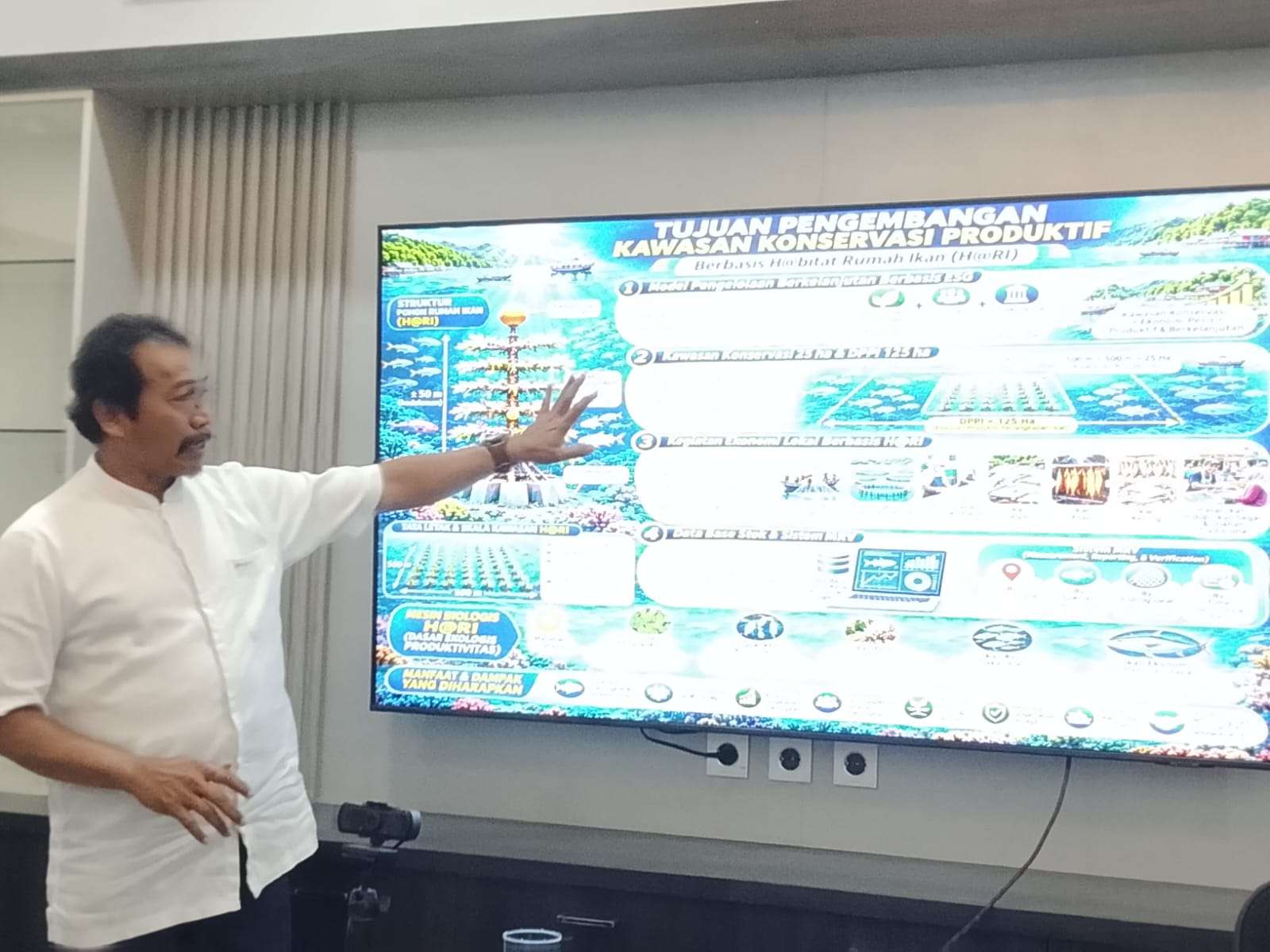
Technically, HARI development began with an innovation called Pohon Rumah Ikan (PARI), or Fish House Tree. It is a vertical artificial habitat structure designed to resemble an underwater tree.
The structure consists of a main buoy, a main rope, attractor branches installed at intervals of approximately 1.5 meters, and a concrete weight placed on the seabed. This arrangement is designed to provide space for marine organisms and attract fish.
PARI is the physical structure that forms part of the initial HARI development. HARI, meanwhile, refers to the habitat and area-management approach that emerges through the interaction of the structure with biological processes and the surrounding marine environment.
Over time, the structure’s surfaces can be colonized by organisms such as periphyton and supported by plankton productivity. These organisms provide food sources and living spaces for various marine species.
In its development, the PARI structure is expected to function as a shelter, feeding ground, nursery ground, and aggregation site for different fish species. These biological processes form the foundation for efforts to establish productive habitats in coastal waters.
However, the presence of artificial structures does not automatically guarantee a permanent increase in fish stocks. Fish aggregation around a structure must be distinguished from the growth of fish populations as a whole. Ecological monitoring is necessary to ensure that the innovation genuinely supports resource recovery rather than merely concentrating fish in a particular location.
This is where scientific knowledge becomes critical. Structural design, site selection, seabed characteristics, currents, depth, and fishing activity regulations must all be incorporated into the planning process.
Two Hectares to Enhance Productivity Across 125 Hectares
One of the most interesting concepts in HARI development is the use of a relatively small core conservation area to enhance productivity in surrounding waters.
Ibnu explained that, under the proposed development concept, a conservation area of approximately two hectares could serve as a center for habitat restoration and fish stock enhancement. From this core area, potential fishing grounds are expected to develop across an area of up to 125 hectares.
The concept seeks to connect ecosystem protection with fishermen’s economic activities. The core area serves as a space for restoration and protection, while surrounding waters can become areas for regulated and sustainable use.
This approach differs from artificial habitat development that focuses solely on placing structures on the seabed or within the water column. HARI positions the habitat structure as part of a broader ecological spatial-management framework.
Nevertheless, the two-hectare and 125-hectare figures should be understood as a development design or potential area described by the source. Their effectiveness depends heavily on site conditions, habitat connectivity, fish movement patterns, and the management rules implemented.
A productive conservation area cannot simply be designated on a map. It requires community agreements, clear spatial boundaries, monitoring, and mechanisms to ensure that fishing activities do not undermine habitat restoration.
Raja Ampat and the Blue Economy Opportunity
HARI has been developed in several regions across Indonesia. Ibnu mentioned Tanjung Bira in Bulukumba Regency, Pangkep Regency, Raja Ampat, Batam, Merauke, Sorong Regency, and several other locations as areas involved in collaborative innovation development.
The experience in Raja Ampat, Southwest Papua, is one of the examples described by Ibnu. In the area, fish house habitats are intended not only to support fish populations but also to create opportunities for marine tourism.
Ecologically attractive areas can be developed for activities such as fish-feeding tourism, recreational fishing, and fish therapy. These activities may provide fishermen with additional income beyond their daily fishing operations.
“With this innovation, we can maintain fish stocks while creating additional income for fishermen through recreational fishing activities. This means the economy and ecology can remain balanced in realizing the blue economy,” Ibnu explained.
This idea is important because fishermen’s welfare does not always have to depend on increasing catch volumes. Income diversification can reduce dependence on fish resources, particularly when marine conditions are unfavorable.
HARI development has also reportedly attracted interest from local governments and the private sector through corporate social responsibility (CSR) funding schemes.
However, marine tourism opportunities still require sound governance. Tourism activities must respect environmental carrying capacity, avoid disrupting conservation functions, and ensure that economic benefits are not limited to operators or outside parties but also reach the fishing communities responsible for maintaining the area.
Assessing Economic Potential Through Measurable Data
During the meeting, Ibnu also presented a simulation of HARI’s potential production and economic value based on minimum assumptions.
A group consists of 50 fishermen working in shifts. Each fisherman is assumed to catch 2.5 kilograms of fish per day. This would result in a total group production of 125 kilograms per day.
If fishing activities take place over 25 days, the group’s estimated monthly production would reach 3.125 tonnes.
Ibnu cited a potential economic value of Rp187.5 million per month, equivalent to Rp2.25 billion annually.
These figures are attractive, but they must be interpreted carefully. With monthly production of 3,125 kilograms, the value of Rp187.5 million assumes an average fish price of Rp60,000 per kilogram. This represents simulated turnover or production value, not necessarily the net income received by fishermen.
Fuel, equipment maintenance, labor, distribution, and actual selling prices will affect the income remaining after expenses. In addition, the assumed catch of 2.5 kilograms per fisherman per day needs to be tested through actual field production records.
In the context of fishermen’s empowerment, such data are essential. A promising innovation must not only demonstrate potential but also provide measurable evidence of change: how much catches have increased, how much operational costs have declined, and how household incomes have changed.
HARI and the Future of Red-and-White Fishing Villages
The meeting at HNSI headquarters opened discussions on how HARI could be integrated with the Red-and-White Fishing Village (KNMP) program, a government priority under President Prabowo Subianto.
KNMP faces more than the challenge of building physical infrastructure in coastal areas. The program’s success will also depend on its ability to develop fisheries businesses, strengthen fishermen’s institutions, and ensure that fish resources remain available.
Within this framework, HARI offers an additional perspective: fishing village development needs to be connected to marine ecosystem restoration as the foundation of production.
Piers, fish landing facilities, storage infrastructure, and business-support facilities will be more meaningful if fishermen have access to productive fish resources. Conversely, marine productivity needs to be supported by institutions, market access, and effective business management.
The potential synergy between HARI and KNMP cannot therefore be realized simply by installing habitat structures in waters surrounding fishing villages. It requires joint planning that includes site selection, ecological assessments, fishermen’s participation, spatial management, fish stock monitoring, and evaluation of economic benefits.
Fishermen must be positioned as the principal actors, not merely recipients of technology. They need to be involved from the planning and construction stages through to monitoring and benefit management.
Local governments, the Ministry of Marine Affairs and Fisheries, academics, fishing communities, and the private sector must also have clearly defined roles. Such collaboration will determine whether HARI can develop into a sustainable approach or remain a technology project that ends once construction is completed.
Restoring the Sea, Strengthening Fishermen
HARI demonstrates how coastal development can connect technology, biological productivity, conservation, and community economics. The concept creates space for a development approach that is not solely focused on physical infrastructure but also on restoring the environmental carrying capacity.
However, the success of ecological innovation cannot be measured by the number of structures installed or the area planned. Its primary indicators must be measurable changes: restored habitats, protected fish stocks, more efficient fishing operations, and sustainably increased community incomes.
If these principles guide its implementation, HARI could become one of the innovations supporting KNMP. It offers a reminder that the future of fishing villages is determined not only by what is built on land but also by how the surrounding sea is cared for.
For fishermen, the sea is more than a place to catch fish. It is their source of life. And protecting its productivity means protecting the future of coastal communities.
___
Source: M. Rusman Madjulekka
Editor K. Azis