

- DFW Indonesia welcomed the swift response by the Ministry of Marine Affairs and Fisheries (MMAF), through the Directorate General of Marine and Fisheries Resources Surveillance (PSDKP), in following up on a viral video and public reports concerning the alleged assault of crew members aboard KM Maulana 23.
- A PSDKP patrol team located and secured KM Maulana 23 while the vessel was operating in the Aru and Arafura Seas. The vessel, along with approximately 28 crew members, was subsequently taken to the PSDKP Working Unit in Dobo, Aru Islands, for further examination.
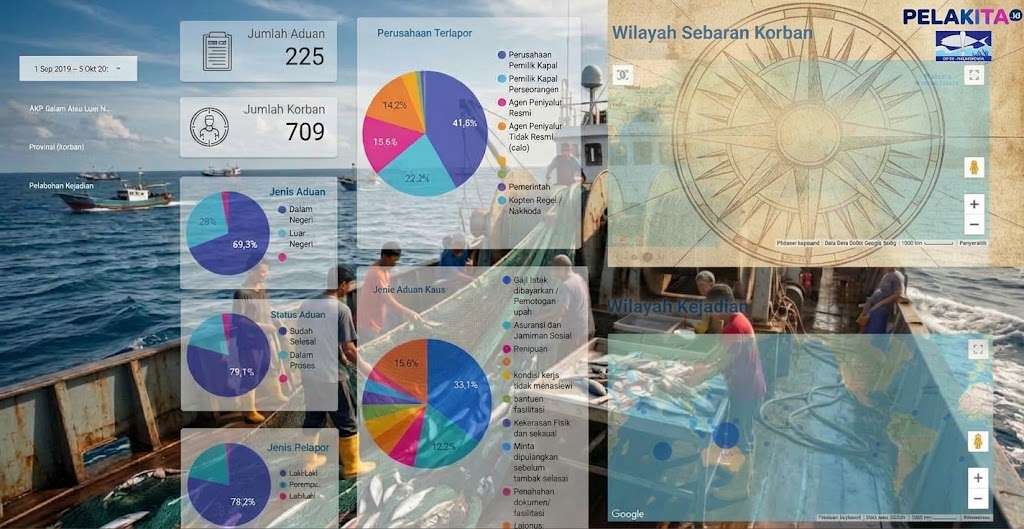
- As of September 2026, the National Fisher Center (NFC) had received 225 complaints involving at least 709 victims. The complaints covered issues including wages, employment relations, recruitment processes, working conditions, alleged violence, and other forms of labor rights violations.
PELAKITA.ID — The alleged violence against crew members aboard the fishing vessel KM Maulana 23 is yet another warning that the protection of fishing workers in Indonesia cannot be considered adequate simply because regulations are already in place.
The case came to public attention after footage allegedly showing violence against crew members circulated widely. The video captured one incident, but it also raises a much larger question: how many cases of violence and violations of crew members’ rights occur without ever being recorded, reported, or known to the public?
Laode Hardiani, Senior Program Officer at DFW Indonesia, said the KM Maulana 23 case should not end with the inspection of one vessel or the handling of a single incident.
Instead, it should be viewed as a reminder of the vulnerability of fishing workers who operate far from shore and often work within unequal employment relationships.
What about crew members who are afraid to report abuse? What about those who do not know where to seek help, fear losing their jobs, face threats, or simply do not believe their complaints will be followed up?
“This case shows that protection for fishing crew members cannot begin only after an incident goes viral. The government must ensure that prevention, monitoring, complaint mechanisms, and response systems are functioning before victims emerge and before cases attract public attention,” Laode said.
709 Victims in 225 Complaints
Complaint data from the National Fisher Center (NFC), managed by DFW Indonesia, indicates that labor-related problems in the fishing sector are not isolated incidents.
As of September 2026, the NFC had received 225 complaints involving at least 709 victims. The complaints included issues related to wages, employment relations, recruitment, working conditions, alleged violence, and other forms of rights violations.
According to Laode, these figures do not capture the full scale of problems facing fishing workers. Rather, they represent only those cases that have successfully entered the complaint system.
“The 225 complaints involving at least 709 victims recorded by the NFC represent only the portion of the problem that has been identified. There may be many more cases that have never been reported,” he said.
The number of complaints, therefore, should not be treated as the sole indicator of the effectiveness of worker protection. Fewer complaints do not necessarily mean fewer violations. They may instead indicate that more workers lack the courage, access, or confidence to report abuse.
MMAF’s Swift Response Needs Continued Oversight
DFW Indonesia welcomed the swift response by the Ministry of Marine Affairs and Fisheries (MMAF) through the Directorate General of Marine and Fisheries Resources Surveillance (PSDKP), which followed up on the viral video and public reports concerning the alleged assault of crew members aboard KM Maulana 23.
A PSDKP patrol team located and secured KM Maulana 23 while the vessel was operating in the Aru and Arafura Seas. The vessel, along with approximately 28 crew members, was subsequently taken to the PSDKP Working Unit in Dobo, Aru Islands, for further examination.
The MMAF has also stated that it suspended the operational permit of KM Maulana 23 and will coordinate with the police in pursuing the alleged criminal assault.
Meanwhile, Dr. Ady Candra, Director of Fisherfolk Protection and Empowerment, said the case involving KM Maulana 23 was a serious concern, as the protection of fishers and fishing vessel crew members must be an integral part of capture fisheries governance.
“KKP is not only responsible for ensuring that fishing activities are carried out in accordance with applicable regulations, but also for ensuring that people working aboard fishing vessels receive adequate protection, safety, and legal certainty regarding their rights,” he said.
“Surveillance and enforcement measures against vessels suspected of violations must go hand in hand with efforts to ensure that crew members’ rights are fulfilled. Therefore, every report or finding concerning alleged violence, violations of employment relations, wage-related violations, or poor working conditions must be followed up seriously in accordance with the relevant authorities and applicable laws,” he explained.
Ady Candra stressed that the protection of fishers and fishing vessel crew members must not stop at responding to problems after they occur.
“Prevention through training and guidance, monitoring, compliance with employment documents, maritime safety, and coordination with relevant ministries and agencies are essential to ensuring that similar incidents do not happen again,” he said.
KKP Expert Advisor on the Protection of Fishers and Fishing Vessel Crew Members, Mohammad Andi, added that fishing vessel crew members are workers who face significant risks because they work for extended periods in environments that are far removed from public oversight.
“That is why protection must begin at the recruitment stage, before they board a vessel, rather than only being provided after a problem occurs. The KM Maulana 23 case needs to be examined comprehensively—not only in terms of the alleged violence, but also the recruitment process, the clarity of employment agreements, wage systems, social security coverage, and the occupational safety and health conditions of the crew,” he said.
According to Abdi, Indonesia now has a stronger legal framework for protecting fishing vessel crew members, particularly following the ratification of ILO Convention No. 188.
“The challenge is to ensure that all these provisions are genuinely implemented in the field and become standards that are respected by vessel owners, companies, recruitment agencies, and other relevant parties. Protecting fishing vessel crew members requires cross-sectoral cooperation involving KKP, the Ministry of Manpower, the Ministry of Transportation, law enforcement agencies, local governments, and businesses, so that crew members’ rights do not remain merely written provisions on paper,” he said.
Laode said the legal process must be comprehensive. All parties allegedly involved should be examined in accordance with applicable law while ensuring the safety, protection, and rights of victims and witnesses.
Administrative sanctions are important as a regulatory and enforcement instrument, but they must not replace criminal proceedings when there are indications of a criminal offense.
“Administrative sanctions are important, but justice for victims requires a comprehensive legal process,” he stressed. “For us, the KM Maulana 23 case is a strong alarm about the urgent need for comprehensive protection of fishing workers,” he added.
Regulations Exist. Enforcement Must Go Beyond Paper
The KM Maulana 23 case is also a reminder that the government needs to strengthen oversight across the entire fishing labor chain, from recruitment to the moment workers return ashore.
Indonesia has ratified ILO Convention No. 188 on Work in Fishing through Presidential Regulation No. 25 of 2026. The convention establishes standards covering employment agreements, occupational safety and health, medical care, accommodation, food, rest periods, and social security.
“Following ratification, the government’s responsibility becomes even more important: ensuring that all provisions of ILO Convention 188 are translated into policies, monitoring systems, services, and protections that are genuinely experienced by crew members aboard fishing vessels,” Laode said.
The challenge now is implementation.
The government must ensure that recruitment procedures, employment contracts, wage payments, working hours, rest periods, occupational safety and health, social security, and complaint mechanisms are actually functioning as required.
Oversight must not wait for complaints to emerge. It needs to begin at the recruitment stage and continue through placement, departure, operations at sea, and the workers’ return to shore.
Possible Human Trafficking Must Also Be Investigated
Beyond the allegations of violence, the possibility of human trafficking should also be investigated if the examination uncovers relevant indications.
Investigations should not focus solely on what happened after the crew members boarded the vessel. The entire chain of events needs to be examined, including recruitment practices, recruiters or intermediaries, information and promises made to prospective crew members, employment contracts, social security entitlements, and the conditions workers experienced at sea.
If elements of human trafficking or other criminal offenses are identified, legal proceedings should be pursued in accordance with applicable laws, while ensuring justice and recovery for victims.
The KM Maulana 23 case should not end as a story about one vessel and one alleged incident of violence. It should become a moment to ask more fundamental questions about Indonesia’s system for protecting fishing workers.
Do not wait for a camera to record abuse. Do not wait for victims to find the courage to speak. Do not wait for social media to make a case go viral.
Fishing crew members are workers with the right to occupational safety and health, fair wages, humane treatment, and a workplace free from violence and intimidation.
They work far offshore, leaving their families for months at a time while facing harsh weather, accident risks, demanding working conditions, and limited access to protection and essential services.
At the same time, their labor feeds a supply chain that ultimately reaches household tables, domestic markets, and even high-end restaurants. The dignity of the people who catch our fish should be part of the value we place on the fish we consume.
Protecting fishing workers is not an act of charity. It is a state obligation and an essential part of responsible fisheries governance.
Don’t Stay Silent. Report It.
Fishing crew members, families, fellow workers, and members of the public who become aware of violence or violations against fishing workers should not remain silent.
Violence, threats, intimidation, exploitation, document retention, wage disputes, unsafe working conditions, suspected human trafficking, and other forms of abuse should be reported through available complaint mechanisms.
The National Fisher Center (NFC) provides information, education, and complaint services for fishing workers.
“If you experience abuse, don’t face it alone. If you know about it, don’t stay silent. Report it.”
Behind every vessel at sea are people who work, families who wait, and a state with a responsibility to ensure that those workers return home safely.
The KM Maulana 23 case should mark a turning point: protection for fishing workers must work before the camera turns on, not only after a video goes viral.
National Fisher Center (NFC) Complaint Service
Information • Education • Crew Complaints
Hotline: 0811-1437-575