
In several cases documented by the National Fishers Center Indonesia (NFC-I) and Destructive Fishing Watch (DFW) Indonesia, fishing crew members facing prolonged working hours, withheld wages, confiscated identity documents, threats, and degrading conditions made a desperate choice.
MARITIMEPOSTS.COM – The sea is supposed to be a workplace, a source of livelihood, and an essential part of Indonesia’s national economy, connecting fishing communities with consumers across the archipelago and beyond.
For some Indonesian fishers, however, the sea has become something much darker: a place where escaping exploitation can mean jumping into open water and gambling with death.
In several cases documented by the National Fishers Center Indonesia (NFC-I) and Destructive Fishing Watch (DFW) Indonesia, fishing crew members facing prolonged working hours, withheld wages, confiscated identity documents, threats, and degrading conditions made a desperate choice.
They jumped overboard.
They knew the sea could kill them, yet the prospect of remaining aboard vessels where they felt trapped and exploited appeared even more unbearable than the danger of drowning.
That single act captures a contradiction at the heart of Indonesia’s expanding Blue Economy, an ambitious development agenda that presents the ocean as a source of economic growth, investment, food security, employment, and national prosperity.
The fish eventually reaches a market, a supermarket, a processing facility, or an expensive restaurant, but the worker who caught it may return home with little money, unpaid wages, debt, trauma, or sometimes never return at all.
According to preliminary data from Statistics Indonesia (BPS), fisheries contributed approximately 2.54 percent of Indonesia’s GDP in 2025, increasing gradually from around 2.1 percent in 2010.
Those figures suggest a sector that has expanded steadily within the national economy, yet economic growth tells only one part of the story because production statistics rarely reveal what happens to workers far beyond the reach of public scrutiny.
The complaint records compiled by NFC-I between 2019 and 2025 documented 188 complaints involving 571 victims, exposing a pattern of vulnerability that challenges assumptions about where exploitation in fisheries actually occurs.
Contrary to the familiar international narrative that severe abuse primarily occurs aboard foreign vessels or in distant fishing grounds, 68 percent of the recorded complaints involved workers on domestic fishing operations inside Indonesia.
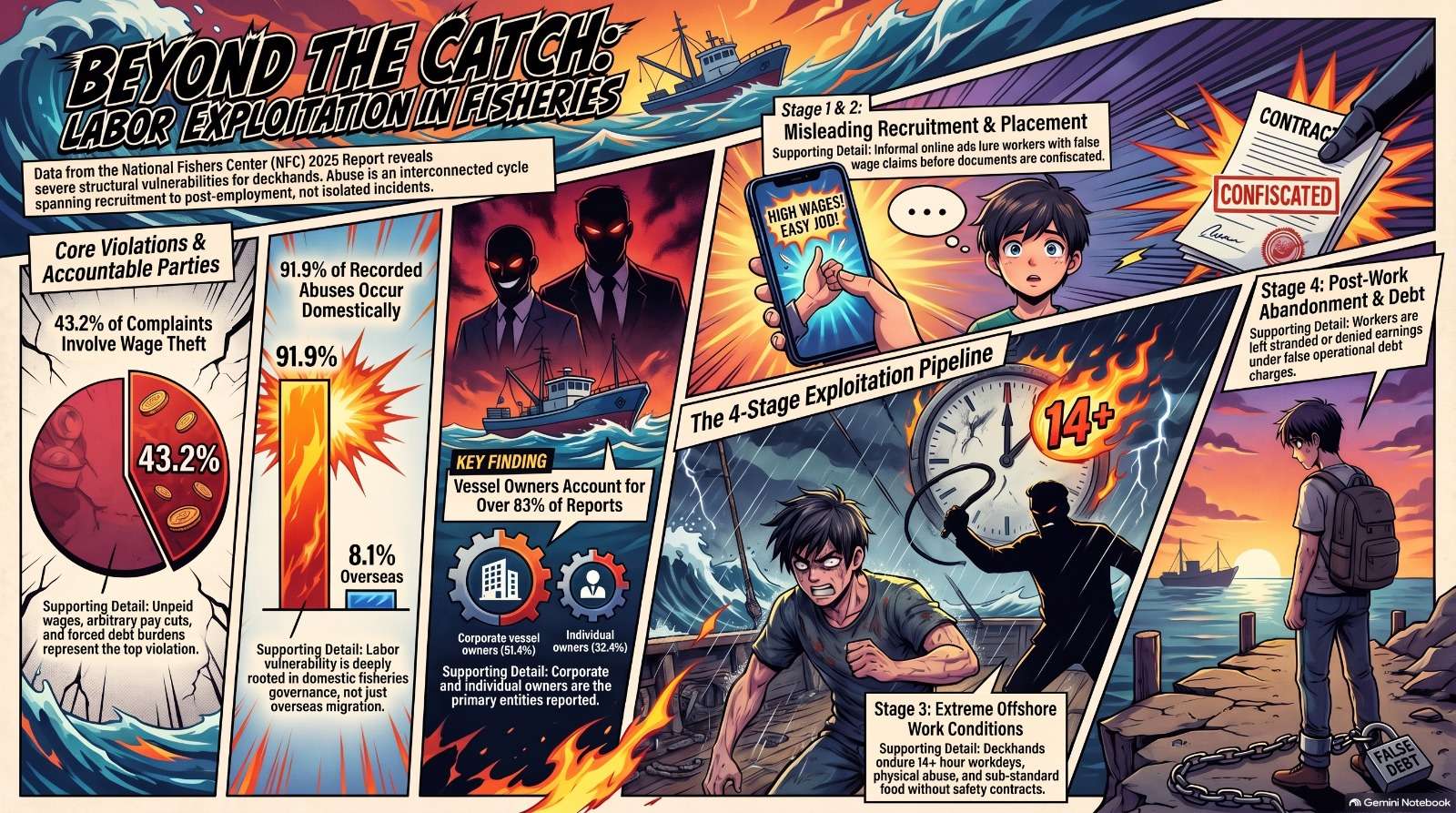
During the December 2024–November 2025 reporting period, the concentration became even more striking, with 91.9 percent of complaints involving domestic operations, representing 37 cases and 113 individual victims.
The crisis, therefore, is not necessarily happening somewhere beyond Indonesia’s horizon, on distant foreign-flagged vessels that consumers rarely encounter.
It is happening much closer to home, within domestic waters and supply chains that ultimately feed Indonesian markets and contribute to the country’s growing maritime economy.
The Exploitation Begins Before the Boat Leaves
For many workers, the journey into exploitation begins long before they step onto a fishing vessel, often starting with a job advertisement appearing on a smartphone screen.
The language is familiar and deliberately attractive, particularly to people who have lost employment, carry family responsibilities, or urgently need money to survive.
Have you been laid off?
Need a high salary?
No identity card? We can help.
No experience required.
Such messages may look like ordinary recruitment advertisements, but investigators found that critical information is frequently missing, leaving potential workers unable to properly assess the risks before accepting a job.
The advertisements may omit the legal identity of the employer, vessel registration details, actual fishing grounds, duration of the voyage, contractual wages, working hours, safety arrangements, and mechanisms available for workers to complain.
In November 2025, NFC-I monitoring of OLX found 38 listings using the search term “lowongan ABK,” meaning deckhand vacancies, and another 68 listings using the keyword “kapal,” or vessel.
On November 11, investigators identified a single account that had posted approximately 160 fishing-worker advertisements before subsequently changing its account name.
Digital platforms have therefore become part of a recruitment chain that can connect economically vulnerable workers with fishing operations while leaving almost no meaningful space for independent verification.
The problem is not simply that false information may appear in an advertisement, but that workers frequently enter employment relationships knowing dramatically less than those recruiting them.
That imbalance becomes particularly dangerous once the worker reaches the port, where promises made online can suddenly give way to documents, debts, restrictions, and a departure schedule they can no longer easily refuse.
The Debt Trap at Sea
One of the mechanisms identified by NFC-I is locally known as tendoan, a practice that can transform the commercial risks of fishing operations into personal financial obligations for individual workers.
The term may sound technical, but its consequences are straightforward: a worker can enter a voyage already carrying debt connected to costs or losses that he did not create.
A vessel loses money during a previous trip, machinery requires expensive repairs, operating costs increase, or an owner records a financial loss from unsuccessful fishing.
Instead of remaining entirely as business risks for the vessel owner or operator, some of these costs can be transferred downward and converted into debts attributed to the crew.
The worker then goes to sea carrying a financial burden before catching a single fish, creating a relationship in which continued labor becomes necessary simply to escape an obligation imposed upon him.
The promise of earning a salary consequently becomes secondary to the requirement to repay accumulated debts, particularly when the worker has little knowledge of how those debts were calculated.
This is where an ordinary employment relationship can begin to resemble debt bondage, especially when workers have limited mobility, limited access to information, and no practical mechanism for challenging deductions.
The same pattern appears through the withholding of personal documents, including national identity cards, seafarers’ books, and Basic Safety Training for Fisheries certificates.
NFC-I documented cases in which these documents were reportedly retained as security for cash advances or other financial obligations, leaving workers without control over papers essential to their employment and movement.
At sea, where the nearest port may be hundreds of nautical miles away and communication can be restricted, the loss of those documents can become an instrument of control.
The vessel itself becomes a closed workplace, while the ocean surrounding it becomes a physical barrier separating workers from families, authorities, lawyers, unions, and possible assistance.
When a Salary Becomes Another Promise
The most frequently reported problem in the 2025 complaint data was not an unusual accident or a catastrophic storm, but something far more basic: workers not receiving the money they were promised.
Unpaid wages or unilateral wage deductions accounted for 43.2 percent of reported violations, making payment disputes the largest category recorded by NFC-I during the reporting period.
Document withholding accounted for another 13.5 percent, while problems involving social security, insurance, and occupational protection represented 8.1 percent of reported violations.
These numbers expose a fundamental contradiction within fishing employment, where workers perform physically demanding and dangerous jobs while remaining vulnerable to disputes over the most basic condition of employment.
Fishing may require workers to spend months away from their families, operate heavy equipment, endure long shifts, and work in unpredictable weather, yet the promise of receiving agreed wages remains uncertain for many workers.
The problem is likely larger than the complaint numbers suggest because NFC-I’s database relies on voluntary self-reporting rather than systematic inspection of every vessel operating in Indonesian waters.
Workers must somehow overcome the barriers separating them from a reporting mechanism, and those barriers can be substantial when the alleged violator controls their employment, documents, accommodation, transportation, or access to the next job.
Some workers fear retaliation, some remain dependent on recruiters, some are trapped by debt, and others simply do not know where or how to report violations.
For workers operating hundreds of miles offshore, even knowing that a complaint mechanism exists may mean little if there is no practical way to reach it safely.
The recorded complaints should therefore not be interpreted as a complete census of exploitation, but rather as visible fragments of a much larger problem.
Four Stages of a Fishing Trap
The cases documented by NFC-I reveal a recurring pattern that stretches across the entire employment cycle, beginning before recruitment and continuing even after workers return to port.
The first stage is deception, when workers receive misleading information about wages, job descriptions, contracts, working conditions, destinations, or the duration of their employment.
The second is placement and isolation, when recruits are transported to boarding houses or mess facilities, have documents taken from them, experience restrictions on communication, or face financial penalties if they attempt to withdraw.
The third stage is exploitation at sea, where workers may depart without proper fishing work agreements, safety certification, social protection, or adequate equipment, while being subjected to excessive working hours and unsafe conditions.
The fourth stage is post-work exploitation or abandonment, when accumulated deductions and alleged debts consume earnings, or workers are left at distant ports without sufficient assistance to return home.
The significance of this four-stage pattern is that exploitation does not necessarily begin with physical violence, nor does it require a single dramatic act of coercion.
It can develop gradually through deception, dependency, financial pressure, isolation, document control, and the removal of realistic alternatives.
The system is therefore not simply a collection of individual abusive incidents, but a chain in which each stage increases the worker’s dependence on the next.
By the time the vessel leaves port, a worker who believed he had accepted a job may discover that he has entered an environment where leaving is extraordinarily difficult.
When Jumping Overboard Becomes an Escape Plan
The consequences become most visible in cases where workers decide that the risk of drowning is preferable to remaining aboard a vessel where they believe their lives and dignity are under threat.
KM Sumber Rizqi-A
Four workers from Serang, Banten, were reportedly recruited through Facebook with promises of monthly wages ranging from IDR 3 million to IDR 6 million, together with cash advances of between IDR 4 million and IDR 6 million.
After arriving at a mess facility in Brebes, Central Java, their identity cards were reportedly confiscated, while the promised monthly wage was reduced to approximately IDR 1.2 million.
They were subsequently sent to sea without BST-F certification and Seaman Books, while the employment documentation was reportedly incomplete or improperly executed, including allegations that signatures had been forged.
The crew was required to work from early morning into the night, handling catches before continuing with squid fishing, creating a working schedule that left little room for rest or recovery.
Eventually, all four workers jumped into the sea, choosing an extraordinarily dangerous escape route from a workplace they believed had become intolerable.
They were not escaping a storm, a sinking vessel, or an accident; according to the case documentation, they were escaping the conditions of their employment.
KM Mitra Usaha Semesta and Run Zheng 03
Another case involved approximately 60 workers recruited through Facebook and subsequently deployed toward fishing grounds in the remote Arafura Sea.
According to NFC-I’s case documentation, workers lacked key employment and social-protection documents, while conditions aboard Run Zheng 03 reportedly included extended working hours, poor food, and disputes concerning wages and holiday allowances.
When workers questioned their rights and sought to return to port, they reportedly faced threats and intimidation, further narrowing the possibility of a safe exit from the vessel.
Several workers eventually jumped overboard into the Arafura Sea, while one worker died during the escape attempt, turning a labor dispute into a fatal human tragedy.
The case also illustrates the difficulties faced by victims seeking justice, with advocates reporting that the matter was referred across institutions without producing the criminal accountability they expected.
For DFW Indonesia and NFC-I, such delays matter because the absence of timely enforcement can reinforce the perception that severe labor violations at sea are difficult to prosecute.
A Job That Was Not the Job
The KM Awindo 2A case reveals another recurring feature of recruitment exploitation: the job advertised to workers may bear little resemblance to the work they eventually perform.
Workers were reportedly promised positions connected to land-based fish processing or collecting operations around Muara Baru, Jakarta, with salaries of approximately IDR 3 million to IDR 3.5 million per month.
Instead, they ended up aboard squid vessels operating from Benoa, Bali, far from the employment conditions they had originally been led to expect.
Their phones and identity cards were reportedly taken, access to land was restricted, and workers were charged an alleged IDR 2.5 million “rope-untying fee”, adding another layer of financial dependency.
The workers were reportedly paid only IDR 35,000 per day while performing physically demanding tasks, including painting vessels, cleaning holds, draining fuel, and handling other heavy work without adequate protective equipment.
Food was reportedly poor, while access to safe drinking water became so problematic that workers were forced to process seawater for consumption.
The case eventually reached court, and on June 25, 2026, the Denpasar District Court convicted five defendants in a human-trafficking case, imposing three-year prison sentences and IDR 200 million fines.
On appeal, the High Court upheld the conviction and increased one principal offender’s sentence to 3.6 years on August 10, 2026, providing an important example of criminal accountability within Indonesia’s domestic maritime sector.
The case demonstrates why these situations should not automatically be reduced to ordinary disputes over unpaid wages, because recruitment deception, coercion, document seizure, and forced labor can create circumstances that potentially meet the threshold of trafficking.
The Youngest Workers Are Not Automatically Safe
The vulnerability extends beyond adult workers and reaches into Indonesia’s vocational education system through field-work placements, known locally as PKL.
Programs designed to provide practical experience can become dangerous when students are placed aboard fishing vessels without adequate occupational safety preparation, labor-rights education, protective equipment, or meaningful supervision.
NFC-I’s findings raise concerns that some students can effectively perform commercial fishing work while still being treated institutionally as interns, creating a dangerous gap between educational status and workplace reality.
In documented cases, students were reportedly registered as commercial fishing workers, charged administrative costs related to documentation or placement, and deployed beyond effective oversight by their schools or families.
That raises a difficult question for Indonesia’s vocational education system: when does an internship stop being education and become labor?
The question becomes even more urgent when the workplace is a fishing vessel operating hundreds of miles from shore, where conventional school supervision becomes almost impossible.
When “Peace” Can Become a Shield
Another concern involves the use of informal settlements following serious labor violations, injuries, or deaths at sea, particularly when victims and families face immediate financial hardship.
Such arrangements, often referred to locally as surat damai, may offer families immediate financial assistance at precisely the moment when medical bills, funeral expenses, transportation costs, or lost income create enormous pressure.
But an informal payment cannot automatically erase a potential criminal offense, particularly when families are pressured to abandon legal claims or sign documents purporting to release operators from further liability.
For vulnerable families, accepting an immediate settlement may be understandable, especially when formal legal processes appear slow, distant, or expensive.
The danger arises when financial desperation is transformed into a mechanism that prevents law enforcement from investigating the underlying conduct and identifying everyone who may have benefited.
A payment can compensate part of a loss, but it cannot substitute for accountability where evidence points toward trafficking, forced labor, violence, or other serious offenses.
For DFW Indonesia and its partners, investigations must therefore follow the entire chain of responsibility and, where evidence supports it, identify the beneficial owners who ultimately control and profit from fishing operations.
What Would a Truly Blue Economy Look Like?
Indonesia’s Blue Economy agenda promises a more sustainable relationship between economic development and the ocean, but sustainability has to include both ecosystems and the people who work within them.
A healthy ocean cannot be separated from decent working conditions because the seafood economy depends on human labor at every stage of harvesting, processing, transportation, and distribution.
Fishing cannot credibly be described as sustainable if workers remain exposed to forced labor, wage theft, unsafe working environments, document confiscation, trafficking, and the absence of meaningful social protection.
The NFC-I report therefore calls for structural reforms rather than temporary, case-by-case responses that address individual victims without changing the systems that repeatedly produce vulnerability.
The proposed reforms include stronger prosecution of illegal recruitment and forged employment documents, transparent wage systems, and rules preventing commercial losses from being transferred to workers through opaque debt arrangements.
They also include a dedicated sectoral minimum wage reflecting the distinctive hazards, isolation, long working hours, and physical demands of fishing, rather than relying entirely on land-based wage structures.
Oversight must also continue after vessels leave port, because a worker’s rights do not disappear when a vessel crosses the harbor entrance and heads toward fishing grounds.
Recruitment agencies require stronger regulation, while national rules should continue moving toward alignment with ILO Convention No. 188 on Work in Fishing, including standards covering contracts, health, safety, food, accommodation, rest, and repatriation.
Criminal investigations should also follow the money and corporate structure, reaching beneficial owners where evidence demonstrates that they directed, financed, controlled, or benefited from exploitative practices.
Finally, workers need independent collective representation, because an isolated worker negotiating alone against a vessel owner or recruitment network will rarely possess the bargaining power necessary to protect his rights.
None of these measures should be considered radical demands because they represent the basic institutional architecture required for decent work in a modern maritime economy.
The more difficult question is why such protections remain incomplete in an industry that is increasingly presented as central to Indonesia’s sustainable economic future.
The Cost of Putting Seafood on the Table
There is at least one encouraging figure within this troubling picture.
During 2025, NFC-I’s assistance and case-management efforts helped facilitate the recovery of approximately IDR 200.75 million for victims, including compensation, medical expenses, repatriation costs, and unpaid wages.
The recovered amount included approximately IDR 120 million in direct compensation, IDR 56.11 million in unpaid wages, IDR 14.8 million for repatriation, and IDR 7.5 million for medical treatment.
That money mattered to the people who received it, but financial recovery after exploitation is not the same as preventing exploitation from happening in the first place.
A worker should not have to escape from a vessel before authorities recognize that the employment system has failed.
A family should not have to negotiate compensation after a death before the state begins asking whether criminal conduct contributed to the tragedy.
A student should not have to become a victim before an internship program is examined for safety and labor-rights violations.
And no worker should ever have to look at the open ocean and conclude that jumping into it is safer than remaining aboard the vessel.
The seafood on our plates has a supply chain, and that chain begins with a person whose labor is often invisible to the final consumer.
We may never know the name of the person who caught the fish served at our dinner table, but governments, companies, retailers, restaurants, and seafood buyers can determine whether that person worked under lawful and humane conditions.
Consumers also have a place in this conversation, because demand for inexpensive and abundant seafood ultimately creates incentives that travel backward through the supply chain.
The question is not whether seafood should be consumed, but whether the seafood economy can be organized so that its environmental and economic benefits do not depend upon hidden human suffering.
The next time a plate of fish arrives at a restaurant table, the question should not stop with where the fish was caught or whether it was sustainably harvested.
It should also be: Who caught it? How were they recruited? Were they paid what they were promised?
Were their documents and freedom of movement respected? Could they leave safely if the job became abusive? And perhaps the most fundamental question of all: Did they return home safely? Until those questions can be answered with confidence, the true cost of Indonesia’s seafood economy remains hidden beneath the surface.
A genuinely Blue Economy cannot be built simply by making the ocean economically productive while keeping the people who work upon it invisible. The sea can provide food, livelihoods, trade, and prosperity.
It should never become a place where a worker has to choose between exploitation on board and death in the water.
___
Editor K. Azis