
MARITIMEPOSTS.COM — What began with a disturbing video circulating on social media has developed into a major investigation involving alleged violence against fishing crew, possible forced labour, suspected human trafficking and fisheries-regulation violations aboard KM Maulana 23, an Indonesian squid-fishing vessel operating in the Aru Sea and Arafura waters.
The vessel, approximately 89 GT and operated by PT Anugrah Maritim Indonesia Raya, departed from Jakarta’s Muara Baru fishing port on 15 July 2026. According to Indonesia’s Ministry of Marine Affairs and Fisheries (KKP), the vessel was licensed to operate with jala jatuh berkapal, while its fishing grounds included Indonesian Fisheries Management Areas 715 and 718.
During the voyage, four crew members — Ilham Shalahudin, Oktavian Makhreza, Syawal Suswono and Johan Saputra — allegedly experienced repeated physical violence.
Preliminary findings reported by KKP indicated that workers were allegedly subjected to punishment when they failed to meet squid-catching targets, while some reportedly worked from the afternoon until approximately 05.00 the following morning.
The case became public after footage allegedly showing violence against crew members circulated online. Indonesian police detected the material around 1 October 2026, triggering an investigation that involved identifying the vessel, locating the alleged victims and examining the circumstances surrounding their employment and treatment at sea.
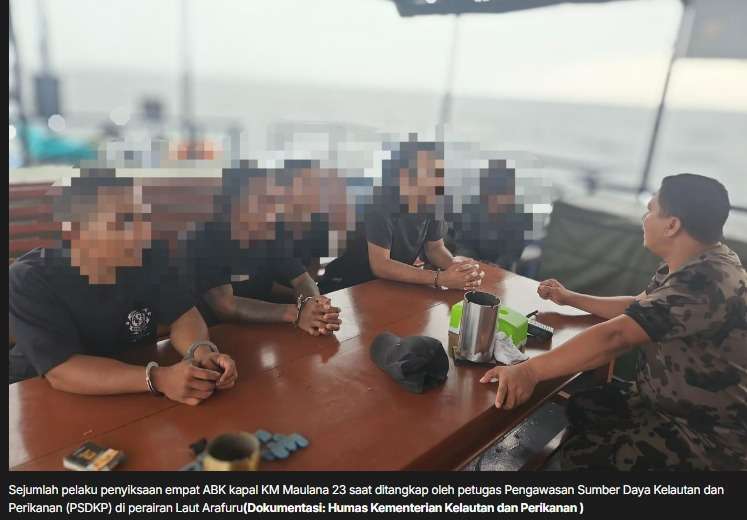
On 2 October, KKP patrol vessel KP Hiu 14 intercepted KM Maulana 23 in the Aru Sea. The vessel was reportedly carrying approximately one tonne of squid and was operating with squid fishing lines. KKP subsequently escorted the vessel and its crew to Dobo for examination of its documents, fishing activities, catch, fishing gear and operational practices.
Another concern emerged from the fisheries investigation: KKP found that the vessel’s Vessel Monitoring System had reportedly stopped transmitting from 22 August. Investigators also examined why the vessel was operating with fishing gear that differed from its registered fishing arrangement. These findings expanded the case from alleged labour abuse into a broader fisheries-governance investigation.
The government response was immediate. KKP suspended the vessel’s operational authorization while the investigation proceeded and secured the vessel for examination.
KKP Director General of Marine and Fisheries Resources Surveillance Pung Nugroho Saksono subsequently stated that the ministry would revoke the vessel’s permit. The ministry also indicated that other vessels operated by the same company would be subjected to further scrutiny.
Meanwhile, the Indonesian National Police expanded its investigation beyond alleged physical assault to possible human trafficking, examining recruitment and employment arrangements surrounding the crew. Police questioned 24 people connected with the vessel, while stressing that individual legal responsibility would have to be established through investigation and due process.
The case has therefore become larger than an alleged assault aboard one fishing vessel. It exposes the intersection between fisheries regulation, recruitment, labour protection, vessel monitoring and seafood production.
The allegations also raise questions about how effectively workers can be protected once fishing vessels leave port and operate hundreds of kilometres from government authorities and their families.
For Indonesia’s emerging blue economy, the lesson is significant. Sustainable fisheries cannot be measured only through healthy fish stocks, legal fishing gear, traceability or vessel monitoring. The sustainability of seafood must also include the people who catch it. A fishing vessel is not merely a platform for harvesting marine resources; it is also a workplace where fundamental labour rights must be protected.
As the KM Maulana 23 investigation continues, the final legal responsibility of crew members, managers, recruiters and company representatives remains to be determined.
Yet the case has already placed an uncomfortable question before Indonesia’s fisheries sector: Can a blue economy truly be called sustainable if the workers behind the seafood remain invisible and vulnerable at sea?