
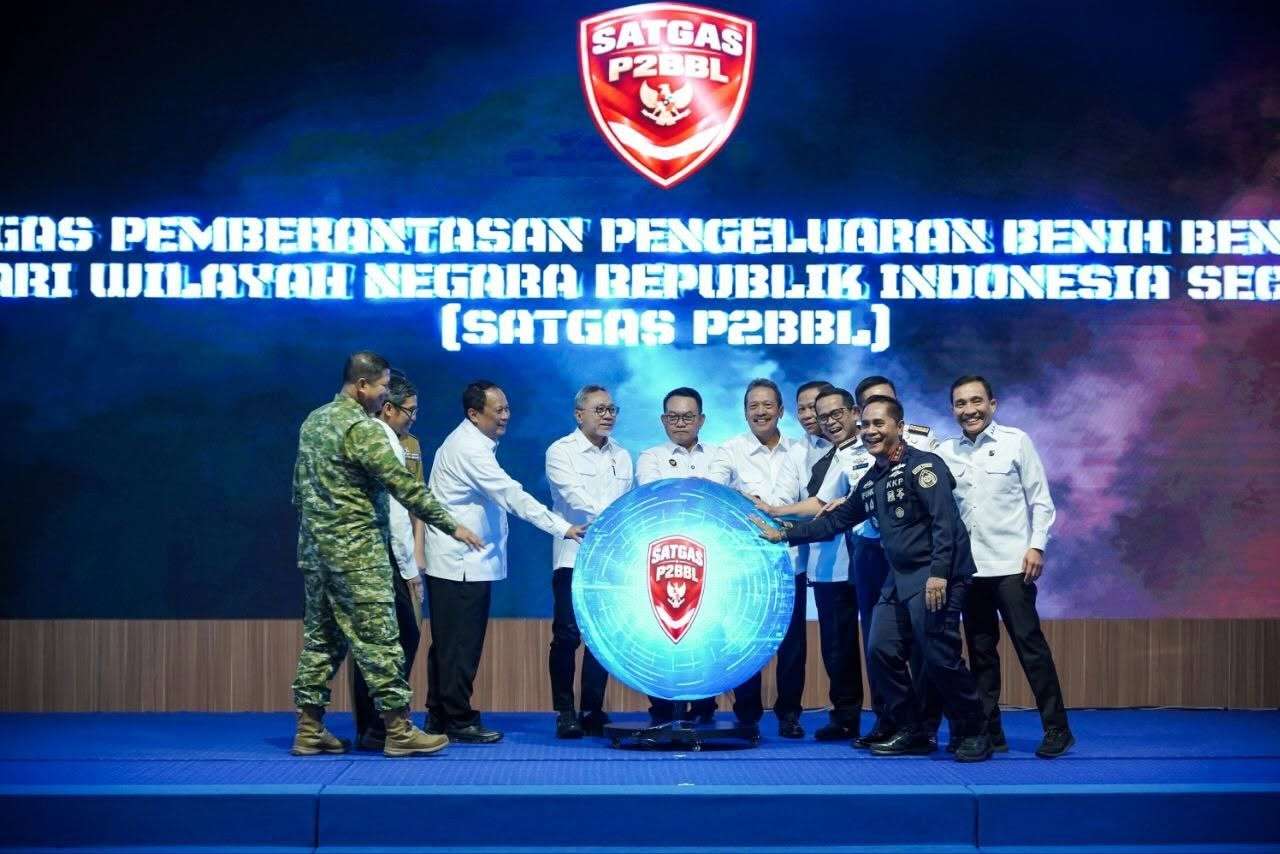
MARITIMEPOSTS.COM – The Ministry of Marine Affairs and Fisheries (KKP) has officially established the Task Force for Combating the Illegal Export of Clear Lobster Seeds (Satgas P2BBL) at the ministry’s headquarters in Jakarta. The task force aims to tighten surveillance and take action against the smuggling of clear lobster seeds (BBL), a practice considered detrimental to the state.
Minister of Marine Affairs and Fisheries Sakti Wahyu Trenggono said the task force was officially launched alongside Coordinating Minister for Political and Security Affairs, General (Ret.) Dudung Abdurachman, and Coordinating Minister for Food Affairs Zulkifli Hasan.
In his statement, Trenggono, who serves as Head of the Satgas P2BBL Executive Committee, emphasized that the task force was established under Presidential Regulation No. 69 of 2026.
The regulation provides the legal basis for strengthening oversight of lobster seed exports and intensifying enforcement against smuggling activities.
According to Trenggono, Indonesia has enormous potential in clear lobster seeds, estimated at hundreds of millions of individuals annually. However, he said, this potential has yet to generate optimal economic value for the country because smuggling remains widespread through various routes, both by sea and by air.
“Indonesia has enormous potential in clear lobster seeds, reaching hundreds of millions of individuals annually, but their value is being eroded by rampant smuggling through both sea and air routes,” he said.
Through the Satgas P2BBL, the ministry will strengthen coordination among ministries, government agencies, and law enforcement authorities. This collaboration is intended to monitor vulnerable routes frequently exploited by smugglers while improving the effectiveness of surveillance and enforcement efforts.
Trenggono stressed that combating clear lobster seed smuggling is not merely a matter of law enforcement. It is also part of broader efforts to safeguard Indonesia’s maritime sovereignty, optimize the development of domestic lobster aquaculture, and ensure that the utilization of marine resources generates greater economic benefits for local communities.
Strengthening surveillance places lobster seed management among the key issues in Indonesia’s marine resource governance.
The country’s abundant supply of clear lobster seeds must be matched by effective monitoring systems, consistent law enforcement, and the development of domestic aquaculture so that the resulting added value can be retained within the country.
With the Satgas P2BBL now operational, the government hopes to improve coordination in monitoring routes used for the movement of lobster seeds out of the country. These efforts are also expected to support local aquaculture businesses and strengthen the contribution of Indonesia’s marine resources to public welfare.