
From the 3rd Small-Scale Fisheries Summit in Rome
Developing 5,000 fishing villages by 2029 will require more than physical infrastructure. It will demand strong local institutions, meaningful participation, transparent governance, ecological safeguards, access to finance and markets, and continuous learning from communities themselves.
MARITIMEPOSTS.COM – ROME, September 6, 2026 — Indonesia has called for a shift in the global approach to small-scale fisheries, arguing that fishing communities should no longer be viewed merely as beneficiaries of development but as equal partners in shaping sustainable fisheries governance, resilient coastal economies and healthy aquatic ecosystems.
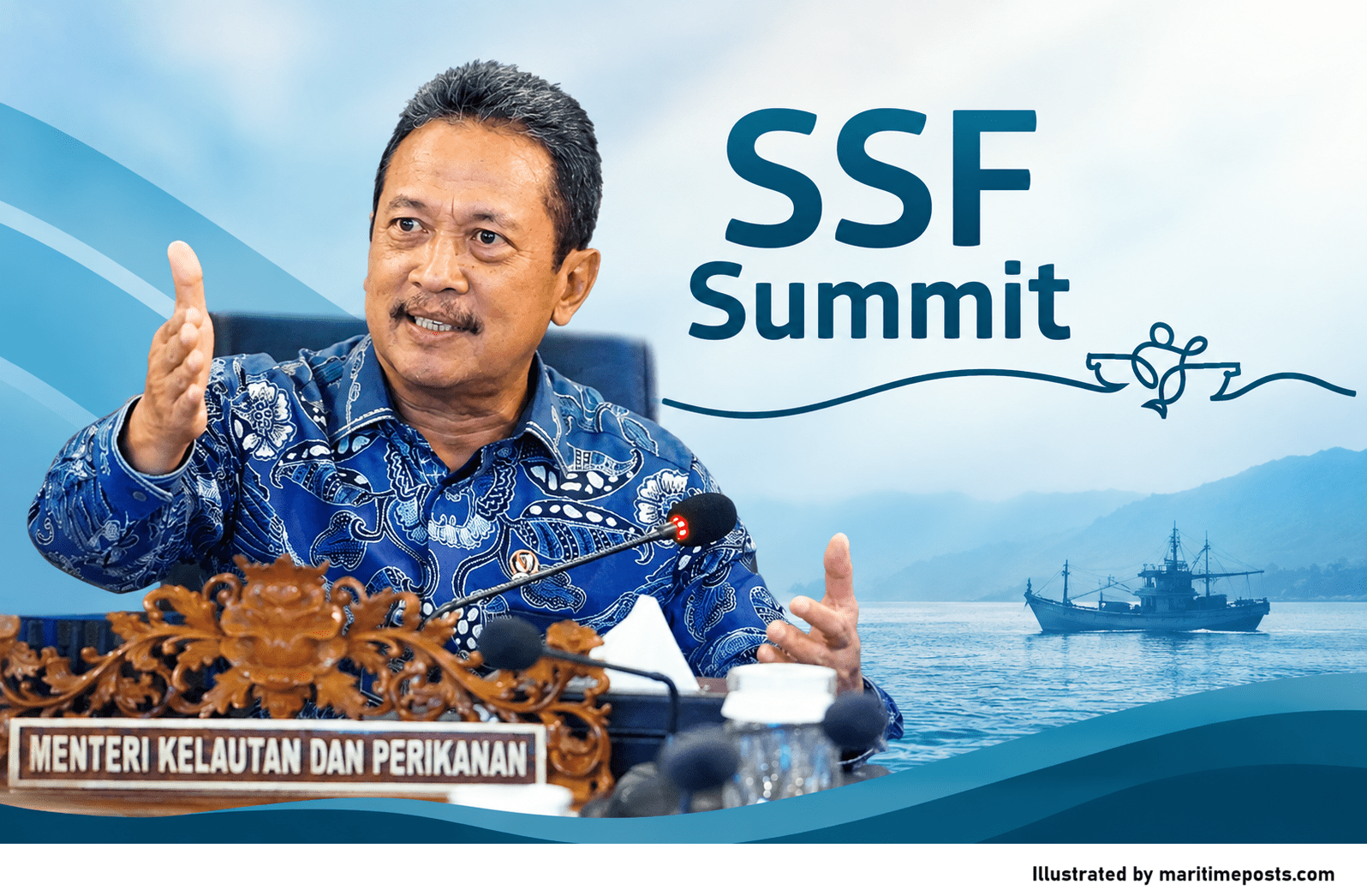
Speaking at the High-Level Ministerial Session of the 3rd Small-Scale Fisheries Summit in Rome, Indonesian Minister of Marine Affairs and Fisheries Sakti Wahyu Trenggono emphasized that the future of small-scale fisheries depends not only on international commitments, but on how effectively those commitments are translated into tangible improvements for fishing communities.
“Small-scale fisheries matter,” Trenggono told ministers, government representatives, researchers, civil society organizations and development partners gathered at the summit.
They matter for food security, livelihoods and poverty reduction, he said, while also playing a crucial role in sustaining oceans, inland waters and biodiversity.
For Indonesia, the issue is particularly significant. As the world’s largest archipelagic nation, approximately 90 percent of Indonesian fishers are small-scale fishers, while around 90 percent of the country’s capture fisheries production comes from the small-scale sector.
This makes small-scale fishers not simply one segment of the fisheries economy, but a fundamental pillar of Indonesia’s food security, coastal economies and social resilience.
Yet their importance contrasts sharply with their vulnerability.
Small-scale fishing communities face declining fish stocks, ecosystem degradation, climate change, extreme weather events and limited access to finance, technology and markets. These pressures, Trenggono stressed, are not abstract policy challenges. They directly influence the livelihoods, dignity and future prospects of millions of fishing families.
From Global Guidelines to Local Action
Twelve years after the adoption of the FAO Voluntary Guidelines for Securing Sustainable Small-Scale Fisheries, the Indonesian minister argued that the global conversation has moved beyond recognizing the importance of small-scale fisheries.
The more urgent question, he said, is how international commitments can be transformed into practical improvements in fishing communities.
For Indonesia, the answer is implementation.
Indonesia has supported the FAO’s Small-Scale Fisheries Guidelines since 2014. That commitment was strengthened in 2025 with the launch of the country’s National Plan of Action for Small-Scale Fisheries (NPOA-SSF).
The national action plan was developed through a participatory process involving government institutions, academia, civil society organizations and fishing communities.
But a national plan, Trenggono acknowledged, is not sufficient by itself.
Policies must ultimately reach the villages, landing sites, fishing households and community institutions where fisheries livelihoods are actually built.
This is where Indonesia’s Kampung Nelayan Merah Putih (KNMP), or Red and White Fishing Village Program, enters the picture.
The program is designed as a practical mechanism for implementing the SSF Guidelines and NPOA-SSF at the local level.
Rather than treating fishing villages simply as recipients of infrastructure, KNMP adopts an integrated approach to transforming small-scale fisheries communities.
Beyond Infrastructure
According to Trenggono, KNMP is not merely an infrastructure initiative.
Its broader objective is to strengthen fisheries governance while improving the economic and social resilience of fishing communities.
The program brings together several dimensions of development, including the strengthening of fisher groups and cooperatives, improved access to finance and markets, social protection, women’s participation and ecosystem-based fisheries management.
In 2025, Indonesia established 100 Red and White Fishing Villages as pilot sites. The government is now moving toward scaling up the approach across the country’s vast archipelago.
The ambition is substantial: 5,000 fishing villages by 2029.
The scale-up reflects an attempt to connect economic development with fisheries management and environmental stewardship rather than treating them as separate policy agendas.
For Indonesia, this integrated approach is increasingly important because the sustainability of fishing communities cannot be separated from the condition of the ecosystems on which they depend.
A healthier coastal ecosystem can support more resilient livelihoods. Stronger community institutions can improve fisheries governance. Better market access can increase the economic value retained by fishing communities. Women’s participation can broaden household and community economic resilience.
The challenge is therefore not simply to produce more fish, but to build fishing communities capable of sustaining their livelihoods while maintaining the ecological foundations of fisheries production.
Four Priorities for Small-Scale Fisheries
Indonesia’s approach is built around four broad priorities.
The first is strengthening legal protection, rights and access to resources for small-scale fishers. Secure access to fisheries resources is essential if fishing families are expected to invest in sustainable practices and long-term community development.
The second is advancing ecosystem-based fisheries management while respecting local wisdom and traditional governance systems. This recognizes that fisheries management cannot rely exclusively on centralized regulation and scientific assessments, but must also incorporate knowledge and institutions developed within fishing communities.
The third is scaling up KNMP as a national platform for implementing the NPOA-SSF. Rather than allowing the national action plan to remain primarily a policy document, Indonesia intends to use fishing villages as practical spaces where its commitments can be tested, adapted and delivered.
The fourth is empowering women and strengthening community resilience through ecosystem restoration and sustainable livelihoods.
Together, these priorities point toward a broader understanding of fisheries development—one that links ecology, economy, social protection, community institutions and governance.
Fishers as Partners, Not Beneficiaries
The message delivered by Indonesia in Rome carries significance beyond the country’s own fisheries policy.
Small-scale fisheries are deeply connected to global debates on food security, poverty, climate resilience, biodiversity conservation and sustainable development. In many countries, fishing communities are simultaneously exposed to environmental change and economic marginalization.
The challenge, therefore, is how governments and development institutions can design policies with communities rather than simply for them.
Trenggono’s central message was explicit.
Small-scale fishers are not beneficiaries of development. They are partners in development.
They are not merely users of natural resources, but stewards of those resources. And they should not be treated as problems to be managed, but as part of the solution.
This perspective places participation at the center of fisheries governance.
It also suggests that the success of the SSF Guidelines should ultimately be judged not by the number of international declarations adopted, but by measurable changes in people’s lives and ecosystems.
Healthier aquatic ecosystems, stronger fishing communities, improved livelihoods and greater recognition of fishers as partners in governance would provide more meaningful indicators of progress.
From Commitments to Results
The Rome summit brings together fishers, fish workers, governments, researchers, civil society organizations and development partners around a shared challenge: no single institution can solve the complex problems facing small-scale fisheries alone.
Indonesia is positioning KNMP as one response to that challenge—a national experiment in translating global principles into local action across thousands of fishing communities.
But the scale of the ambition also means implementation will matter enormously.
Developing 5,000 fishing villages by 2029 will require more than physical infrastructure. It will demand strong local institutions, meaningful participation, transparent governance, ecological safeguards, access to finance and markets, and continuous learning from communities themselves.
The Indonesian experience could therefore become an important case study in how global fisheries commitments are localized across a geographically vast and socially diverse archipelagic country.
For Trenggono, the task ahead is clear: Indonesia has come to Rome not only to share its experience, but also to learn from other countries, build partnerships and strengthen international cooperation.
Ultimately, the test of the Small-Scale Fisheries Guidelines will be whether global commitments can become local results.
For millions of small-scale fishers, those results will be measured not in diplomatic declarations, but in healthier waters, stronger communities, more secure livelihoods and a greater voice in the governance of the resources upon which their future depends.