
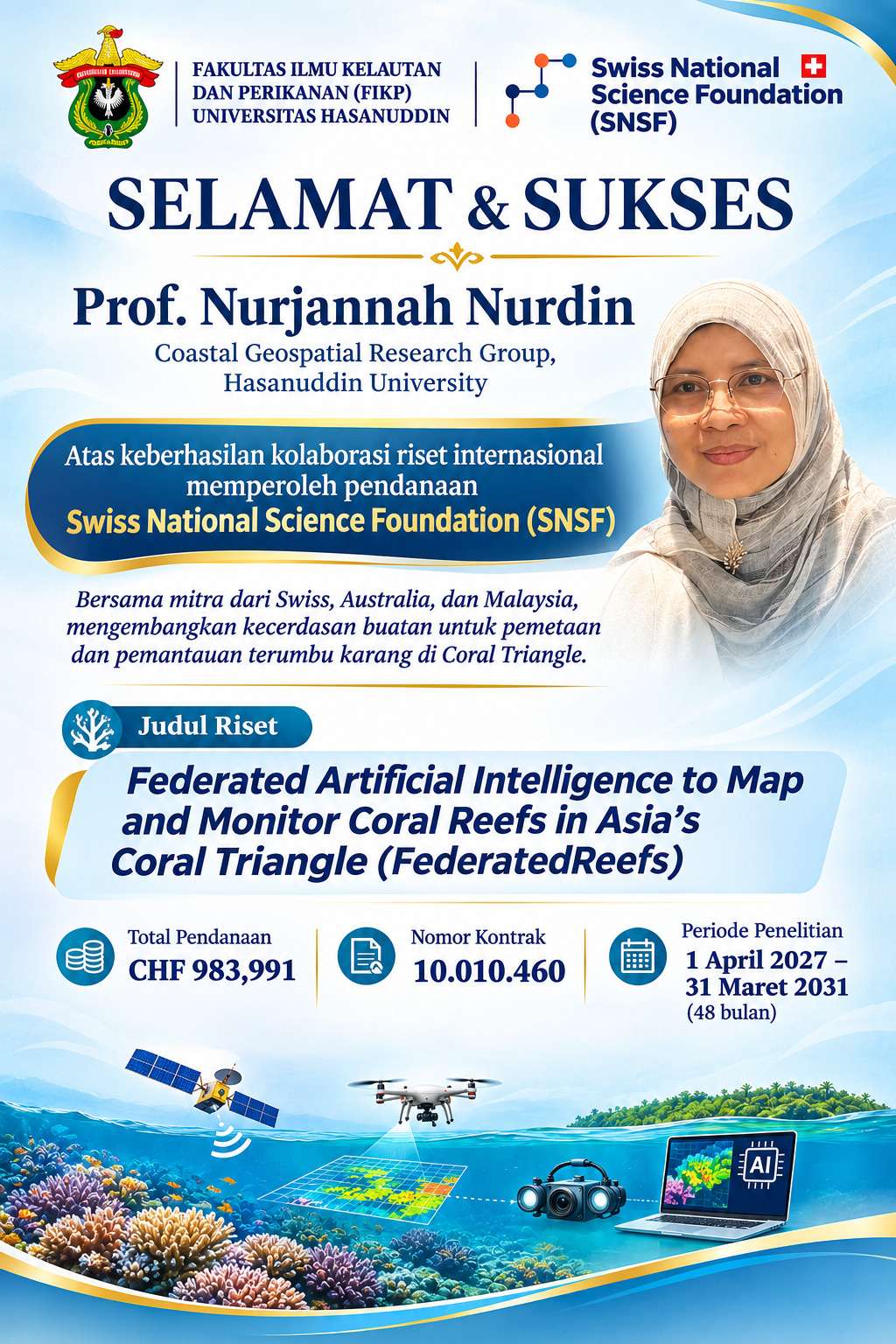
- The decision letter dated September 23, 2026, confirms that the proposal has been awarded CHF 983,991 in research funding for a period of 48 months, or four years, commencing on April 1, 2027. The approval follows a competitive evaluation process involving an assessment panel and external experts.
- This collaboration involving Switzerland, Australia, Malaysia, and Indonesia has secured nearly one million Swiss francs to develop artificial intelligence for mapping and monitoring coral reefs in the Coral Triangle region of Asia.
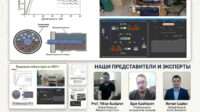
- In the funding decision, Prof. Nurjannah Nurdin, S.T., M.Si., from Hasanuddin University, is officially listed as one of the project partners. She joins Guilhem Banc-Prandi of EPFL Lausanne, Switzerland; Renata Ferrari Legorreta of the Australian Institute of Marine Science, Australia; and M. Muslim Aidy of Universiti Malaysia Terengganu, Malaysia.
MARITIMEPOSTS.COM – FederatedReefs: Bringing Artificial Intelligence and Marine Science Together to Protect Coral Reefs
Coral reefs are far more than beautiful underwater landscapes rich in biodiversity. These ecosystems sustain the livelihoods of millions of coastal communities, provide vital food resources, support fisheries, and play an essential role in maintaining the ecological balance of the world’s oceans.
For this reason, the ability to map, understand, and monitor changes in coral reef conditions has become increasingly important, particularly as marine ecosystems face mounting pressures from climate change, coral bleaching, pollution, and human activities.
Against this backdrop, an international research collaboration known as FederatedReefs is introducing an innovative approach that brings marine science and artificial intelligence together to strengthen coral reef monitoring across Asia’s Coral Triangle.
The project, formally titled Federated Artificial Intelligence to Map and Monitor Coral Reefs in Asia’s Coral Triangle, has received funding approval from the Swiss National Science Foundation (SNSF), referred to in the original French-language document as Fonds National Suisse (FNS).
The decision letter dated September 23, 2026, confirms that the proposal has been awarded CHF 983,991, with a project duration of 48 months, or four years, starting on April 1, 2027.
The approval follows a competitive evaluation process involving an assessment panel and external experts.
With this support, FederatedReefs will have the opportunity to develop a research approach that combines technological capabilities, marine data, and the expertise of several international institutions.
One of the most interesting aspects of FederatedReefs is its use of Federated Artificial Intelligence, or Federated AI.
Under this approach, AI models can be developed through collaboration among multiple institutions without necessarily requiring all raw data to be transferred to a single central storage system. Each institution can contribute its own data, computing capacity, and expertise while participating in the collaborative development of artificial intelligence models.
This approach creates opportunities for cross-country research to benefit from diverse datasets and field experiences while maintaining appropriate data governance and protection.
In the context of coral reefs, the technology could support underwater image analysis, habitat mapping, the identification of changes in coral cover, and the development of more efficient monitoring systems.
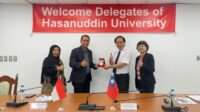
For Indonesia, the participation of Hasanuddin University represents an important component of this international collaboration.
In the funding decision, Prof. Nurjannah Nurdin, S.T., M.Si., of Hasanuddin University is officially listed as one of the project partners. She joins Guilhem Banc-Prandi of EPFL Lausanne, Switzerland; Renata Ferrari Legorreta of the Australian Institute of Marine Science, Australia; and M. Muslim Aidy of Universiti Malaysia Terengganu, Malaysia.
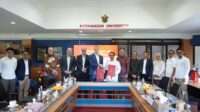
This partnership reflects the international academic character of FederatedReefs, bringing together institutions with different experiences and capacities in marine research.
Nurjannah’s position, as explicitly stated in the official funding decision, is that of a project partner representing Hasanuddin University. The decision letter does not specify the technical division of responsibilities, leadership of individual work packages, or the specific funding allocation managed by each partner.
Nurjannah’s involvement also creates opportunities for Hasanuddin University to strengthen its academic contribution to the advancement of marine research through digital technologies.
As a university with a strong academic tradition and longstanding engagement in marine and fisheries studies, Hasanuddin University is strategically positioned to connect knowledge of Indonesia’s marine ecosystems with emerging methods of artificial intelligence-based analysis and monitoring.
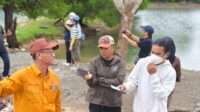
Field experience, knowledge of tropical coral reef characteristics, and the availability of data from Indonesia’s coastal and small-island regions can provide valuable foundations for the development of this research.
The collaboration may also open opportunities for knowledge exchange, stronger research capacity, and the expansion of international scientific networks among Hasanuddin University academics.
Furthermore, FederatedReefs is closely aligned with the needs of managing the Coral Triangle, a region widely recognized as one of the world’s most important centers of marine biodiversity. Indonesia lies at the heart of this region and carries significant responsibility for safeguarding its ecological sustainability.
More accurate monitoring can provide scientific information to support conservation policies, marine protected area management, coral reef rehabilitation planning, and the development of sustainable fisheries.
Artificial intelligence is certainly not a substitute for field observations or ecological knowledge. Rather, it can serve as a powerful instrument to strengthen researchers’ ability to understand and assess ecosystem changes in a more systematic manner.
The nearly one-million-Swiss-franc funding awarded over four years also demonstrates that research into the future of coral reefs requires collaboration beyond geographical boundaries and academic disciplines. The challenge of protecting marine ecosystems cannot be addressed by a single country or institution alone.
It requires collective efforts involving scientists, universities, research institutions, governments, and coastal communities. Within this framework, Hasanuddin University’s participation through Nurjannah Nurdin represents an opportunity to bring Indonesia’s experience and perspectives into international scientific discussions about the future of coral reefs.
Ultimately, the significance of FederatedReefs extends beyond the amount of research funding or the sophistication of the technology being developed.
More importantly, the project creates an opportunity to connect scientific progress with the practical needs of marine ecosystem protection. For Hasanuddin University, this participation represents an opportunity to further expand its contribution to global marine research.
For Indonesia, the research outcomes are expected to strengthen the scientific foundation for protecting the country’s coral reef wealth, one of its most valuable ecological assets.
When technology meets a genuine commitment to protecting the ocean, research goes beyond the laboratory and becomes part of a broader effort to safeguard the future of coastal communities and marine ecosystems worldwide.