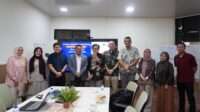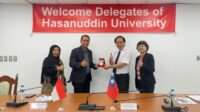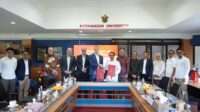

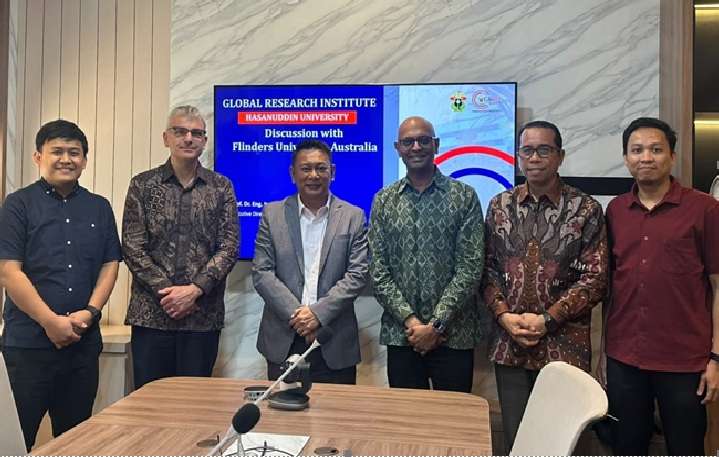
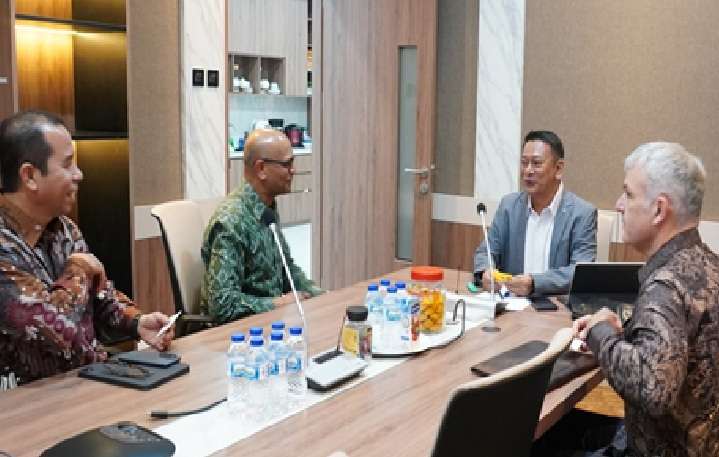
On Thursday, October 29, 2026, executive delegations from the Global Research Institute (GloRI) at Universitas Hasanuddin (Unhas) and Flinders University, Australia, convened in Makassar for a two-hour strategic bilateral session. The primary objective of this high-level summit was to formalize the architecture for research-oriented Transnational Education (TNE) Master’s and Ph.D. pathways specifically tailored for early-to-mid career researchers (early-mid career researchers) across Eastern Indonesia.
MARITIMEPOSTS.COM – By synthesizing Unhas’s institutional authority as the anchor research university in Eastern Indonesia with Flinders University’s advanced research capabilities, the strategic partnership addresses regional development imperatives, accelerates natural resource downstreaming (hilirisasi), and expands interdisciplinary inquiries into deep-time human history and maritime heritage.
The strategic inclusion of leadership from the Faculty of Public Health (FKM Unhas) directly aligns with Flinders University’s established status as an approved destination institution under the Indonesian Endowment Fund for Education (LPDP) scheme, particularly within public health domains (kesehatan masyarakat).
Key Delegation Members
Global Research Institute (GloRI) Universitas Hasanuddin:
- Prof. Dr. Eng. Adi Maulana, ST., M.Phil., IPU – Executive Director, GloRI Unhas
- Ansariadi, SKM., M.Sc.PH., Ph.D. – Dean, Faculty of Public Health (FKM Unhas)
- Andi Imam Arundhana Thahir, S.Gz., MPH., Ph.D. – Secretary, GloRI Unhas
- Zulung, S.Pi., M.Env. – Research and Cooperation Manager, GloRI Unhas
Flinders University:
- Prof. Eugene Sebastian – Executive Director, International Research Strategy
- Prof. Timothy Cavagnaro – Pro Vice-Chancellor, Research Training and Capabilities
The 1+1 Research-Oriented Dual-Degree Master’s Framework
The proposed Master’s initiative operates as a structured Transnational Education (TNE) dual-degree framework (double degree) spanning two academic years (1+1 model). Upon meeting all institutional and research criteria, graduating candidates will be awarded two separate, formal postgraduate diplomas (ijazah dari kedua perguruan tinggi)—one issued by Universitas Hasanuddin and one by Flinders University.
Year 1 Curriculum (Unhas)
During the initial year based at Unhas in Makassar, candidates undergo intensive foundational coursework and methodological preparation. This phase equips scholars with prerequisite analytical rigor and regulatory compliance training, covering:
- Advanced academic research proposal development
- Systematic literature review methodologies
- Institutional Review Board (IRB) research ethics processing and compliance
- Quantitative and qualitative empirical research design
Year 2 Focus & Artificial Intelligence Integration (Flinders)
The second year transitions candidates to full-time research immersion on-site at Flinders University in Adelaide.
- Dual-Advisorship Infrastructure: Each candidate is assigned a joint supervisory committee comprising one primary academic advisor from Unhas and one primary research supervisor from Flinders.
- Methodological AI Integration: Building upon the manual methodological rigor and ethical frameworks established during Year 1 at Unhas, Year 2 integrates structured training in utilizing Artificial Intelligence (AI) tools to execute, categorize, and synthesize complex literature datasets.
- Academic Progression: High-performing graduates exhibiting superior research capabilities will be funneled directly into doctoral research tracks.
Target Research Outputs
To enforce a strict research orientation over conventional coursework, candidates are required to publish high-impact scholarly manuscripts prior to degree conferral at the end of Year 2. Mandatory publication formats include:
- Scoping Reviews
- Systematic Reviews
- Meta-Analyses
Target Demographics & Recruitment Mechanics
Unhas functions as the primary recruitment, screening, and coordination hub, leveraging its institutional network across state universities in Eastern Indonesia.
The recruitment pipeline targets young faculty and early-to-mid career researchers. Admitted scholars are governed by strict institutional return-to-service obligations (komitmen kembali) to mitigate regional brain drain and guarantee long-term academic capacity retention within their home institutions.
Seaweed Biorefinery and Downstream Processing: The PhD Specialization Pipeline
The strategic partnership directly targets the economic imperative of transitioning Eastern Indonesia’s maritime economy from raw commodity extraction (upstream focus) to high-value bio-refining and material extraction (downstream processing / hilirisasi).
While local industries historically export unrefined raw biomass, Flinders University operates a specialized seaweed biorefinery center equipped to process raw marine materials into advanced pharmaceutical, cosmetic, functional nutritional, and bio-plastic applications.
To operationalize this technology transfer, the institutions are establishing a dedicated doctoral scholarship pipeline targeting 15 to 20 Ph.D. candidates.
Scholars will be allocated across four specialization tracks, returning post-graduation to staff Unhas’s Center of Excellence (Pusat Keunggulan) and Science & Technology Park (Science & Technology Park Unhas).
The Ph.D. Specialization Track is designed to strengthen Unhas’s institutional impact through its Center of Excellence and Science & Technology Park, with a focus on four strategic sectors.
In Pharmacy, the research establishes advanced bio-refining methodologies to isolate bioactive marine compounds and develop medical-grade pharmaceutical derivatives. In Cosmetics, it expands bioprocess engineering capabilities to produce high-value cosmetic formulations, anti-aging compounds, and biochemical extracts.
In Plastics, the research drives advances in polymer science to synthesize biodegradable seaweed-based plastics and develop sustainable material alternatives.
Meanwhile, in Nutrition, it advances functional food formulations, dietary derivatives, and large-scale public health nutritional interventions. Together, these four specialization areas aim to translate scientific research into innovation, industrial applications, and tangible societal benefits.
Strategic Contextual Drivers
This downstream processing pipeline aligns with three core contextual drivers that position Eastern Indonesia as an attractive target for international research funding and academic co-investment:
Health Human Resources: There is an urgent need to develop specialized human resource capacity in public health, biomedical sciences, and functional nutrition to address emerging health challenges and strengthen healthcare systems.
Educational Capacity Building: Structural improvements in research and teaching competencies are essential across higher education institutions in Eastern Indonesia to enhance academic quality, strengthen institutional capacity, and foster innovation.
Marine Resource Downstreaming: Indonesia must capitalize on its largely untapped marine biomass through sustainable downstream processing and value addition, creating new economic opportunities while directly supporting the country’s national green economy framework.
Evolutionary Pathways and Microbiome Research
The institutions are initiating joint research into deep-time evolutionary pathways (evolutionary pathways) to elucidate biological and cultural connections linking Australian and Indonesian populations across deep time.
This scientific agenda synthesizes fossil, historical, cultural, and genomic datasets: Gastrointestinal Microbiome Sequencing: Comparative metagenomic research evaluating the gut microbiomes of ancient human remains against contemporary populations to map dietary, environmental, and immunological shifts.
Denisovan Genetic Lineages: Genomic investigations into Denisovan ancestry markers that connect Southeast Asian populations with Pacific island communities, constructing novel scientific narratives of human migration.
Maritime Archaeology & Heritage Infrastructure
Flinders University will utilize its world-renowned Maritime Archaeology program as an institutional bridge to partner with Unhas’s marine science domain. This synergy leverages Eastern Indonesia’s rich underwater archaeological sites and maritime heritage assets through joint field expeditions, underwater survey mapping, and collaborative faculty exchanges.
First Nations & Unhas Bilateral Research Forum
To honor and scientifically examine centuries of pre-colonial maritime trade—such as the historical Macassan-Aboriginal trepang trade networks linking Northern Australia and South Sulawesi—the partnership will establish a bilateral research forum bringing together First Nations researchers from Flinders and research teams from Unhas. The forum will convene reciprocal symposia in Makassar and Darwin, organized around four central themes:
- Climate
- Health
- Inclusion
- Coastal Communities
Institutional Capability & Operational Infrastructure
The Research Training Hub Model
Flinders University presented its Research Training Hub administrative framework, which provides end-to-end career mentoring, grant proposal development, and technical upskilling for academic faculty.
Crucially, approximately 50% of the hub’s cohort comprises professional research support personnel, including specialized grant proposal writers and legal contract management officers. Professionalizing administrative research support staff directly drives institutional research revenue growth by increasing competitive international grant submission success rates (win rates).
Accelerating institutional contract negotiations and intellectual property (IP) execution and guaranteeing strict compliance with international funding agency protocols.
Funding & Tuition Architecture
The program operates under a reciprocal tuition offset and multi-tiered bilateral scholarship co-financing model designed to remove financial barriers for scholars:
- Tuition Fees: Fully covered through reciprocal tuition fee waivers negotiated between Unhas and Flinders University.
- Living Allowances & Stipends: Primary doctoral and master’s living expenses will be funded via Indonesia’s LPDP scholarship scheme, leveraging Flinders’ standing as an approved LPDP target institution across public health and related disciplines.
- Targeted Bilateral Quotas: Supplementary candidate quotas are actively being integrated into Australia Awards scholarship funding allocations.
Implementation Roadmap (2026–2027)
- MOU Drafting & Review: Unhas will formally transmit its revised draft Memorandum of Understanding (MOU) to Flinders University to integrate explicit clauses governing the 1+1 dual-degree Master’s structure, Ph.D. co-supervision, and joint IP rights.
- Diplomatic & Grant Engagement: Flinders University executive leadership will convene formal sessions with the Australian Embassy in Jakarta to secure dedicated co-funding allocations and align scholarship quotas.
- Formal Execution: Official execution of the MOU is scheduled for February–March 2027, coinciding with an official delegation visit by Flinders University’s Deputy Vice-Chancellor (Research) (Wakil Rektor Bidang Riset) to Unhas in Makassar.
- Joint Submissions & Program Branding: Unhas and Flinders will execute concurrent funding submissions to LPDP (led by Unhas) and Australia Awards (led by Flinders). This step will be accompanied by the joint formulation of a distinct program title to establish a recognized institutional brand identity (menyiapkan nama program yang dapat menjadi identitas inisiatif ini) prior to public recruitment rollout.
___
Editor K. Azis