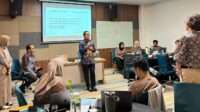

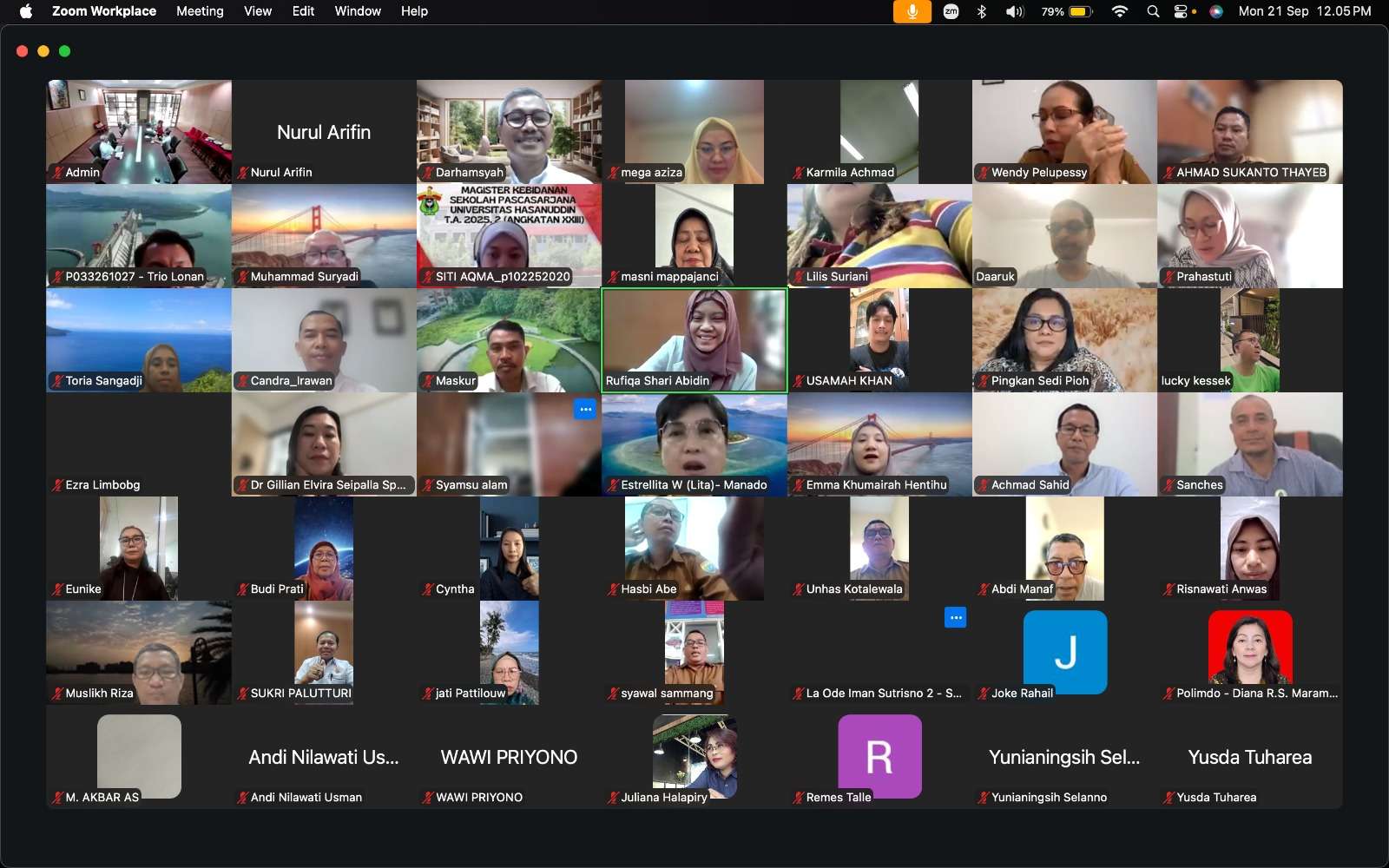
PELAKITA.ID – MAKASSAR — The Graduate School of Hasanuddin University (Unhas) expanded its platform for international learning and knowledge exchange through a guest lecture on Water and Environmental Engineering and Science, held online via Zoom on Monday (21 September 2026).
The guest lecture featured Prof. Dr. Muthukrishna Vellaisamy Kumarasamy of the University of KwaZulu-Natal, South Africa, who highlighted the importance of modelling innovation in supporting environmental protection and the sustainable management of water resources.
In his opening remarks, Dean of the Unhas Graduate School Prof. Sukri Palutturi, S.KM., M.Kes., M.Sc.PH., Ph.D., expressed his appreciation to Prof. Kumarasamy for sharing his academic knowledge and experience with the Unhas academic community. He noted that academic engagements of this kind could provide an entry point for developing longer-term institutional relations between Indonesia and South Africa.
Prof. Sukri emphasized that such relations could be developed through various forms of collaboration, including joint research, student and staff exchanges, and visiting professor programmes that would facilitate more intensive exchanges of experience and knowledge.
Prof. Kumarasamy is a civil engineering academic who leads the Civil Engineering discipline at the University of KwaZulu-Natal and is actively involved in research on waste management and climate change. In his presentation, he positioned modelling innovation as an important instrument for understanding the dynamics of water resources while designing more effective strategies for environmental protection.
The lecture covered a range of topics, including water resource management, watershed planning, and flood risk management. He explained that an integrated approach to water resource management needs to bring together three major considerations: economic efficiency, social equity, and environmental sustainability.
He noted that the condition of a water body cannot be assessed through a single indicator alone, but needs to be examined through a combination of quantitative and qualitative parameters.
River discharge, water availability, and groundwater levels need to be considered alongside physical, chemical, and biological indicators to provide a more comprehensive picture of the condition of aquatic ecosystems.
Pressures on water resources are becoming increasingly complex due to agricultural activities, urban expansion, stormwater runoff, wastewater discharge, and industrial activities, all of which can affect both water quality and availability.
Amid climate change, which is increasing hydrological uncertainty, field monitoring needs to be strengthened through the use of hydrological and water quality models to track changes, assess risks, and develop pollution-control strategies.
An important part of the lecture focused on emerging contaminants in aquatic environments, including antibiotic residues, pharmaceutical compounds, personal care products, and microplastics. These pollutants present new challenges because their detection and assessment often require more specific monitoring methods and analytical approaches.
Prof. Kumarasamy then presented a water quality modelling study conducted in one of South Africa’s river basins. The research involved sampling at 18 locations, laboratory analysis, and mathematical modelling to describe the movement and concentration patterns of pollutants along the river system.
The study illustrated how a model can be developed through a systematic sequence of stages, beginning with the collection of river-flow and water-quality data, followed by parameter identification, calibration, validation, and simulation to explore different possible conditions within the aquatic system.
Once properly calibrated and validated, models can help identify locations with high pollutant concentrations while providing valuable information for decision-making, particularly in watershed protection and sustainable water resource planning.
The discussion was highly interactive, with participants raising questions about the minimum parameters required for modelling, the potential application of models in different research contexts, and methods for tracing sources of antibiotic contamination in aquatic environments.
Responding to these questions, Prof. Kumarasamy explained that data requirements should fundamentally be aligned with the objectives and characteristics of the model being used. Nevertheless, river-flow data, water-quality data, and appropriate testing to ensure model validity remain essential components of water quality modelling.
The session was moderated by Dr. Ir. Darhamsyah, M.Si. Toward the end of the event, Prof. Kumarasamy also opened opportunities for further collaboration between the two institutions, including joint publications, research projects, visiting positions, student and staff exchanges, thesis and dissertation examination, curriculum development, participation in advisory boards, and the organization of joint conferences.
The guest lecture demonstrated the commitment of the Unhas Graduate School to expanding its international academic network while bringing cross-country and cross-disciplinary perspectives to increasingly complex environmental challenges.
Through knowledge exchange on environmental engineering, integrated water resource management, and the use of modelling technologies, the forum is expected to serve as an initial platform for research collaborations that not only strengthen academic capacity but also contribute meaningfully to environmental protection and the well-being of communities.