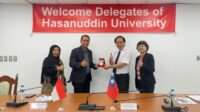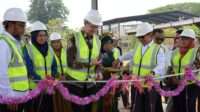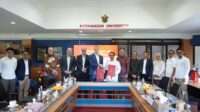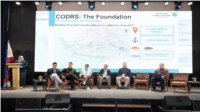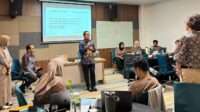

For more than three decades, the Nusa Tenggara Association (NTA) has connected Australian development support with community-led initiatives in East Nusa Tenggara, working with rural households in Flores and West Timor to strengthen livelihoods, food security, water access and education.”
Written by Kamaruddin Azis, founder maritimeposts.com
MARITIMEPOSTS.COM – EAST NUSA TENGGARA — In East Nusa Tenggara, development can begin with something deceptively simple: water. A tank beside a house, a well within walking distance, a vegetable garden that survives the dry season, or a school equipped with books and sanitation facilities may not look like major development projects when viewed from a distance.
For a family living through a long dry season, however, these things can change the rhythm of everyday life.
This week I read this on Facebook:
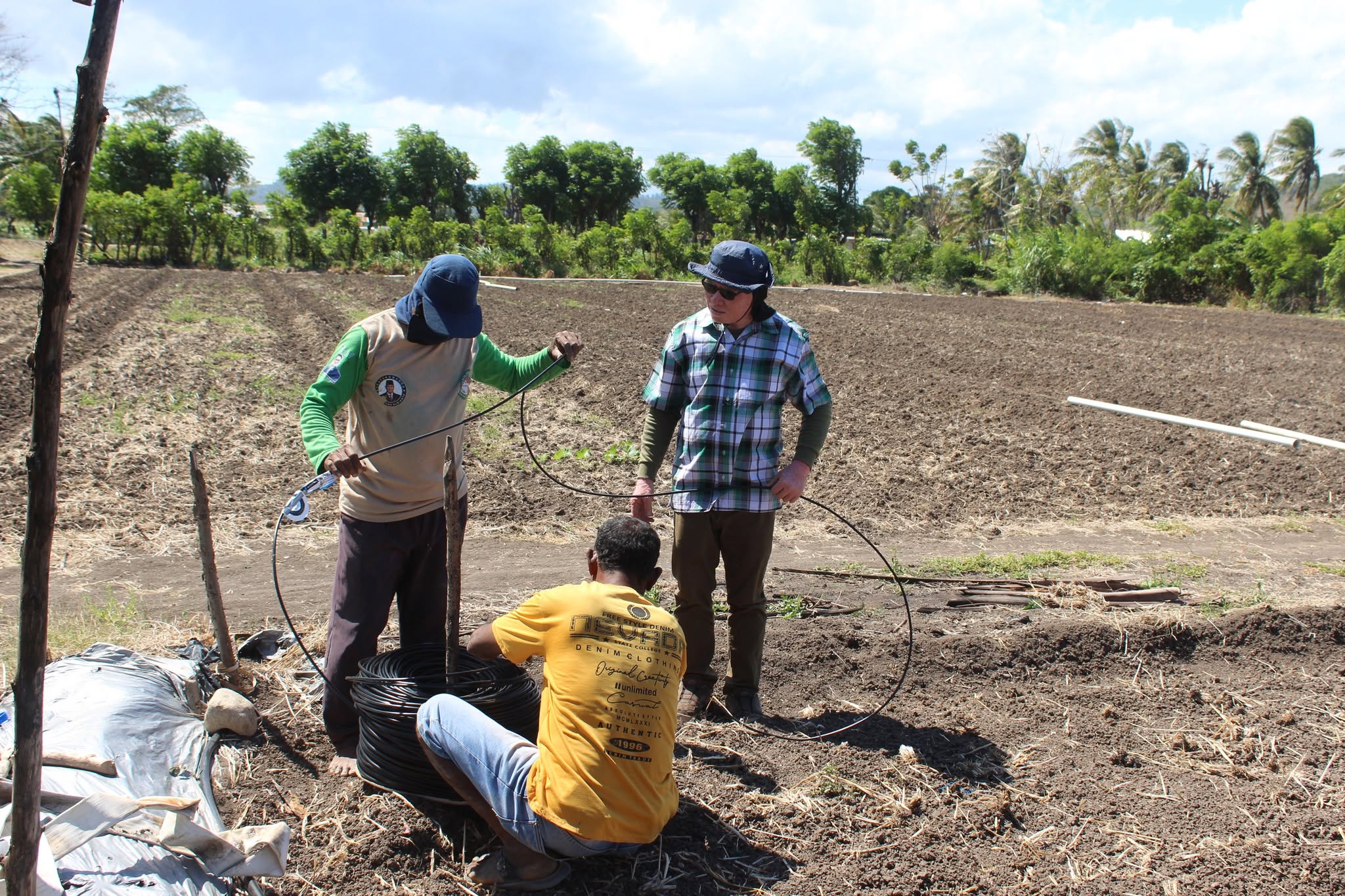
Farmers in West Kupang are preparing for cucumber planting with support to install a drip irrigation system designed to make better use of limited water during what is anticipated to be a long and harsh dry season. The system delivers water slowly and directly to the root zone of each plant, reducing evaporation, runoff and unnecessary watering while allowing farmers to maintain productive crops with less water. More consistent soil moisture can also reduce crop stress during periods of heat and drought, giving plants better conditions to survive water shortages while supporting farmers’ efforts to sustain agricultural production.
Beyond the immediate cucumber crop, the initiative illustrates how relatively simple agricultural technologies can contribute to broader climate adaptation in rural communities. By improving water-use efficiency and helping farmers respond to increasingly variable rainfall patterns, drip irrigation can strengthen the resilience of farming systems in areas where water availability is a persistent challenge. For farmers in West Kupang, the coming growing season will provide an opportunity to observe how the system performs in the field and whether more efficient irrigation can translate into more reliable production and sustainable livelihoods.
Source: Philip Domaschenz, my friend from Australia
This is where the work of the Nusa Tenggara Association (NTA) becomes interesting.
The Australian not-for-profit organisation has spent decades working with rural communities in East Nusa Tenggara, or NTT, focusing on livelihoods, agriculture, food security, water and sanitation, education, and other community-based initiatives.
Its geographical focus is concentrated in Flores and West Timor, parts of a province where agriculture remains important to household livelihoods while drought, variable rainfall and limited water access continue to shape everyday economic life.
The story of NTA, therefore, is not simply about an Australian NGO giving assistance to Indonesian communities.
It is about what happens when external resources meet local knowledge, when development is negotiated through community meetings, and when relatively small interventions accumulate into something more consequential: the capacity of rural households to live, produce food and face uncertainty with greater room to manoeuvre.
The geography of vulnerability
NTT occupies an unusual position in the Australian imagination.
It is geographically close to Australia, yet the socioeconomic realities of its rural communities can be profoundly different from those across the Timor Sea.
NTA’s own account describes the province as one of Indonesia’s poorer regions, with more than half of its population historically dependent on farming and agriculture for income. The organisation also points to the dry landscape and variable rainfall as structural challenges for rural households.
The problem is not simply that there is little rain. The deeper issue is what the absence or irregularity of water does to an entire household economy. When water is scarce, someone has to fetch it. When that task takes hours, those hours come from somewhere. They may come from farming, childcare, schooling, livestock management or other income-generating activities.
A water problem can therefore become a livelihood problem, a livelihood problem can become a food-security problem, and a food-security problem can eventually become a question of whether a household has enough resilience to withstand another failed harvest, another drought or another unexpected shock.
This chain helps explain why NTA’s water program sits alongside agriculture, education and livelihoods rather than being treated as an isolated infrastructure intervention.
A tank is more than a tank
NTA currently describes its water and sanitation work around 15,000-litre ferro-cement water tanks, wells and household sanitation facilities. Local workers undertake construction, while NTA generally provides funding for materials such as cement and piping.
The physical object is simple. The social consequences can be much larger. A case documented by Australia’s Department of Foreign Affairs and Trade illustrates this clearly. Before receiving a water tank, Esaul and his wife Ester in West Timor reportedly made repeated trips each day to collect water from an underground stream about 600 metres from their home. After the tank was constructed, the daily collection burden was eliminated.
The significance lies not only in the quantity of water stored. It lies in the time returned to the household. Time is one of the least discussed resources in development. Yet for rural families, time can determine whether someone tends a crop, cares for children, attends school, raises livestock or looks for another source of income.
A water tank can therefore function as infrastructure, but also as a redistribution of household time. That is a very different way of understanding development.
Development begins with listening
NTA’s model is also notable because the organisation says communities identify their priorities through a consensus process known as musyawarah.
The approach places local people in the process of determining which projects are considered most essential, while NTA staff provide oversight, technical assistance and resources. NTA says it supports around 150 to 200 small activities at any given time, covering agriculture and income generation, water and sanitation, and education.
This is important because development projects often arrive with a familiar sequence: a program is designed, funding is allocated, an activity is implemented and an output is reported.
The village can then become the place where the project happens rather than the place where the problem is defined. NTA’s stated approach attempts to reverse that sequence. The community is expected to identify what matters.
That does not automatically make every intervention successful, and community participation should not be romanticised. Local communities contain differences of interest, access and influence, just as governments, NGOs and donor institutions do.
Still, starting with community-defined priorities creates a different entry point. It recognises that people living with the consequences of drought, poor roads, inadequate sanitation or weak agricultural productivity possess knowledge that cannot simply be imported from outside.
From Australia to Kupang, then to the village
The institutional architecture behind NTA is equally revealing.
In 2016, NTA Australia and NTA Indonesia became separate legal entities. NTA Australia focuses on fundraising, while NTA Indonesia manages project implementation and supervision of local partners. NTA says the change was intended to increase devolution and make the organisation more responsive to emerging needs.
NTA Indonesia’s core team is based in Kupang, the capital of NTT, and is led by founder and director Ir. Debora Kana Hau, M.Si. This structure matters. It places Indonesian personnel and institutions closer to implementation while retaining the Australian organisation’s role in fundraising and broader strategic support.
The arrangement also illustrates a wider question in international development: who makes decisions when money comes from one country and implementation occurs in another?
The answer matters because localisation is not simply about employing local staff. It concerns who identifies priorities, who controls implementation, whose knowledge is considered authoritative, and who remains accountable when a project does not work as expected.
NTA’s separation of Australian fundraising and Indonesian implementation can be read as one institutional response to that challenge.
Agriculture sits at the centre of NTA’s livelihood work.
The organisation works with small-scale farming groups to improve agricultural productivity, incomes and food security, while its broader portfolio has included crops such as cocoa, coconut and vegetables
There is an important distinction here. A farmer should not be understood only as a recipient of agricultural assistance. Farmers already possess land, experience, social networks, local ecological knowledge and production strategies. External support enters an existing livelihood system.
The question is whether that support strengthens the system or creates another dependency.
NTA’s model of working with farming groups, providing technical assistance and encouraging community contributions points toward the former approach, at least in its stated design. The organisation reports that communities contribute labour, local materials and sometimes cash, while NTA contributes technical support, limited financial assistance and purchased materials.
Such arrangements shift the meaning of assistance. The project becomes something that communities participate in producing rather than something simply delivered to them.
The social life of a project
This is perhaps where NTA’s decades-long presence becomes most significant. A project does not end when construction ends. A water tank needs to be maintained. A farming technique needs to be practiced. A school library needs someone to manage it. A sanitation facility needs to be used and cared for. A livelihood initiative needs access to markets and a viable economic environment.
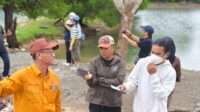
NTA’s field observations from Flores provide an illuminating glimpse into this process. During monitoring visits in Sikka, NTA teams and local partners assessed water tanks, household toilets, school libraries, agricultural activities and ikat textile production while meeting farming groups and teachers across different locations.
The observation also points to something often absent from development statistics: relationships.
The field account describes collaboration between Australian and Indonesian representatives, including the use of Bahasa Indonesia and attention to local cultural protocols.
That may sound like a minor detail. It is not. Development is carried through conversations, meetings, negotiations, disagreements and trust. Technical expertise matters, but so does the ability to sit with people, listen and understand how a community makes decisions.
Women and the economy beyond the farm
NTA’s livelihood approach also reaches beyond agriculture.
The organisation supports ikat weaving, presenting the activity as part of efforts to strengthen women’s sustainable livelihoods. Its gender policy also recognises that women and men may have different needs, roles and opportunities within development programs.
This matters in rural economies where households rarely depend on a single source of income.Agriculture may provide food and seasonal income. Livestock can function as a household asset. Weaving can create cash income. Education can expand future opportunities.
The household economy is therefore diversified across activities, people and seasons. Development interventions that recognise this complexity are more likely to see the village as an economic ecosystem rather than a collection of individual beneficiaries.
Education is part of the same story
NTA’s work with schools adds another layer.
The organisation reports assistance including books, teacher training and scholarships, alongside improvements to school facilities and sanitation. Its current profile lists 80 teachers trained, 1,987 books distributed mainly to primary schools, and 280 scholarships provided to support school attendance.
These numbers are outputs. Their deeper meaning lies in what happens after the project. A book becomes useful when a child reads it. Teacher training becomes meaningful when teaching practices change. A scholarship matters when financial constraints no longer prevent a child from attending school.
This is why development cannot be reduced to counting objects. The number of tanks, books, toilets or training sessions matters, but the more difficult question is what those interventions enable people to do differently.
A long-term Australian–Indonesian relationship
NTA’s work also sits within Australia’s broader development relationship with Indonesia.
The Australian Department of Foreign Affairs and Trade lists NTA–East Indonesia Aid among Australia’s accredited non-government organisations. DFAT records also show NTA’s participation in the Australian NGO Cooperation Program, including a 2025–26 grant agreement. (DFAT)
This places NTA within a formal development cooperation architecture, but its actual work remains intensely local. Australian resources eventually become a tank in a village. A training program eventually becomes a farmer experimenting in a field.
A book eventually sits on a school shelf. A piece of equipment eventually enters the hands of a woman producing ikat. Between the policy document and the household lies a long chain of people. That chain is where development either acquires meaning or loses it.
The politics of small things
There is also a lesson here for anyone interested in development policy. Large development projects are visible.
Small projects often disappear into the landscape. A road, dam or major building can become a symbol of government action. A household water tank rarely does. Yet the absence of water can consume hours every day.
That makes small infrastructure politically and socially significant even when it is visually unremarkable. The same is true of sanitation, school books, agricultural training and livelihood assistance. Their value lies less in their physical scale than in their relationship to everyday life.
NTA’s experience suggests that development can sometimes be understood through these ordinary objects and activities: a tank, a field, a classroom, a weaving loom, a meeting under a village roof. These are places where policy becomes tangible.
Resilience cannot be donated
There is an important caution in this story. External assistance can provide resources, technical knowledge and opportunities, but resilience itself cannot simply be donated. It has to be built through institutions, skills, relationships, local ownership and repeated practice.
This may explain why NTA’s emphasis on community groups and local implementation deserves attention. The objective is not merely to bring an intervention into a village. The longer-term question is whether people and institutions can continue using, adapting and maintaining what has been created after the project cycle ends.
That is where the real test of sustainability begins.
The unfinished work
NTA was founded in 1988 after Australian and Indonesian researchers visited NTT and became concerned about poor living conditions and limited economic opportunities in remote communities. Its early years involved spending time with farming families and studying the work of Indonesian NGOs before launching its own projects in the early 1990s.
More than three decades later, the organisation remains focused on the same broad challenge: reducing poverty among rural communities in East Nusa Tenggara. The persistence of the mission is revealing.
If development were simply a matter of building a project, the work would eventually be finished. But rural poverty is not a single infrastructure deficit. It is entangled with climate, water, agricultural productivity, education, markets, health, gender relations, geography and access to opportunities.
That makes development a long conversation rather than a completed project. For NTA, that conversation continues across Flores and West Timor. It continues in village meetings, farming plots, classrooms, weaving groups and households collecting water.
In East Nusa Tenggara, development may begin with water. But it does not end there. It ends, if it succeeds, with people having more time, more choices, stronger livelihoods and greater capacity to shape the future of their own communities.
___
References
Nusa Tenggara Association (NTA) – Who We Are
Provides background on NTA as an Australian not-for-profit organisation working in NTT, its community-based approach, musyawarah, agriculture, water and sanitation, education, books, teacher training, scholarships, and the scale of its activities.
NTA – Who We Are
Australian Government, Department of Foreign Affairs and Trade (DFAT) – Water Tanks Improving the Lives of Families in Indonesia
Particularly important for the story of Esaul and Ester in West Timor, the 15,000-litre water tanks, prolonged dry seasons, water access, and the connection between water infrastructure and household livelihoods.
DFAT – Water tanks improving the lives of families in Indonesia
Philip Domaschenz – Facebook post, September 2026
This is the direct source for the West Kupang cucumber/drip-irrigation episode quoted in the article. Because the information comes from a personal Facebook post rather than an independently verified NTA/DFAT publication, it should be identified as a field/social-media source rather than presented as independently verified evidence.