
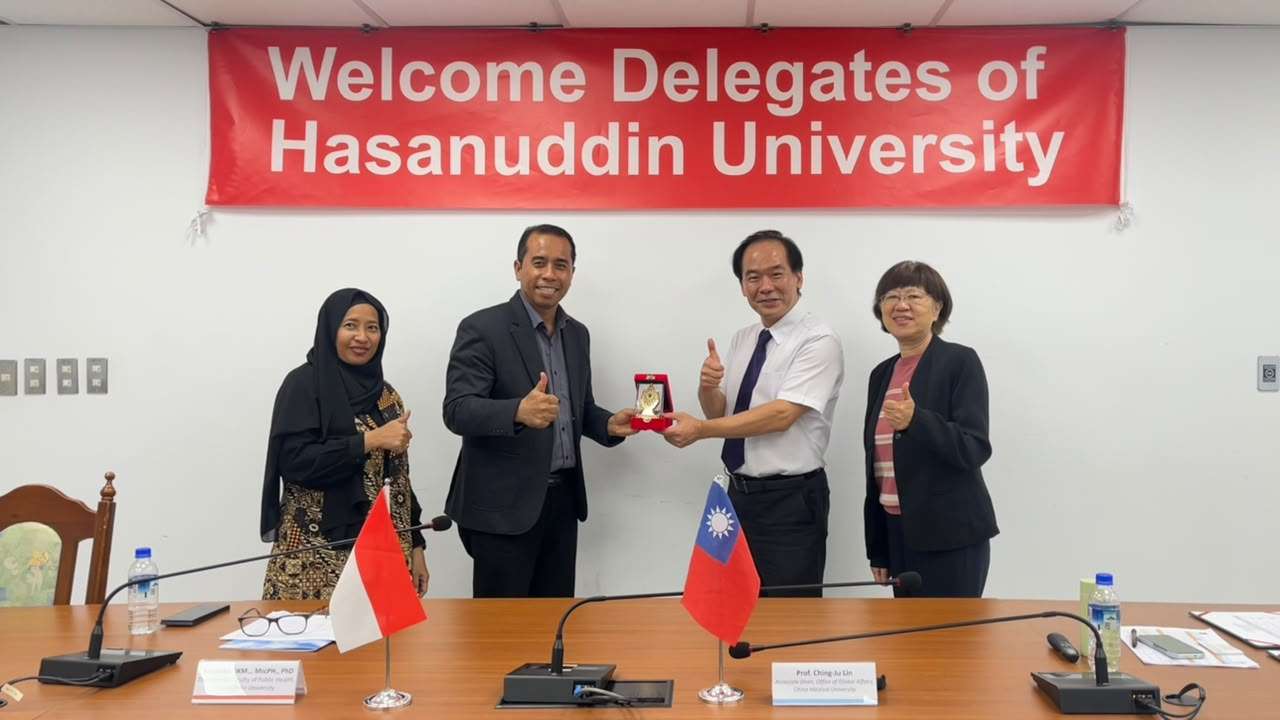
PELAKITA.ID – TAICHUNG, TAIWAN — The Faculty of Public Health, Hasanuddin University (Faculty of Public Health Hasanuddin University), conducted an academic visit to China Medical University (CMU), Taiwan, on Tuesday, October 20, 2026.
The visit marked an important step toward strengthening international academic partnerships, expanding collaboration in education and research, and promoting knowledge exchange between the two institutions.
The Faculty of Public Health Hasanuddin University delegation was led by Ansariadi, SKM., M.Sc.PH., Ph.D., Dean of the Faculty of Public Health, accompanied by six faculty members and academic representatives: Dr. Hasnawati Amqam, Dr. Nurzakiah, Ulfah Najamuddin, Ph.D., Dr. Balqis, Muflihah Darwis, M.Kes., and Suci, M.Kes. Three undergraduate students also participated in the visit: Rr. Hafizhah Qanita Najiyyah, Najwa Khalilah Nursafitrah, and Muhammad Fakhri Ikhsan.
The activities took place at the Excellence Building, China Medical University, in Taichung. The program began with welcoming remarks from Prof. Chingju Lin, Associate Dean of Global Affairs at CMU, followed by remarks from the Dean of Faculty of Public Health Hasanuddin University.
One of the main highlights of the visit was an academic meeting and discussion on potential areas of cooperation with Prof. Ho Wen-Chao, representing the College of Public Health at CMU. The meeting provided an opportunity to exchange perspectives and explore future collaboration in education, scientific research, and international academic initiatives.
The visit also featured a research-sharing session entitled “Predicting PM2.5 and Allergic Diseases Using AI with Sensor, Satellite, and GIS Data,” presented by Prof. Hwang Bing-Fang from the Department of Occupational Safety and Health, China Medical University.
The session highlighted the integration of artificial intelligence (AI), sensor technology, satellite data, and Geographic Information Systems (GIS) to predict fine particulate matter (PM2.5) concentrations and explore their relationship with allergic diseases. This discussion provided valuable insights into emerging research methodologies in environmental health, particularly the application of digital technologies and spatial data analysis to address environmental and public health challenges.
In addition to academic meetings and research discussions, the Faculty of Public Health Hasanuddin University delegation participated in an institutional introduction and campus tour, providing an opportunity to learn more about CMU’s academic environment and educational and research facilities.
Strengthening Academic Relations and International Student Networks
Beyond institutional and faculty-level engagement, the visit also served as an opportunity to strengthen academic relationships among students from both universities. Eight students from China Medical University participated in the activities: Suhartina Hamzah, Sitti Raoda Juanita Ramadhan, Vinsensia Launardo, Yayah Inayah Syamsuddin, Nasyrah Hidayati, Noor Hikmah, Basir, and Winda Amalia.
Student engagement was further strengthened through the Senior-Junior Reunion Dinner, which provided a platform for networking, sharing academic experiences, and building connections across institutions. The gathering encouraged meaningful interactions among students and strengthened academic relationships within an international learning environment.
The visit also included a welcome dinner involving representatives of Hasanuddin University and China Medical University at the Evergreen Laurel Hotel in Taichung. This gathering provided an additional opportunity to enhance institutional relationships and foster communication between the two universities.
Supporting Indonesia’s Asta Cita and the Sustainable Development Goals
The academic visit aligns with Indonesia’s national development priorities outlined in Asta Cita, particularly the fourth priority, which emphasizes strengthening human resource development, science, technology, education, and health.
Through international academic engagement, Faculty of Public Health Hasanuddin University continues to promote faculty and student capacity building, improve the quality of higher education, and encourage innovative research that responds to emerging public health challenges. Such initiatives reflect the university’s commitment to developing globally competitive academic and research capabilities.
The visit also supports several United Nations Sustainable Development Goals (SDGs), particularly SDG 3 (Good Health and Well-being), through the advancement of environmental health research and scientific understanding of air pollution and its potential health effects.
Furthermore, the activities align with SDG 4 (Quality Education) by promoting international academic exchange, improving learning experiences, and expanding opportunities for students and faculty members to engage in global educational environments.
The research discussions involving artificial intelligence, sensor technologies, satellite observations, and spatial analysis also contribute to the objectives of SDG 9 (Industry, Innovation and Infrastructure) by promoting technological innovation and interdisciplinary research approaches to address environmental and health challenges.
Importantly, this academic engagement reinforces SDG 17 (Partnerships for the Goals) by strengthening international institutional partnerships, facilitating knowledge exchange, and creating opportunities for future collaborative research and educational initiatives.
Through this visit, Faculty of Public Health Hasanuddin University reaffirmed its commitment to expanding international cooperation, enhancing academic and research excellence, and fostering innovation in public and environmental health.
The engagement with China Medical University is expected to provide a foundation for sustainable partnerships and the development of future joint academic and research programs.
The visit also reflects Faculty of Public Health Hasanuddin University’ continued contribution to Indonesia’s Asta Cita and the global Sustainable Development Goals, while strengthening the role of Indonesian higher education institutions in addressing public health challenges at both national and international levels.